
What Is Fixed Pricing? How It Works and When to Choose It
What is fixed pricing? Learn how a flat rate works, how it differs from subscriptions and usage fees, and when it suits your business.

Tired of nonsense pricing of DocuSign?
Start taking digital signatures with BoloSign and save money.
Fixed pricing is an agreed price set before the work or service begins. It doesn't change with the seller's actual costs or with routine usage that stays inside the agreed terms.
You're comparing two quotes this month, and the invoices don't behave the same way. One grows when you hire, send another contract, or hit a busy quarter. The other sits still, at least on the headline. Owners in the US, Canada, Australia, New Zealand, and the UAE meet this choice on software, agencies, and contractors. The flat figure looks calmer. It isn't necessarily cheaper, and it isn't necessarily complete. A plan that looks kind at a handful of documents can outrun a higher flat fee once a team sends hundreds. What you need next is a plain reading of who carries the risk, and of what the agreement includes.
What Fixed Pricing Means in Plain Terms
Fixed pricing is a pricing arrangement in which a buyer and a seller agree on a specified price before delivery or performance, rather than recalculating the charge from the seller's actual costs. U.S. federal acquisition rules describe the strongest form, a firm-fixed-price contract, as placing maximum responsibility on the contractor for all costs and for the resulting profit or loss. The agreed price can't be adjusted merely because the contractor's costs change.

Picture a taxi. You and the driver agree a flat fare before you leave the curb. Traffic, a longer route, or a jump in fuel doesn't reopen that fare. A meter does the opposite. It runs with distance and waiting time, and you learn the bill only when you stop. Fixed pricing works like the agreed fare. Time-and-materials billing works like the meter. You pay according to labor hours, materials, or other usage, and those same federal rules classify time-and-materials and labor-hour contracts as non-fixed-price arrangements.
The trade-off you actually buy
You get budget certainty. The provider absorbs more risk if labor, materials, infrastructure, or delivery costs run past what it expected. That is why the model fits when scope, specifications, and expected effort can be defined with reasonable confidence. If nobody can describe what "done" looks like, a flat number is a guess in contract clothing.
U.S. housing guidance built on this procurement logic points to stronger incentives for contractor efficiency and a lower administrative burden, with reduced flexibility as the downside. You don't reopen the price for every extra hour. You also can't shrink the fee easily if the job shrinks.
A fixed price buys a forecast. It doesn't buy the right to change the job without talking about money.
What it means on a monthly service
In a recurring service, an extra user, document, or transaction doesn't automatically create a separate variable charge, provided the agreement states what is included and which exceptions, if any, permit a change. Say a clinic sends consent forms all month. Under a true flat arrangement, the tenth form and the two-hundredth form sit inside the same fee. Under a per-envelope plan, each send is a new line.
That inclusion language is the part people skip. A headline number can still leave out setup, overages, a renewal reset, or the cost of leaving. Those lines decide whether the price you were quoted is the price you will pay.
Fixed Pricing Compared With Other Pricing Models
Read each row from left to right. How the bill is set is the formula. Who carries cost risk is who loses if the work runs long or volume jumps. Budget predictability is whether finance can lock a number for the quarter.
| Model | How the bill is set | Who carries cost risk | Budget predictability | Best fit |
|---|---|---|---|---|
| Fixed (flat-rate) | One agreed price for a defined scope or period | Provider | High | Steady, well-defined work or volume |
| Per-user subscription | Fee per seat, per month | Buyer | Medium, rises with headcount | Stable team sizes |
| Usage-based | Charge per unit, document or transaction | Buyer | Low to medium | Low or irregular volume |
| Tiered | Price band set by volume tier | Shared | Medium | Volume that grows in clear steps |
| Hybrid | Base fee plus usage or overage charges | Shared | Medium | Predictable base needs with occasional spikes |
A team that grows by five people
A 20-person team on a per-seat plan watches the bill rise with every hire. Move that same team to 25 inside an agreed flat scope and the flat fee stays put. The buyer isn't paying for each new login. The provider is carrying the extra seats. Per-seat stays reasonable when the roster barely moves, because the "medium" predictability is really just "we know our headcount."
Five contracts, then four hundred
A per-document plan costs little for a team sending five contracts a month. The same plan climbs fast when a busy quarter sends 400. Usage-based pricing suits low or irregular volume, because you aren't paying for capacity you don't touch. It suits a growing desk poorly. At small volume the variable quote wins the spreadsheet. At scale it can pass a higher flat fee, which is why that higher fee can be the rational choice when demand is hard to predict.
A tier is easy to misread. You sit inside a band, then one extra batch pushes you into the next price. The jump is the bill, not a gentle slope. A hybrid looks fixed because of the base fee, then overages stay open. You still need a number for the spike months.
The same comparison shows up outside software. Teams hiring part-time leadership often weigh a retainer against an hourly advisory bill, and Capstacker pricing for fractional executives is one published menu that makes those two shapes easy to set side by side.
Practical rule: Fixed suits steady, well-understood demand. Usage-based suits low or irregular volume. Hybrid suits a predictable base with occasional spikes.
How Fixed Pricing Works and Its Main Variants
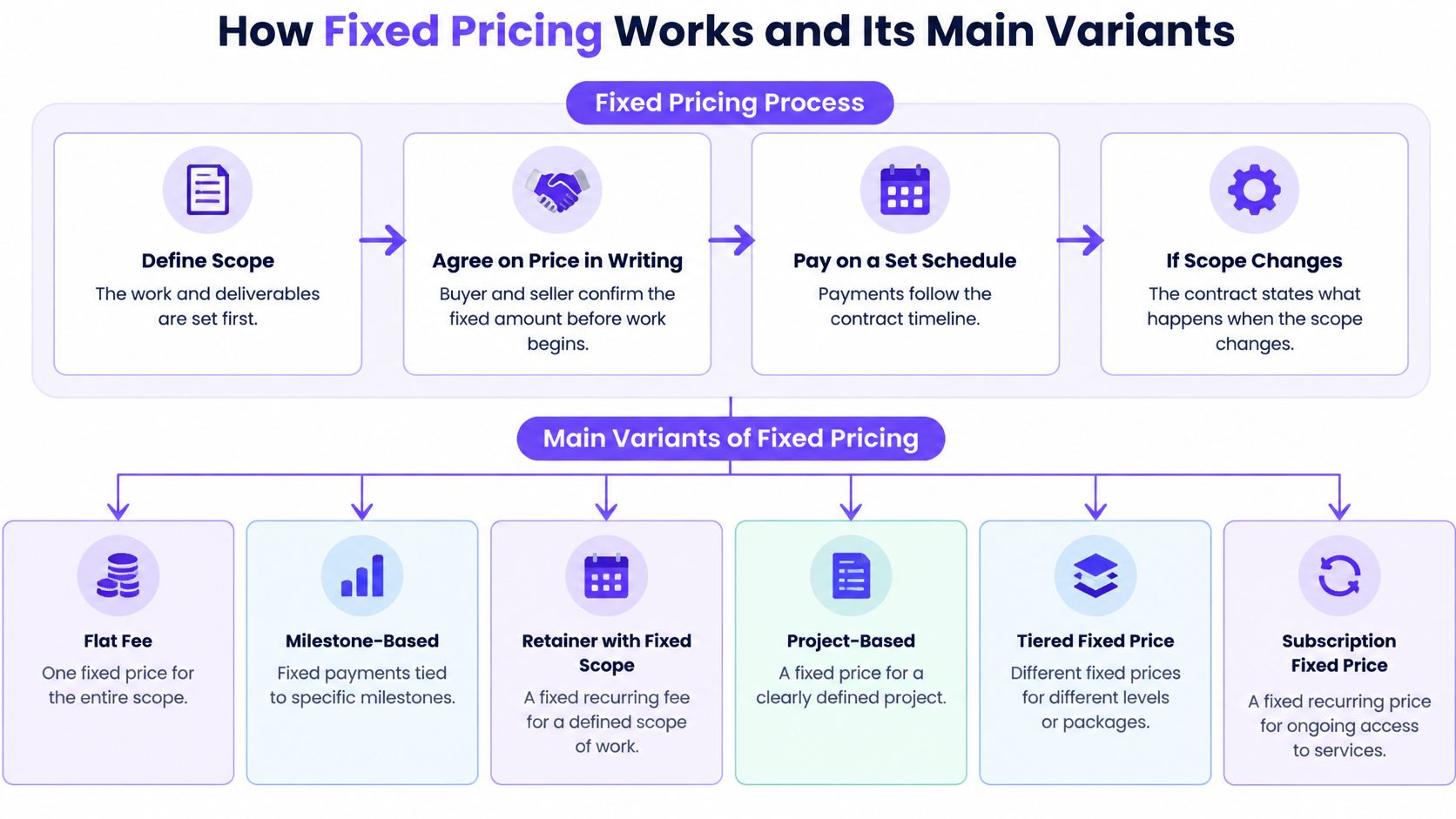
A website is quoted at $12,000. Mid-build, developer rates rise. Under a firm-fixed-price deal the invoice still reads $12,000. That number holds only for the work written into the scope. Extra pages, extra review rounds, or a cost index the buyer never noticed can reopen the bill.
You name the work. You agree the price in writing. You pay on a set schedule. The contract also says what happens when the scope changes. "Fixed" is not one shape. A Congressional Research Service overview identifies six major fixed-price variants: firm-fixed-price, fixed-price with economic price adjustment, fixed-price incentive, fixed-price with prospective price redetermination, fixed-ceiling-price with retroactive price redetermination, and firm-fixed-price with a level-of-effort term.
Fixed-price and related contract types are used across many defense acquisition programs. That range exists because a fully flat price and a price protected by adjustment rules create different budgets, different risk, and different admin work. A fixed price is only as fixed as its exclusions. A variable quote that looks cheapest on day one can pass a higher flat fee once volume climbs.
Six ways the word can still move
- Firm-fixed-price. The price stays the same based on the contractor's cost experience. The $12,000 website stays $12,000 even if rates rise mid-build. Cost experience does not reopen the number.
- Fixed price with economic price adjustment. The price may move up or down only when specifically stated conditions occur, such as a recognized cost index leaving an agreed band. Only that stated trigger moves the fee.
- Fixed-price incentive. The parties share savings or overruns against a target. A provider might keep half of any saving below that target cost, and give back the rest.
- Fixed price with prospective redetermination. An opening period keeps its price, then later periods reset at pre-agreed times. A three-year managed-services deal might hold year one flat and reset in year two. This variant shows up in long government purchases because it balances predictability with protection when conditions are hard to forecast over a long performance period.
- Fixed-ceiling-price with retroactive redetermination. A cap sits over the work, and the final figure is set after performance is measured. A research engagement might carry a maximum fee, with the actual amount confirmed after review.
- Firm-fixed-price, level of effort. You pay one set total for a defined amount of effort, such as 400 analyst hours at an agreed sum, rather than an open hourly meter. The hours are the exclusion. Work past that pool is a new deal.
A flat price works like a set dinner: the plate price covers the dishes on the card, and anything ordered later is a separate check. A price with capped exceptions, or a formula-based adjustment, hands budget risk to a different party. Write the variant into the contract, not into a sales slide. If you are locking a services deal, put that clause in the same file you use to prepare and sign service agreements, so the pricing language and the signed record match.
Pros and Cons of Fixed Pricing for Small Businesses and Enterprises
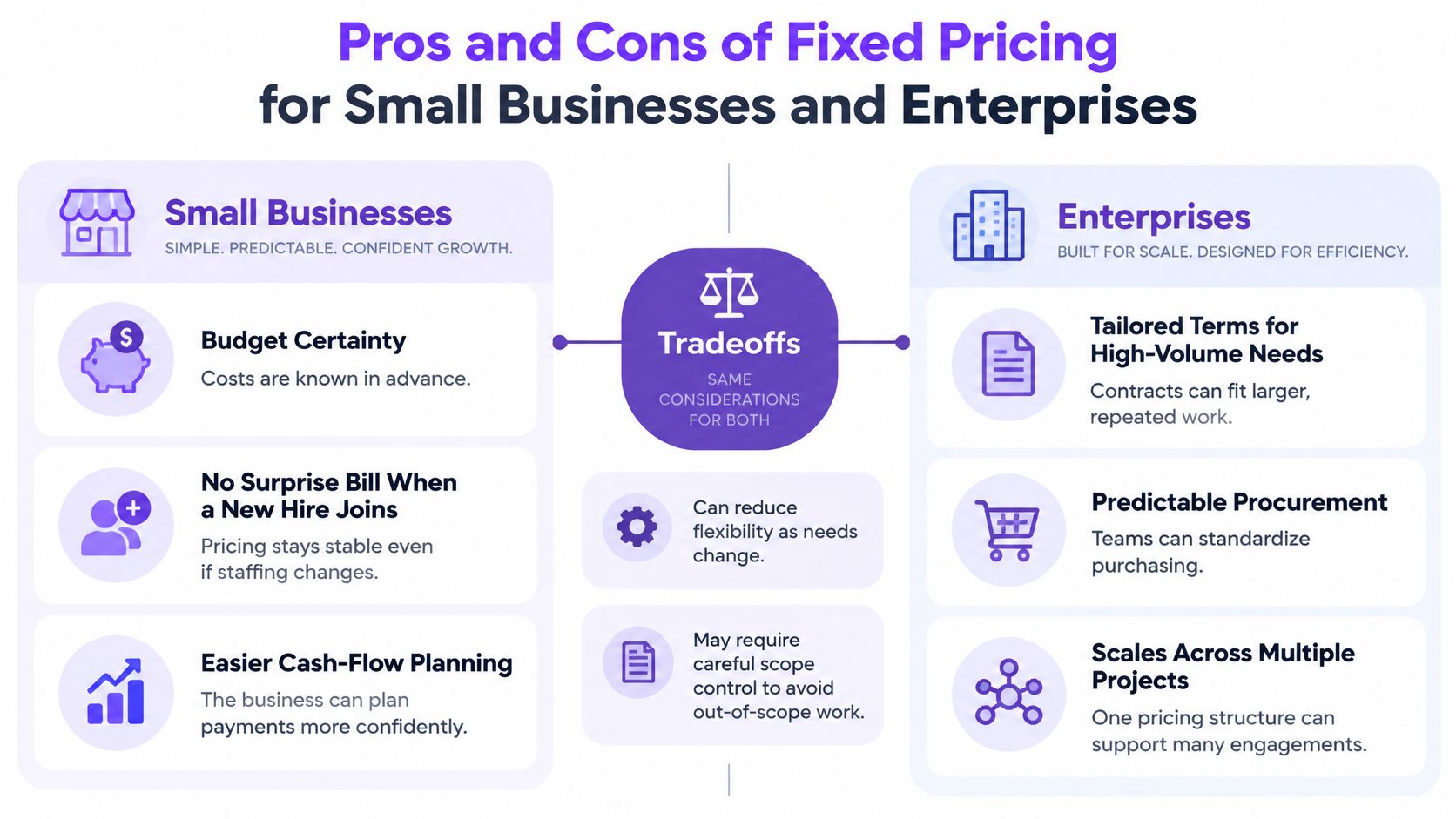
A bakery that pays one monthly software fee can write that number beside rent before the month starts. A rival that pays per signature looks cheaper in a quiet week, then spends more in a busy month than the flat fee would have cost. A fixed price is only as fixed as its exclusions, and a variable plan that looks cheap at low volume can cost more once usage climbs.
What a small team actually gains
Three gains show up first on a small-business bank feed. Budget certainty means the owner can tell a bookkeeper the monthly number before the month starts. No surprise bill when a hire joins means onboarding does not inflate the software line. Easier cash-flow planning means rent, payroll, and the tool sit on one forecast.
Closer Innovation Labs Corp. uses one fixed price that includes unlimited signatures, templates, and team members. That shape fits a shop whose document count wobbles week to week while headcount is the figure finance watches. The same flat number can still be a poor fit if volume stays tiny, because you pay the full fee either way.
What changes at enterprise scale
Larger buyers usually want custom terms for high-volume needs, less staff time spent auditing every usage line, and a provider with a reason to work efficiently. Once the fee is set, the provider keeps more of it by finishing cleanly, not by stretching hours. The Enterprise plan uses custom pricing for high-volume document needs and seats, with no single published fixed price, so a heavy user is not forced onto the same sticker as a small team. Procurement can still standardize one structure across repeated projects instead of renegotiating a meter on each one.
At that scale, the cheapest-looking per-unit plan often loses. Extra signatures and extra seats add up, and a year of heavy use can outrun a higher flat fee that already covers those units.
Where it strains
Flexibility drops if your needs shrink. You may still owe the agreed fee. A risk premium can make the fixed fee higher than a variable plan while volume stays low. Fairness is the quieter problem. Light users can subsidize heavy users inside one shared price, and people push back on a charge they cannot see into.
In 2025 research commissioned by UK energy regulator Ofgem, 62% of respondents considered standing charges unfair, while only 19% considered them fair, and extra explanations reduced perceived unfairness from 58% to 54%, according to the Ofgem pricing research summary. Buyers in general want the total cost up front, and many leave a purchase when a fee appears after they thought the price was settled.
Price transparency means publishing the total expected cost, not advertising a stable headline and hiding the rest.
For a small business, ask whether the fee covers likely volume and cuts forecasting work without concealing exclusions. For an enterprise, ask whether one shared fee still makes sense across projects, or whether custom high-volume terms are the honest fit. Fixed pricing suits steady, predictable demand. It suits poorly when volume is low or spiky.
Hidden Exclusions to Check Before You Sign
A fixed price is not the same thing as an all-inclusive price. Canadian procurement guidance treats a firm-fixed-price contract as a specified amount that generally doesn't change because of the supplier's actual costs, and it also recognizes adjustable fixed-price structures when stated contingencies apply. A calm base fee can still sit on top of setup fees, overages, taxes, contract-change fees, migration costs, or cancellation costs.
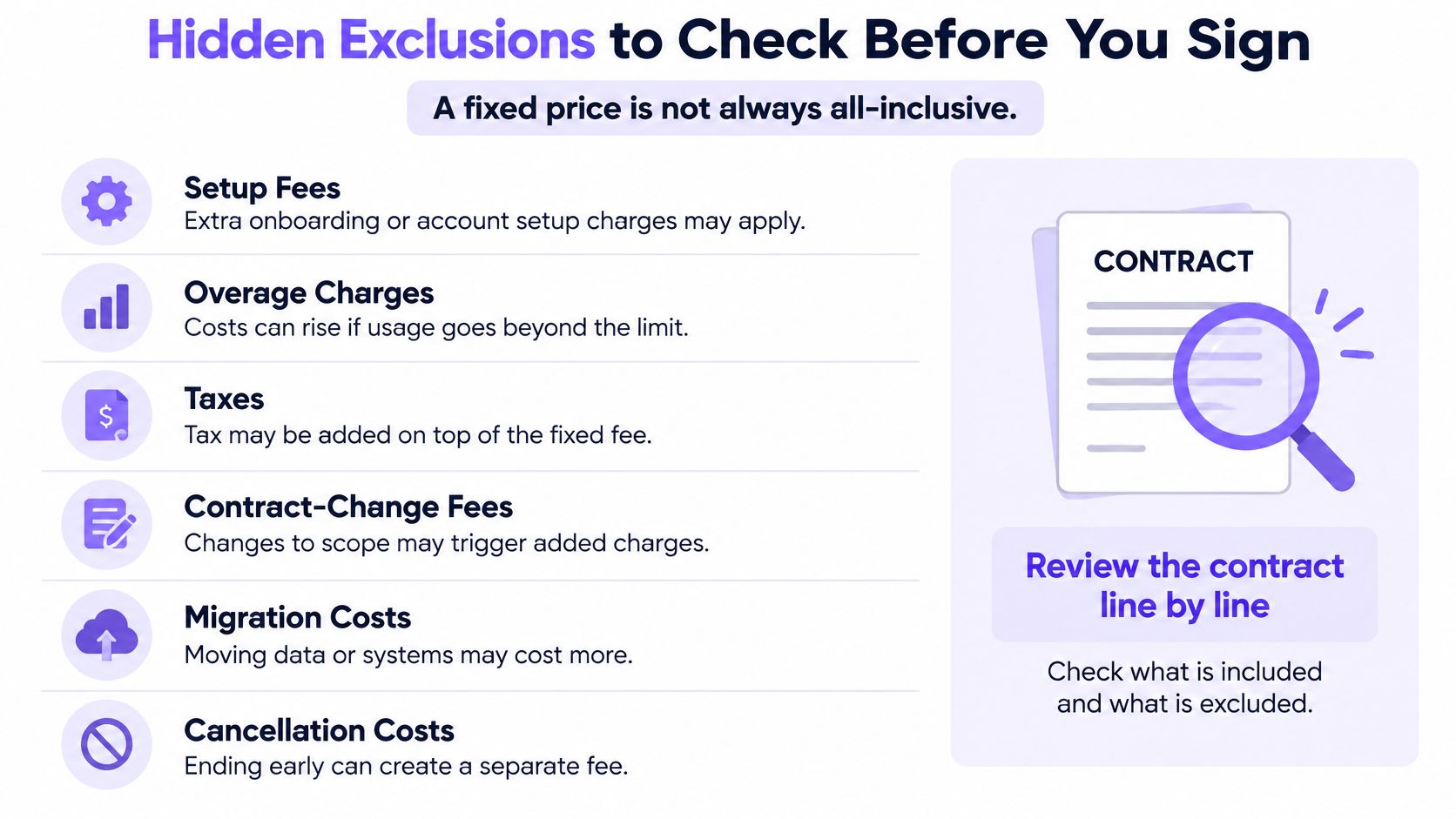
Five checks, in the order they bite
- What is included: Name documents, users, support, and storage in the quote, not in a slogan.
- Whether usage is unlimited: Ask whether "unlimited" has a fair-use cap, a throttle, or a review right.
- Which events trigger extra charges: Overages, extra signers, scope edits, and taxes belong on one page.
- Whether the price can change at renewal: A flat year can become a new number on the next cycle.
- Whether cancellation or migration costs apply: Leaving should have a price you can see before you join.
On our own terms, items marked unlimited on the pricing page are subject to a Fair Usage Policy. We may change that policy, including usage limits and unlimited plan terms, at our discretion and without prior notice. Subscription fee changes take effect at the end of the current billing cycle, after reasonable prior notice. Read every other vendor the same way. The supplier takes cost-overrun risk and may build a premium into the fee for carrying it. That premium can still be the sensible buy when demand is hard to forecast.
Paste this into the vendor email before you sign:
Please confirm, in writing, what the fee includes, whether usage is unlimited and under what fair-use terms, which events add charges, whether the price can change at renewal and when that change hits, and what cancellation or migration costs apply.
Run those five questions on every quote, including the file you will sign as a contract once the pricing email comes back. If a line is missing, the price isn't fixed yet.
Decide Whether a Fixed Price Fits Your Team
A recruiting desk can look cheap on a per-seat quote in a quiet January, then get expensive the month five managers hire at once. A fixed price is only as fixed as its exclusions. A variable plan that looks cheapest on a slow month can cost more once volume and extra users pile up.
Staffing teams feel that swing first. Offer letters and client agreements go out every week, then a busy hiring month doubles the packets. A per-seat tool charges for every new recruiter who needs access. A flat eSignature fee does not, if the published price really covers signatures, templates, and people.
A clinic has a different test. Consent forms need controlled access and a traceable history. The monthly number only helps if sending and storage stay inside those safeguards, including HIPAA expectations for electronic health information. On many plans a HIPAA business associate agreement is a paid add-on, so count that line before you call the fee flat.
Real estate work bunches around settlement dates, and contractors rotate through the office. Charging per user gets awkward when the roster is not what drives the work. Listing agreements and disclosures still have to leave the same week.
Logistics has the sharpest spike. Delivery confirmations and vendor agreements jump in peak freight weeks. Supplier agreements for supply-chain teams can stay in one signing flow instead of a pile of inboxes. A meter that felt kind in a slow week turns harsh when the trucks are full.
Schools see the same shape on a calendar. Admission and consent forms arrive in a wave, then go quiet. Usage pricing is gentle in summer and expensive when the term starts.
Professional services firms close client contracts in clusters. Partners want contract automation and digital signing solutions without a new invoice line every time an associate joins.
From the file to the fee
Upload a PDF or a template, place signature fields, send it, and store the signed copy. You can sign PDFs online, reuse templates, and add signature to Google Form collection when intake already lives in a form. One fixed price covers unlimited signatures, templates, forms, contracts, and team members, with no additional charges for extra signatures or users. The platform starts at $49 per month. The Enterprise plan uses customized pricing for high-volume document needs and seats, with no fixed price listed. AI-powered automation and secure document workflows support ESIGN, eIDAS, HIPAA, and GDPR requirements, which matters when a packet crosses a clinic, a campus, or a border.
In 2024, 68% of surveyed customer-service buyers preferred inclusive pricing that covered different user categories without extra charges for each type, according to a survey of 200 customer-service professionals reported by Forbes.
If the request arrives after the office closes, you still need a way to capture inquiries after business hours so the signing packet starts from a complete ask, not a missed call.
Free trials are offered at the company's discretion for a limited period. Run one on a real packet, a candidate pack, a consent form, or a vendor agreement, before you commit. Put that flat fee next to what the same month would cost if every extra signer and every quiet-to-busy swing were metered.
Closer Innovation Labs Corp. builds BoloSign so a small team can create, send, and sign agreements on one fixed price instead of a meter that moves with every user or document. If you are weighing a variable plan against a flat fee for everyday contracts, start with the files you already send each month. Visit Closer Innovation Labs Corp. and run that workflow on a live document before your next renewal.

Paresh Deshmukh
Co-Founder, BoloForms
13 Nov, 2026
Take a Look at Our Featured Articles
These articles will guide you on how to simplify office work, boost your efficiency, and concentrate on expanding your business.