

9 Reseller Agreement Templates for 2026: Pros and Cons
Compare 9 reseller agreement templates for SaaS, distribution, and marketplaces. Review pros, cons, key clauses, and eSign workflow tips.

Tired of nonsense pricing of DocuSign?
Start taking digital signatures with BoloSign and save money.
You closed a regional SaaS reseller last month on a handshake, a discount agreed over coffee, and a rough email thread. Six months later the reseller is discounting below your direct price, a customer is asking who owns support, and nobody can find a signed version of anything.
Then termination comes up. The reseller says the customer list is theirs. You say subscriptions transfer back to you. Finance can't tell which deals were registered, which were direct, or what margin was promised.
That's the job of reseller agreement templates. They're not paperwork for its own sake. They're the place where you decide, before money moves, whether you're running a buy-sell, referral, marketplace, or white-label model, and who owns the customer when it ends. If you're weighing white-labeling products for SaaS founders, that choice changes the clauses you need most.
Below, I judge each template by the business model it assumes and by what it leaves out, not by page count. For each one you'll get its best fit, its gaps, and the clauses I'd rewrite first. The final section covers how to keep the chosen template versioned, redlined, and eSigned so you don't lose the master copy again.
1. Partner.io SaaS Reseller Agreement
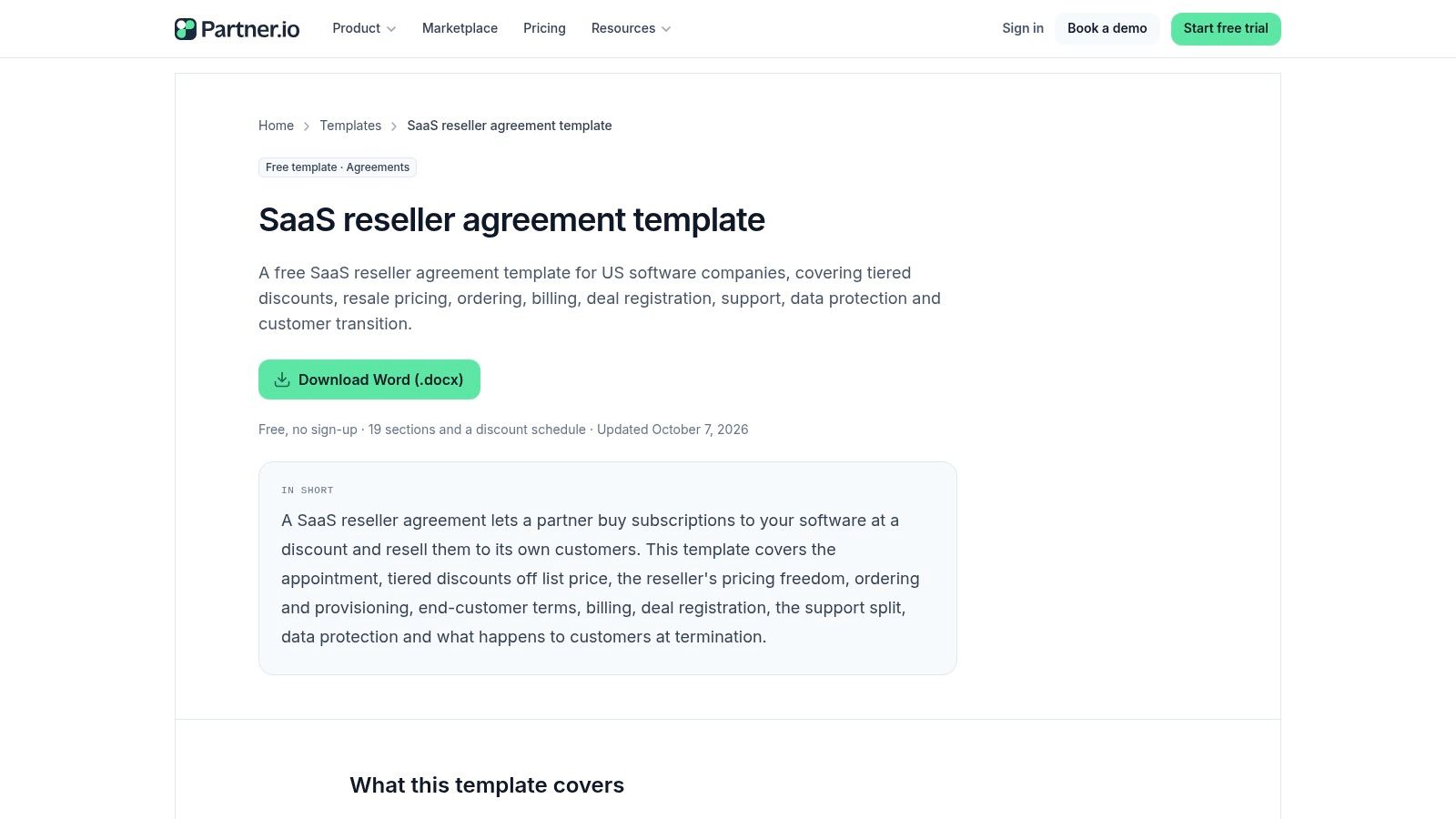
Start here if you're a US SaaS company running a classic buy-sell channel. The reseller buys subscriptions at a discount and resells them, which matches how Partner.io's SaaS reseller agreement is built.
What it handles well
- Tiered discounts and pricing freedom: The reseller sets its own resale price rather than following a fixed price you dictate.
- Ordering and billing: Clear mechanics for how orders flow and who invoices whom.
- Deal registration and support: It assigns who registers opportunities and who handles first-line help.
- Customer transition: It addresses continuity after termination, which many short forms skip.
That last point matters in the EU too. The EU Vertical Block Exemption Regulation 2022/720 provides a safe harbor when each party's market share does not exceed 30%, and it treats fixed or minimum resale prices as hardcore restrictions. Pricing freedom isn't just commercial preference there, it's compliance.
Pros: Designed for SaaS, free Word download with no sign-up, and it thinks about the end of the relationship. Founders exploring a white label reseller program will still need extra branding terms, though.
Cons: It assumes buy-sell. It won't fit referral commissions or marketplace-only sales without surgery, and you'll need counsel to review it.
Rewrite first: Territory, exclusivity carve-outs for your direct team, and the transition timeline. Then save one approved version as your master, send that exact file for eSignature, and store the signed copy against the partner record, not in someone's inbox.
2. Montague Law Software Value-Added Reseller Agreement
Say your partner doesn't just resell your software. They embed it, bundle it with implementation, or put their own brand on it. That's VAR and OEM territory, and a plain reseller form will break.
Montague Law's software VAR agreement is built for that layered world. It covers embedded OEM, SaaS resale, and standalone sublicense models in one DOCX, with end-user license terms and revenue reporting attached.
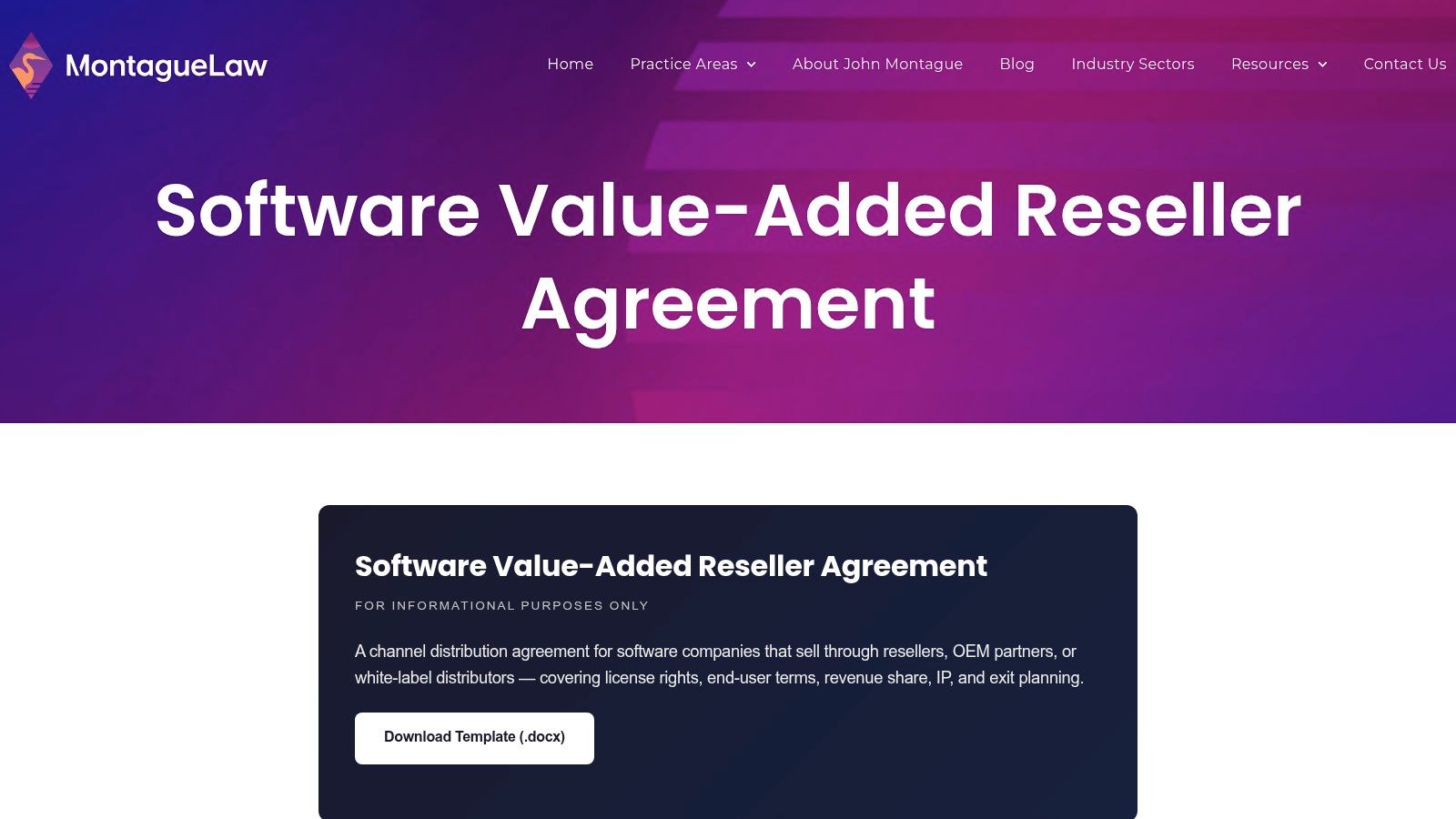
The exhibits are the useful part. Termination and customer-continuity exhibits force you to decide, in writing, whether end customers keep access after you and the VAR split, and who supports them during the handover. IP, branding, data, and security provisions sit alongside that, which is right for white-label deals where the partner touches customer data.
Don't sign a white-label deal until you can answer, in one sentence, who the customer calls on day one after termination.
Pros: It addresses several channel models at once and suits complex VAR, OEM, and white-label arrangements where sublicensing is real.
Cons: It's heavy for straightforward resale. It's marked for informational purposes only, and no price was visible in the listing I reviewed. You'll spend legal time trimming it if your model is simple.
Rewrite first: Revenue reporting cadence, audit rights, and your liability position. If you're tightening that language, our guide to limitations of liability is a useful companion before you redline. Route the final DOCX through version control, lock the exhibits as attachments, and eSign the full packet so the exhibits can't drift from the main agreement.
3. Bonterms Standard Reseller Agreement for Marketplaces
Marketplace selling breaks the usual reseller logic. The provider, the marketplace, and the reseller are three different parties, and orders often happen inside the platform, not on your paper.
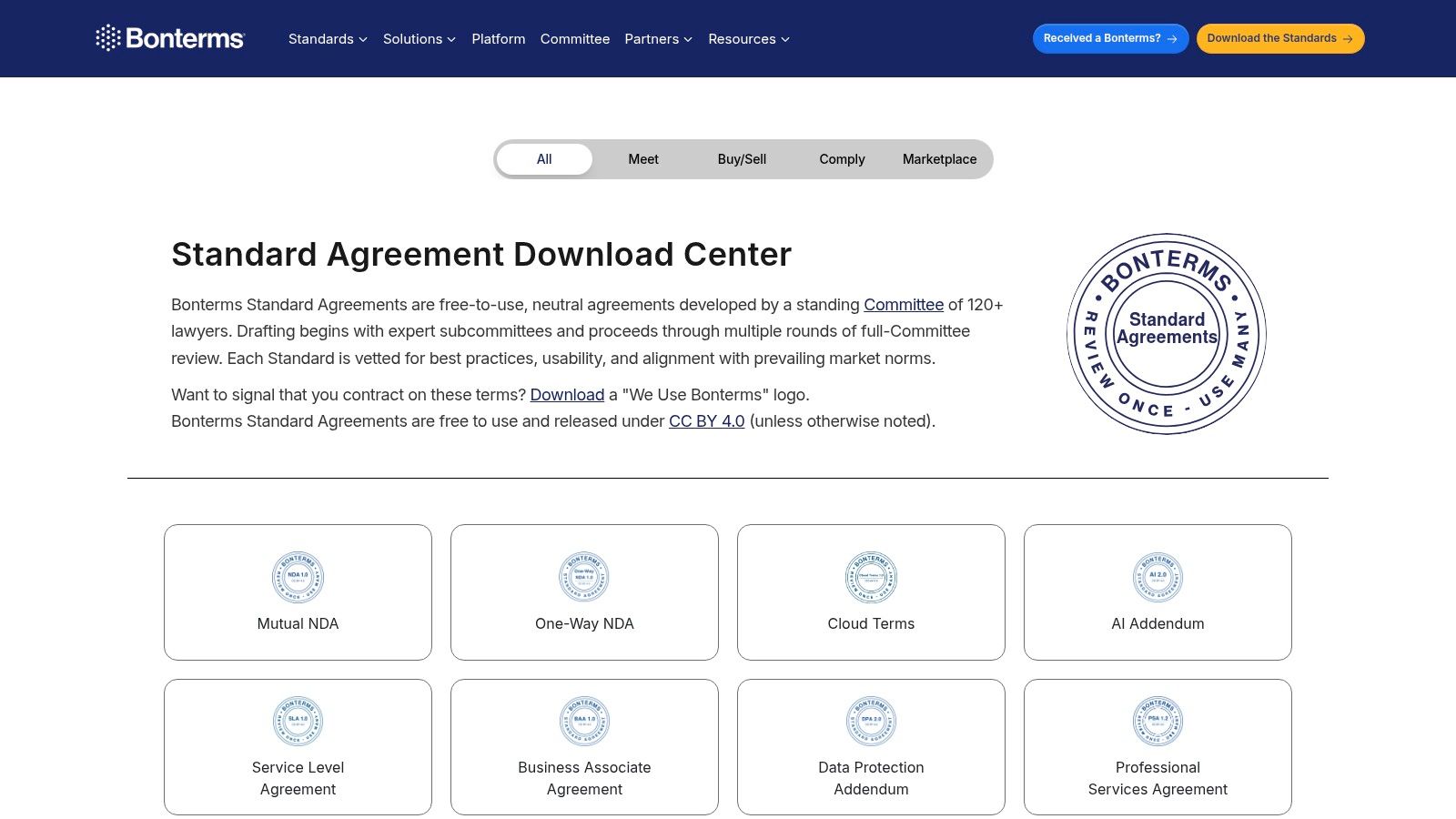
Bonterms' reseller agreement for marketplaces accepts that. It's an open-standard agreement with implementation instructions and an optional cover page you can sign, while provider-specific terms sit in attachments.
Where it fits and where it doesn't
Pros: It's free under an open license, standardized enough to cut repeated drafting, and it tells you how to implement it, either through the marketplace or with a signed cover page.
Cons: It's marketplace-specific, not a general wholesale form. Pricing, orders, and payments are handled outside the agreement, so your commercial terms live elsewhere. Standard drafting also doesn't guarantee the terms suit your particular deal.
That outside-the-agreement gap is the risk I watch. If fees and payment timing live in platform settings, say so explicitly and name which document wins in a conflict. Add a role schedule too, covering seller of record, product information, and who handles customer notices if a listing is pulled.
Rewrite first: Confidentiality scope for data shared through the platform, which our explainer on the clause of confidentiality can help you sanity-check, plus termination effect on live listings. For signing, use the cover-page route with digital signing solutions that keep the cover page, standard terms version, and attachments bundled as one signed record.
4. PandaDoc Distributor Agreement Template
Physical goods need different promises. Inventory, delivery windows, damaged stock, and territory by postcode matter more than subscription provisioning.
PandaDoc's distributor agreement template is aimed at that world. A distributor buys products and resells them, and the form gives you territory and product fields, exclusivity and sub-distributor provisions, and payment and delivery terms to work with.
Warranty, trademark, governing-law, and dispute provisions are in there too, so you're not starting from a blank page on brand use or defective goods. For a logistics or consumer goods business appointing regional distributors, that's a reasonable skeleton.
Watch the competition-law traps in territory clauses, though. Commission Regulation (EU) 2022/720 says an indefinite non-compete or one lasting more than 5 years generally falls outside its exemption, and it took effect on 1 June 2022. If you're drafting for Europe, state duration, products, and territory plainly instead of using a blanket non-compete.
Pros: Free, detailed sample text, and useful when territory, inventory, and delivery drive the deal.
Cons: It isn't built for commission agents or SaaS partners. The blanks and sample provisions need real customization, especially around minimum purchases and what happens to stock at exit.
Rewrite first: Exclusivity tied to performance, delivery risk transfer, and trademark use after termination. Convert your approved draft to PDF, sign PDFs online with the territory schedule attached, and file the signed version by region so overlapping appointments are easy to spot.
5. FileIt Reseller Agreement Template
Some teams don't want a drafting project. They want to fill in names, products, discount, and territory, then send it today. FileIt's reseller agreement template is built for that impulse, with integrated e-signing.
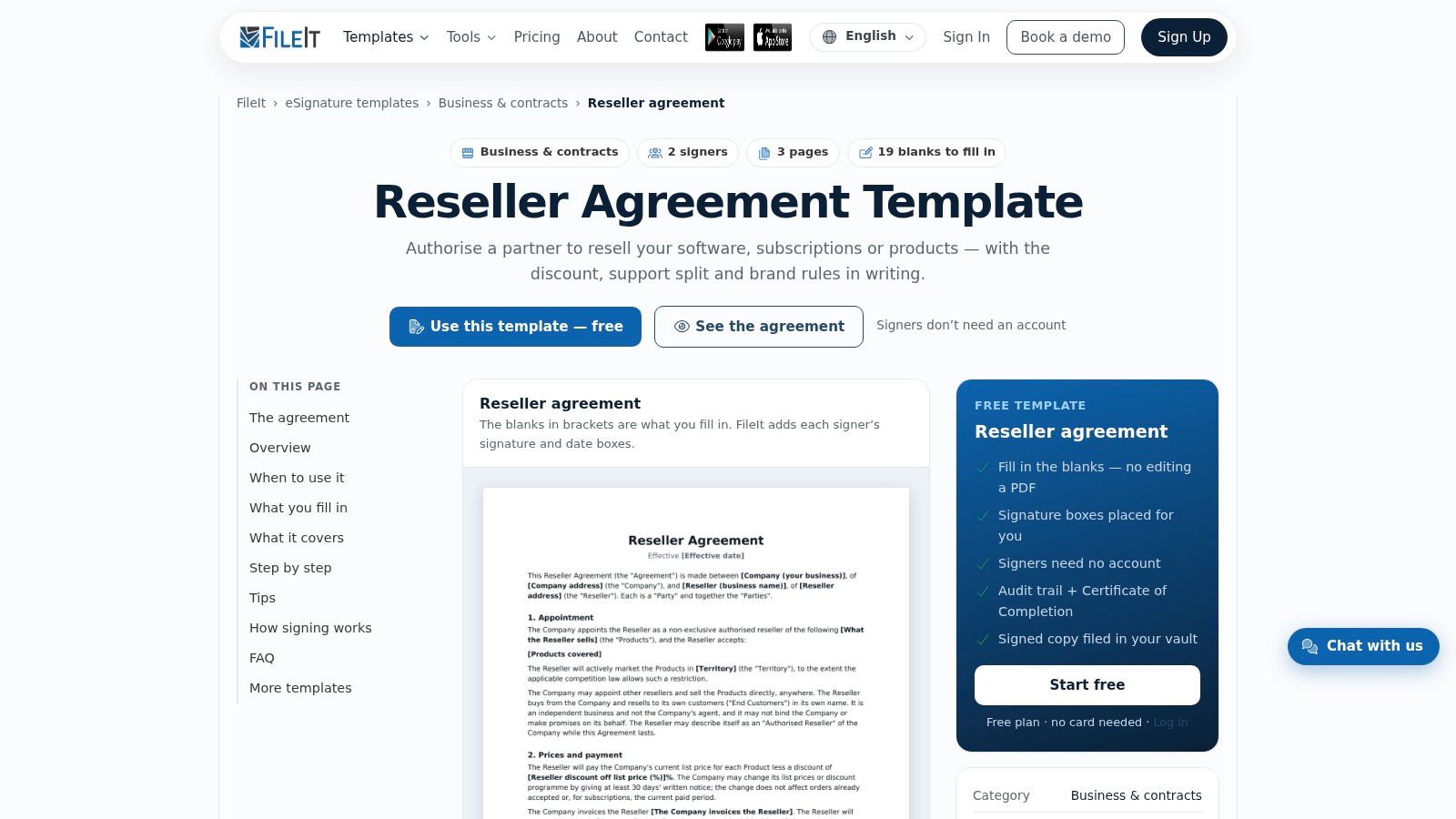
It covers a non-exclusive appointment with optional territory, product and subscription selections, support allocation, and reseller discounts. Branding, data protection, liability, and subscription-transition provisions are included, and it spans software, subscriptions, physical products, or a mix.
- Pros: Clear fill-in workflow, signers reportedly don't need an account, and it's free through FileIt's eSignature service.
- Cons: Complex channel economics, tiered rebates, and custom licensing will outgrow it quickly. You still need to check every clause against your actual transaction.
Practical rule: Fill-in speed is valuable only if the fields force the hard decisions, like support ownership and transition, before the send button.
That point connects to how reseller agreements should be structured in the first place. Independent guidance on drafting reseller contracts emphasizes clearly defining appointment, products, term, territory, and reciprocal obligations. If a quick form lets you skip any of those, slow down.
Rewrite first: Support levels, discount basis, and what subscription transition means day to day. Because signing is built in, your version-control job is simpler, but export and archive the completed PDF in your own repository as well. Don't let the only copy live inside a sending tool.
6. ContractsCounsel SaaS Reseller Agreement
Paying for a template makes sense when the alternative is paying a lawyer to draft from zero, and when you might want that lawyer's help anyway. ContractsCounsel's SaaS reseller agreement is sold by a named lawyer on that basis.
The listing shows $39 for the editable template and $195 for additional attorney support, with Schedules A to D included. Verify current pricing on the listing before you budget, but the transparency is welcome.
Schedules are where reseller deals live. Products, territory, pricing, and support commitments change per partner, while the legal core stays stable. A schedule-driven form lets you reuse the core and swap the commercial details, which is how a channel with ten partners stays manageable.
Pros: More specifically designed for software resale than a generic reseller form, a clear listed price, and an optional path to paid legal assistance from the drafting lawyer.
Cons: You'll likely still need changes for your jurisdiction and deal structure, and attorney support costs extra on top of the template.
Channel context supports investing in that structure. An industry analysis citing a Techaisle survey found 45% of channel partners identified managing uncertainty as their top business issue. Written schedules for pricing and reporting remove a good chunk of that uncertainty.
Rewrite first: The schedules themselves, governing law, and renewal criteria. Keep one master core agreement, generate partner-specific schedules from your CRM data, and eSign core plus schedules as a single packet.
7. LegalZoom Guided Reseller Agreement
Guided builders suit owners who don't know which clauses they're missing. You answer questions, the tool assembles a document, and you edit and sign in the same flow. LegalZoom's reseller agreement follows that model for product resale.
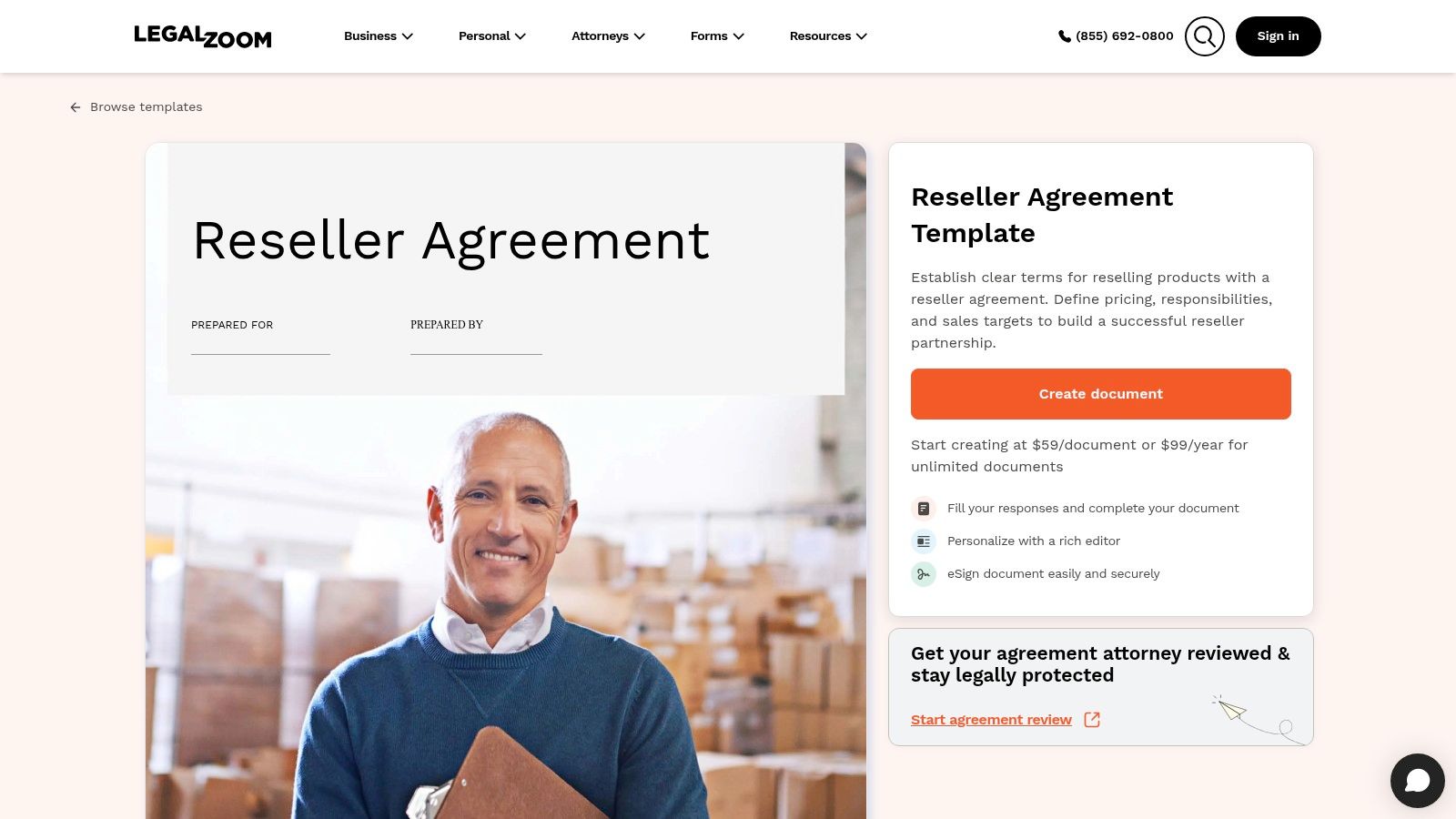
It covers resale authorization, payment, responsibilities, delivery, confidentiality, intellectual property, and termination, with an editor, e-signature workflow, and optional attorney review. The listing shows $59 per document or $99 per year for unlimited documents, so check pricing at checkout before you commit.
Pros: Document preparation and signing in one place, sensible coverage for a straightforward product arrangement, and an attorney review option if you want a second pair of eyes.
Cons: The visible template is product-oriented, so SaaS and services resellers will be editing against the grain. Sample language includes terms such as perpetual duration, which you should check hard. A reseller appointment with no end date and no performance test can block a territory for years.
My take for services businesses
A real estate agency reselling a listings tool, or an education provider reselling course software, needs subscription, data, and support clauses this product form wasn't designed around. You can get there with editing, but count that time realistically.
Rewrite first: Term and termination, delivery versus access, and IP permissions for marketing materials. Once edited, don't rebuild it per partner inside the guided flow. Save your reviewed output as the master, then send copies of that version for signature.
8. Template.net Reseller Agreement Templates
Sometimes you don't know your model yet, and browsing variants helps you decide. Template.net's reseller agreement collection offers standard, product, software and SaaS, equipment, and mutual reseller versions, editable in the browser.
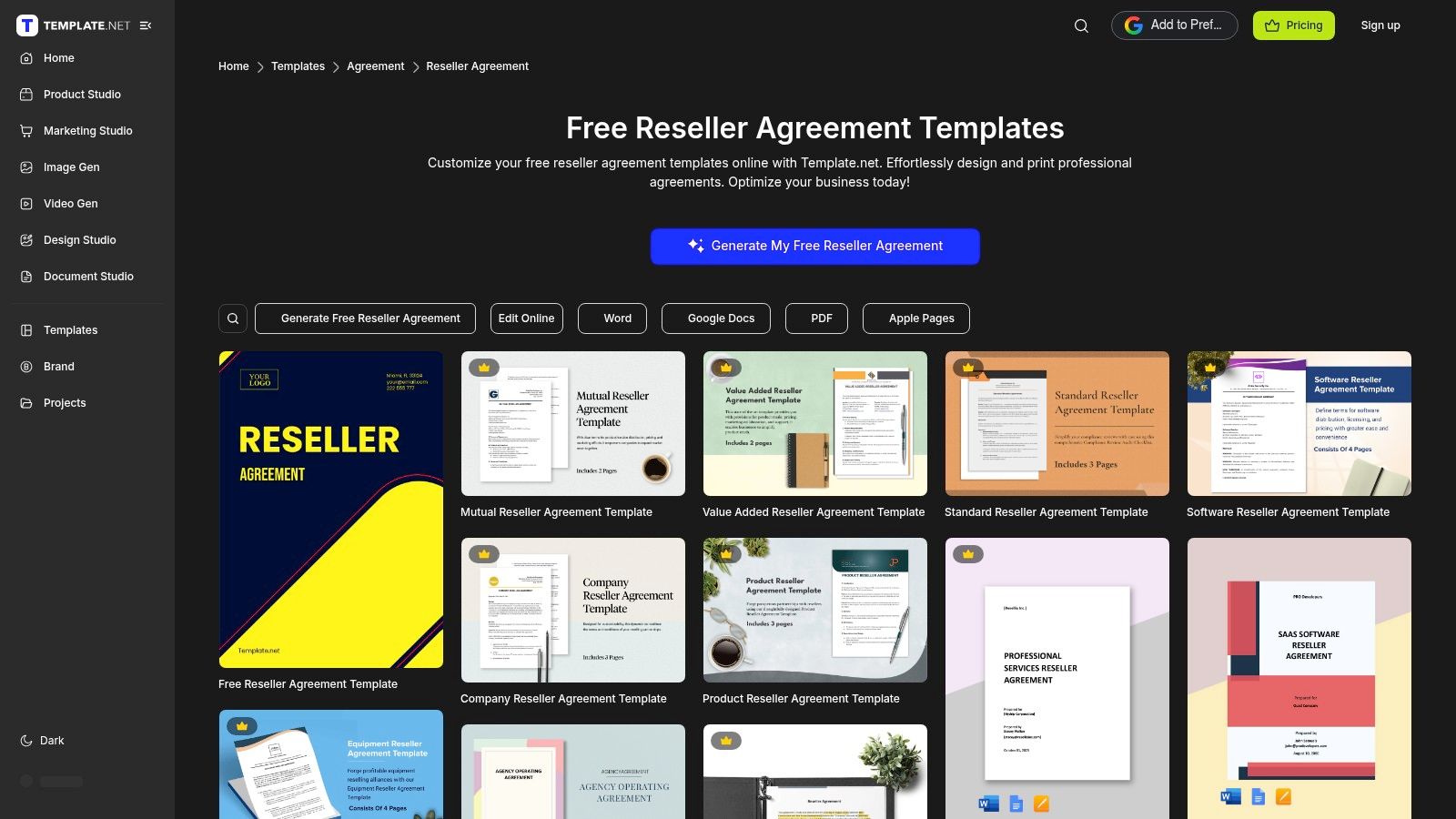
Formats include Word, PDF, Apple Pages, and Google Docs, with AI-assisted document tools in the mix. That flexibility is handy for a fast first layout, especially if your team lives in Google Docs and just needs a draft to react to.
Pros: Real choice across reseller models, flexible file formats, and a quick route to a readable draft you can circulate internally.
Cons: The burden of choosing the right model sits entirely with you. Some templates or features may require a paid plan, and you should review the actual clauses rather than rely on general claims about legal soundness. A mutual reseller agreement, where both sides sell each other's products, creates data and brand obligations in both directions that a one-way form won't capture.
If you're organizing the wider document set around a channel launch, our overview of business documentation templates helps you place the reseller agreement alongside order forms and partner onboarding paperwork.
Rewrite first: Whichever variant you pick, rewrite pricing, territory, and post-termination customer handling, then delete clauses for models you aren't using. Download your approved version, rename it as the master with a date, and route only that file into your contract automation flow for signature.
9. Document eSign Distributor Agreement Template
The last entry is unapologetically about physical distribution. The distributor buys wholesale, holds the goods, and resells for its own account. Document eSign's distributor agreement template is free in Word and PDF, with online signing available.
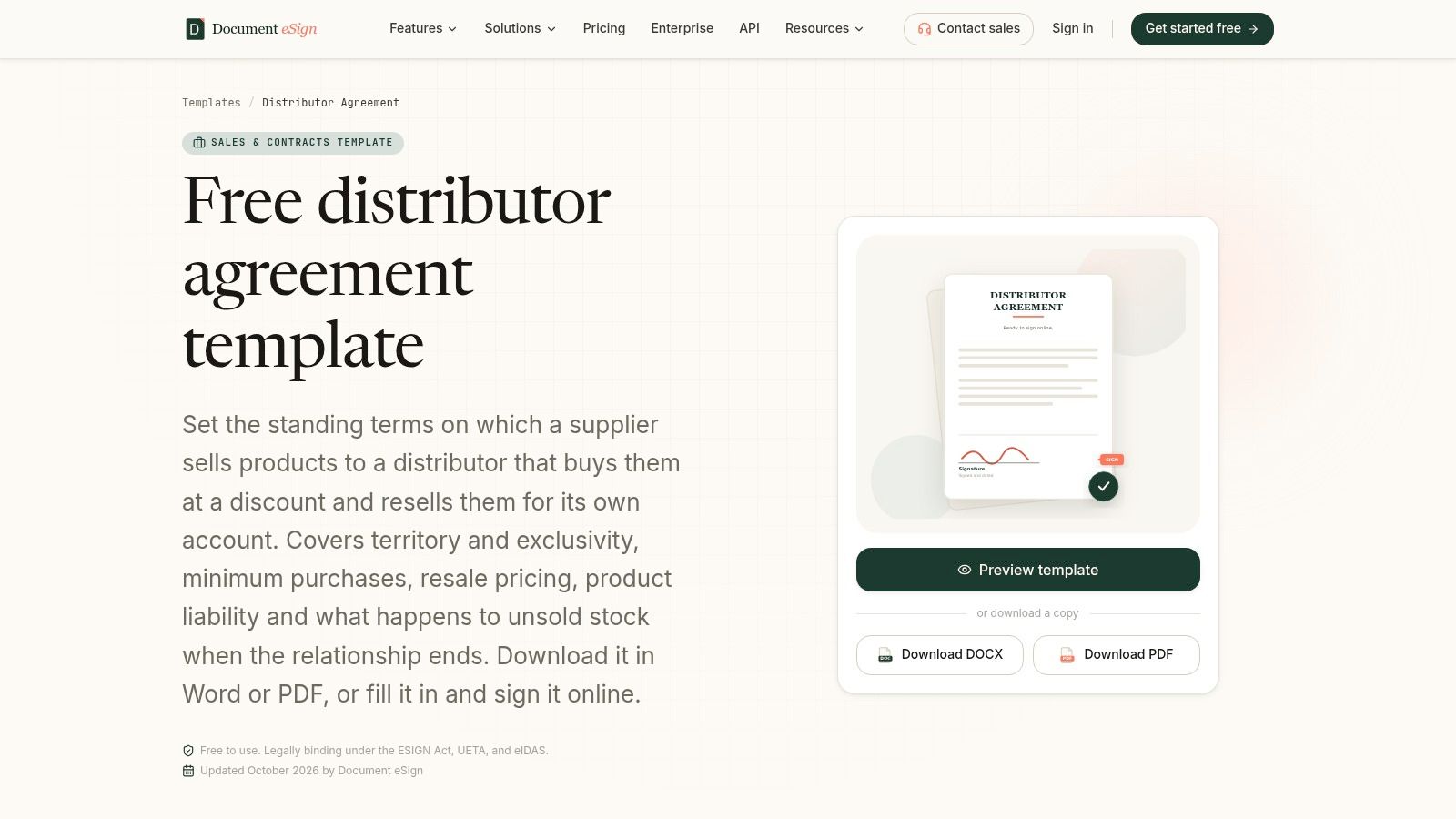
It covers territory and exclusivity options, purchase commitments, pricing and payment terms, warranty and product-liability provisions, and exit and inventory terms. That inventory piece is the one people forget. When a distributor relationship ends with a warehouse of your product, you need a buy-back, sell-off period, or write-down rule agreed in advance, not negotiated during a dispute.
The distinction it draws matters too. A distributor that owns goods carries credit and stock risk. A commission agent doesn't. Mixing those models in one sloppy contract creates tax, liability, and pricing confusion that shows up at audit time.
Distribution is also where channel scale becomes tangible. A Channelnomics and Global Technology Distribution Council survey in 2024 found over 50% of more than 400 North American and European resellers and solution providers sourced up to 50% of their products and services through distribution.
Pros: Free, downloadable or signable online, and clear about the own-account distributor model.
Cons: Less suited to software subscriptions or referrals, and every term needs checking against your real fulfillment process.
Rewrite first: Purchase commitments, product liability allocation, and unsold inventory at exit. Sign the territory map or schedule with the agreement, and store both together.
Reseller agreement templates at a glance
| Item | Best for | Listed price | Format |
|---|---|---|---|
| Partner.io, SaaS Reseller Agreement | US SaaS buy-sell reseller channels | Free | Word template |
| Montague Law, Software Value-Added Reseller Agreement | Complex VAR, OEM, and white-label software deals | No price listed | DOCX download |
| Bonterms, Standard Reseller Agreement for Marketplaces | Online marketplace reseller arrangements | Free | Agreement, instructions, optional cover page |
| PandaDoc, Distributor Agreement Template | Physical-goods distribution with territory and delivery terms | Free | Editable template |
| FileIt, Reseller Agreement Template | Reselling software, subscriptions, physical goods, or both | Free | Fill-in template with e-signing |
| ContractsCounsel, SaaS Reseller Agreement | SaaS resale with optional attorney support | $39; attorney support listed at $195 | Editable template with schedules |
| LegalZoom, Guided Reseller Agreement | Straightforward product-resale arrangements | $59 per document or $99 per year | Guided document with editing and e-signing |
| Template.net, Reseller Agreement Templates | Choosing among reseller agreement types and formats | Some templates or features may require a paid plan | Word, PDF, Apple Pages, and Google Docs |
| Document eSign, Distributor Agreement Template | Wholesale physical goods resold for the distributor's own account | Free | Word, PDF, or online signing |
From Downloaded Draft to Signed, Version-Controlled Contract
Choosing a template is only the start. The harder work is fitting it to your business model, revising the clauses that carry risk, and ensuring the signed copy matches the version your team approved.
Start with the model: buy-sell, referral, marketplace, VAR or OEM, or physical distribution. Then address territory, pricing, and customer transition before polishing boilerplate. Those terms shape who can sell where, how revenue is calculated, and what happens to customers when a partner leaves. After that, review exclusivity, non-compete duration, and liability caps with counsel, and agree on fallback positions. Keep one approved master for each contract type so new deals use current language.
For a logistics firm appointing resellers in several regions, a shared template library keeps the core terms consistent. Each deal can use the same approved master while its territory schedule, discount band, and support owner reflect the local arrangement. Without version control, one region could sign an outdated liability clause saved on an individual laptop.
A staffing agency reselling placement software faces a different transition risk. Recruiters and partners may change, but the agreement should make clear who retains candidate data and who informs clients when a partner exits. Put those responsibilities in the contract rather than relying on a general confidentiality clause.
Build compliance into the workflow. For European partners, the EU eSignature FAQ explains that eIDAS recognizes simple, advanced, and qualified electronic signatures, with qualified signatures carrying the legal effect of handwritten signatures across EU Member States. Choose the signature level to suit the deal's risk, and retain the integrity evidence with the signed file.
Healthcare agreements need specific handling of protected health information. HHS guidance on business associate agreements covers permitted uses, safeguards for electronic PHI, and breach reporting in written contracts. If a clinic resells your health technology, make those duties approval checkpoints in the agreement. For education and professional services partners, define the relevant ESIGN and GDPR obligations for the deal.
The right tools reduce avoidable rework. AI contract review can flag non-standard clauses for counsel to assess. Connecting contracts to Salesforce or HubSpot lets deal data auto-fill names, territory, and pricing, reducing copy-and-paste errors. BoloSign combines reusable templates, AI-assisted review, and eSignature. Each contract type can have one designated master template, and new contracts pull its latest version.
Test the workflow on one real deal before applying it across the channel. Start a free trial with BoloSign, run a reseller agreement from the master template through redlines to the signed record, and identify where approvals or version tracking break down. Fix those points before expanding the process.
Turn the selected draft into a reusable, version-controlled master, send it for secure eSignature, and keep each signed agreement tied to its approved version. Start your free trial with BoloSign and route your next partner deal through that process before signing another handshake agreement.

Paresh Deshmukh
Co-Founder, BoloForms
2 Nov, 2026
Take a Look at Our Featured Articles
These articles will guide you on how to simplify office work, boost your efficiency, and concentrate on expanding your business.