

Your Guide to Creating a Bulletproof Media Release Form
Unlock the essentials of a media release form. Learn why it's crucial for your business, what it must include, and how to create and sign them online.

Tired of nonsense pricing of DocuSign?
Start taking digital signatures with BoloSign and save money.
Think of a media release form as the ultimate permission slip for your content. It’s a straightforward, legally binding agreement that gives you the green light to use someone's image, voice, or likeness in your marketing materials, PR efforts, or at events. Without this simple but essential document, you're leaving your business wide open to serious legal headaches over privacy violations.
What Is a Media Release Form and Why Is It Your First Line of Defense?

At its heart, a media release form is a contract. It's the official handshake that needs to happen before you publish a photo, video, or audio clip that features an identifiable person. This piece of paper (or digital file) is your shield, protecting your business from potential lawsuits by proving you have explicit consent to use someone's identity for the purposes you've laid out.
A casual "sure, it's fine" just won't cut it in court. A signed document gets rid of any gray areas, making sure everyone is on the same page and agrees to the terms.
The Real-World Impact Across Industries
This isn't just a formality for big media companies. All sorts of businesses rely on these forms every single day to operate without taking on unnecessary risk.
- Healthcare: A clinic can't share a patient's glowing testimonial video online without a signed release. It’s a non-negotiable step for HIPAA compliance.
- Education: Schools need a parent’s signature on a media release before they can post photos from the school play or graduation on their website or social media.
- Professional Services: A marketing agency has to get a release from a happy client before plastering their headshot and positive feedback all over a new case study.
- Staffing and Recruitment: Recruitment agencies often record candidate interviews to share with employers, a process that absolutely requires clear, documented consent.
In any of these situations, skipping the form could lead to a legal nightmare filled with takedown notices, steep fines, and a black eye for your brand's reputation. The right to privacy is a big deal, and a media release is your go-to tool for respecting it properly.
The Modern Approach to Securing Consent
Let's be honest—printing, signing, and scanning paper forms is a clunky, outdated process. Smart businesses are now using digital tools to handle this critical task far more efficiently. With BoloSign, you can create, send, and get your media release forms signed in minutes, turning a tedious workflow into a slick, secure process.
By using a digital signing solution, you can create, send, and track a media release form in minutes, capturing legally binding eSignatures that are compliant with global standards like ESIGN and eIDAS. This not only saves time but also creates an unalterable audit trail for every agreement.
In the world of public relations, where press releases fly out at an incredible rate, having a signed media release for every photo or quote is non-negotiable. With major newswires distributing thousands of releases daily, the need for legally sound consent is more critical than ever. Dive into the latest press release statistics for 2025 and you'll see just how high the stakes are.
Switching to a secure and efficient eSignature workflow for documents like a media release form is a smart move. It’s not just about dodging legal bullets; it’s about building trust and showing that you operate with professionalism.
Decoding the Essential Clauses of Your Media Release

A solid media release form is more than just a piece of paper with a signature line—it's your legal safety net. Every clause has a job to do, working together to shield your business from messy disputes down the road. Let’s pull back the curtain on the non-negotiable parts you absolutely must include.
Think of these clauses like the foundation of a house. If you leave one out, you create a weak spot that could cause the whole structure to crumble when tested. Getting a handle on what each part does will give you the confidence to draft or review these forms like a pro.
Identifying the Parties Involved
First things first, you need to state exactly who is involved. This sounds incredibly basic, but getting it wrong—or being vague—can make the entire agreement useless. Your form has to clearly identify:
- The Releasor: This is the person giving you permission. They're the subject of the photo, video, or testimonial whose likeness you want to use.
- The Releasee: That’s you. Your company or organization is the one receiving the permission to use the content.
For example, if your professional services firm is filming a client testimonial, your company is the "Releasee," and your client is the "Releasor." Being crystal clear with full legal names and contact info leaves zero room for confusion.
Defining the Scope of Consent
This section is the heart and soul of your media release. It's where you spell out exactly what rights the Releasor is signing over. Vague language is your worst enemy here. You need to be specific enough for the person to give informed consent, yet broad enough to give you flexibility for future use.
Your "scope of consent" clause should detail:
- Media Type: Are we talking about photos, video clips, audio recordings, or written quotes? Spell it out.
- Purpose of Use: How do you plan to use this content? Be upfront. Is it for your website, social media ads, internal training manuals, or a press kit?
- Duration: How long can you use it? Many forms grant permission "in perpetuity" (which means forever), but you can also limit it to a specific campaign or a set number of years.
- Territory: Where can this media appear? A "worldwide" clause is standard for anything posted online, giving you the most breathing room.
A staffing agency, for instance, might need a broad scope to share a candidate's video profile with multiple potential employers. In contrast, a healthcare provider filming a patient story needs an incredibly specific clause, limiting its use to a single webpage to stay compliant with HIPAA. This is where the details really matter.
A well-drafted media release form acts as a clear roadmap, outlining the permissions granted and the boundaries of use. It’s your best tool for preventing future misunderstandings and ensuring everyone’s expectations are aligned from the start.
Compensation and Consideration
For any contract to hold up in court, something of value has to be exchanged between the parties. Lawyers call this consideration. While this can be cash, it doesn't always have to be.
Consideration can come in a few different flavors:
- Monetary Payment: This is a straightforward, one-time payment for participating.
- Non-Monetary Value: This could be anything from providing a model with professional headshots, giving someone a copy of the finished video, or even just the opportunity for public exposure.
- Acknowledgement: Often, simply stating in the document that the Releasor is participating willingly in exchange for the opportunity is enough.
The crucial part is to clearly state the consideration in the form, even if no money changes hands. This simple step reinforces the agreement’s legal validity.
With a platform like BoloSign, you can easily create templates that include these essential clauses and send them off for a secure eSignature. Once signed, you have an indisputable digital record of consent, ready to be filed away in your secure document workflow.
Choosing the Right Type of Media Release Form
Not all media releases are created equal. Grabbing a generic template for every situation is one of the fastest ways to leave your business exposed to risk. It's like using the same key for your house, car, and office—it just doesn’t offer the right kind of protection for each one.
Picking the correct media release form from the get-go is the only way to ensure the consent you get is valid and legally sound for what you plan to do. The form you need boils down to two simple questions: who are you featuring, and how will you use the content? A quick photo for a company blog post has vastly different legal strings attached than a national advertising campaign, and taking a moment to choose the right document upfront will save you from massive legal headaches down the line.
Releases for Adults vs Minors
The first and most important distinction to make is the age of your subject. This isn’t just a minor detail; it’s a critical legal line that can completely invalidate your agreement if you get it wrong.
- Adult Release Form: This is your standard agreement for anyone who is legally an adult (that's 18 years old in most places like the US, Canada, and Australia). The person signs for themselves, giving you permission to use their likeness. Simple enough.
- Minor Release Form: Now, when your subject is a minor, things change. They legally cannot consent for themselves. A parent or legal guardian must sign the form on their behalf. This is absolutely non-negotiable, whether you're an education provider filming a school play, a marketing agency using a child actor, or any business featuring someone under 18.
If you miss getting a guardian's signature for a minor, that release form isn't worth the paper it's printed on. It's a simple step that provides an essential layer of legal armor.
Commercial vs Editorial Use
The next critical fork in the road is figuring out the purpose of your media. Are you using that photo or video to sell something, or is it for informational, newsworthy content? Your answer determines the kind of release you need.
Commercial use is anything that promotes a product, service, or brand. Think ads, brochures, and branded social media. Editorial use, on the other hand, is for news, education, or public interest content. The legal standards for getting consent are much, much stricter for commercial use.
To help clear things up, let's look at the key differences side-by-side.
Commercial Use vs Editorial Use Releases
This table breaks down the fundamental differences between the two main types of releases you'll encounter. Understanding these distinctions is key to staying compliant and avoiding legal trouble.
| Feature | Commercial Use Release | Editorial Use Release |
|---|---|---|
| Primary Goal | To advertise, market, or sell a product or service. | To inform, educate, or report on newsworthy events. |
| Consent | Always required if a person is identifiable. No exceptions. | Often not required for photos taken in public spaces for news purposes. |
| Example | A logistics company using an employee’s photo in a recruitment brochure. | A news outlet publishing a photo of a crowd at a public festival. |
| Risk Level | High. Using an image without a signed release can lead to expensive lawsuits. | Lower, but getting a release is still the safest bet to avoid any gray areas. |
In short, if money is being made or a brand is being promoted, you need a rock-solid commercial release. If you're reporting news, the rules can be more flexible, but it's always better to be safe than sorry.
Specialized Release Forms
Beyond those two main categories, some situations call for even more specific types of releases to cover all the bases.
- Talent/Model Release: This is a beefed-up commercial release used for professional models, actors, or performers. It gets into the nitty-gritty, often including clauses about payment and spelling out the exact campaigns where the media will appear.
- Location Release: Planning a shoot on private property? You'll need one of these. A real estate agency, for example, has to get a location release from a homeowner before splashing photos of their house across marketing materials.
- Interview Release: This one is a staple in media and professional services. It grants permission to use not just the person's image and voice, but also the actual content of their statements. It’s crucial for podcasts, documentaries, and testimonials.
Choosing the right form is the first, most important step in building a secure consent workflow. With a digital signing tool, you can create templates for each scenario and send the right one for a quick, compliant eSignature. This makes sure your permissions are always perfectly matched to your project’s needs.
How to Automate Media Releases with Digital Signatures
Let's be honest: manual paperwork is a major drag on any fast-moving business. Printing out a media release, chasing down a signature, scanning the document, and then trying to keep track of it all is a slow, clunky process that just doesn't work when you need to move quickly.
Thankfully, there's a much smarter way to handle this. By automating your media release workflow with digital signatures, you can turn a tedious administrative chore into a smooth, secure, and incredibly efficient operation. This simple shift frees you up to focus on what really matters—creating amazing content—instead of chasing paper.
From Manual Effort to Automated Workflow
Picture this: you're at a huge corporate event or a busy university open day, and you need to get releases from dozens, maybe even hundreds, of people. The old-school way meant clipboards, pens, and a mountain of paper. The modern way? You send a single link to a digital form that attendees can sign on their phones in just a few seconds.
That’s the real power of contract automation. Using a platform like BoloSign, you can build a system that manages the entire lifecycle of a media release—from creation to secure storage—with almost no manual effort.
- Create Reusable Templates: Just upload your PDF media release form once, and it becomes a reusable template. You can add fillable fields for names, dates, and of course, a legally binding eSignature block.
- Send in Bulk: Need releases from an entire department or a long list of event attendees? No problem. Send the same document to multiple people at once, and each person gets their own unique, secure link to sign.
- Track in Real-Time: Stop the guesswork. A central dashboard shows you the status of every single request in real-time. It even sends out automatic reminders to anyone who hasn't responded yet.
This flowchart breaks down the decision-making process for choosing the right media release based on who you're filming and how you plan to use the content.
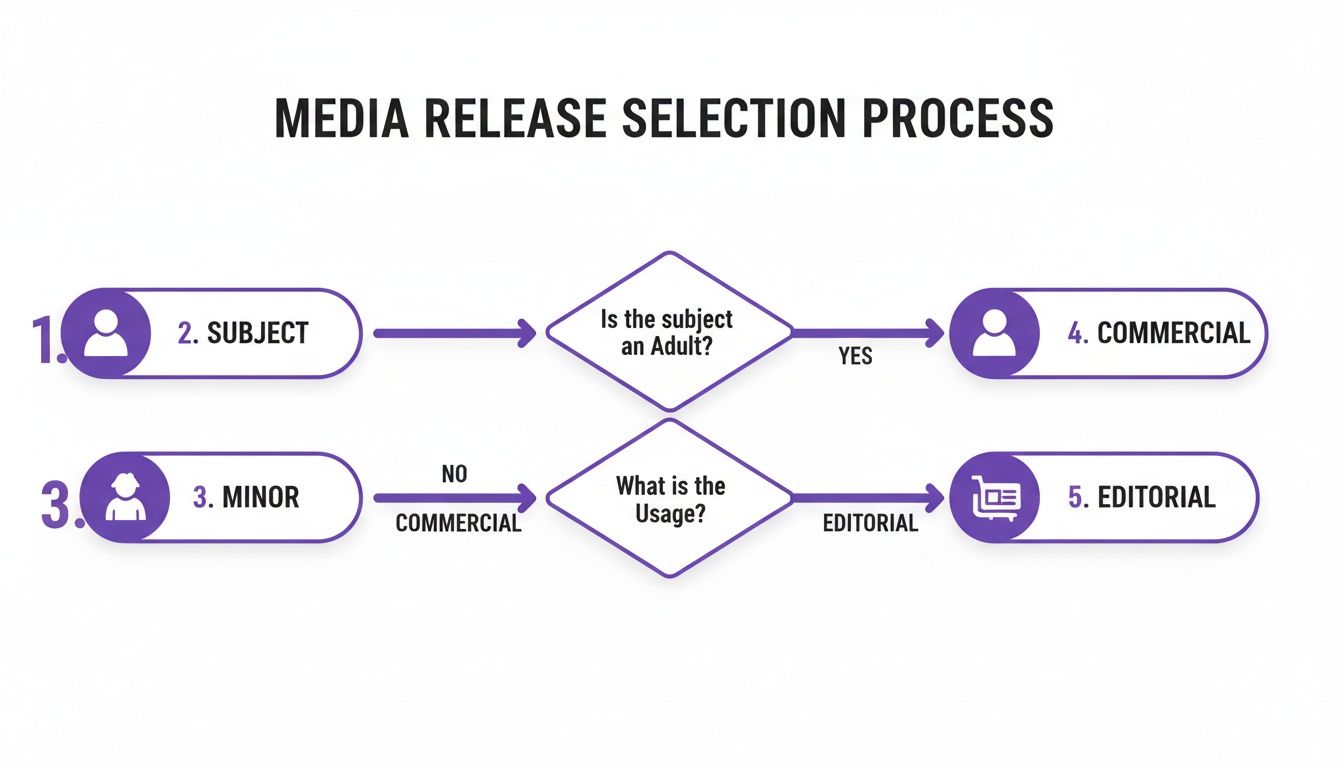
It's a quick visual guide to help you figure out if you need a form for an adult or a minor, and whether your content is for commercial or editorial purposes.
Integrating Signatures Directly into Your Forms
For many organizations, especially in education or professional services, the consent process starts with a registration or intake form. Instead of making people fill out one form and then sign a totally separate document, why not combine the two?
BoloSign lets you add a signature to Google Form fields, turning a simple survey or registration tool into a powerful consent-gathering machine. This is a game-changer for collecting media releases for webinars, workshops, or client onboarding. You can learn more about how it works in our guide on how to add a digital signature to Google Forms.
This integration means your data collection and legal consent happen in one seamless step. It’s a much better experience for your users and a more efficient workflow for your team. Plus, every signed form is automatically saved with a complete, unchangeable audit trail.
To really get the most out of digital automation, it's important to understand the legal side of things. Using platforms that follow ESIGN and eIDAS standards is non-negotiable. Resources on ensuring the validity of electronic signatures in HR forms offer great insights that apply to all kinds of consent management.
The BoloSign Advantage: Affordability and Security
A lot of digital signing solutions punish you for growing by charging per user or per document. As your needs get bigger, your bill skyrockets. We think that’s backward. BoloSign is designed for businesses that need predictability and real value.
We offer unlimited documents, team members, and templates at one fixed price. This makes our platform up to 90% more affordable than the big-name tools out there. For a logistics company, that means getting releases from every driver without a second thought. For a healthcare provider, it means managing patient consent without worrying about hitting a cap.
And this affordability doesn't mean we skimp on security. Our AI-powered platform is built with top-tier, enterprise-grade protections and is compliant with major regulations like HIPAA, GDPR, ESIGN, and eIDAS. This ensures your automated media release process isn't just fast, but also legally solid and totally secure.
Ready to stop wasting time on manual paperwork? The best way to see the impact of automation is to try it for yourself.
Making Sure Your Media Release Process is Legally Sound
Getting a signature on a media release form isn't the finish line—it’s the starting block. The real work is what comes next: securely managing that consent and keeping your entire process compliant over time. That’s how you truly shield your business from legal headaches.
Simply having consent isn't enough; you have to be able to prove it. This means keeping clear, organized records that can hold up under pressure. A sloppy, disorganized file system can be just as dangerous as not getting a release in the first place.
The Power of a Digital Audit Trail
When you use a paper form, your proof is little more than an ink signature on a page. But with a digital signing solution like BoloSign, you get a solid, unchangeable audit trail for every single document. Think of it less as a digital copy and more as a complete, detailed history of the entire signing event.
This trail is your rock-solid evidence of consent, capturing all the critical details:
- Timestamps: It shows the exact date and time the form was opened, signed, and finalized.
- IP Addresses: It logs the location where the document was accessed and signed from.
- Action History: It records every single step, from the moment you sent the request to the final click.
This level of detail is your best defense if someone ever questions their consent. It gives you a clear, verifiable story that's far stronger than a paper signature, providing the confidence that your process is legally sound.
Navigating the Maze of Global Privacy Regulations
Handling personal data, especially photos and videos, means you're playing in the big leagues of privacy law. Different parts of the world have different rules, and a one-size-fits-all approach just won't cut it if you have an audience in the US, Canada, Australia, or the UAE.
A few key regulations you need to know about include:
- GDPR (General Data Protection Regulation): This EU law is the gold standard for data privacy globally. It gives people serious control over their personal data, including the "right to be forgotten."
- HIPAA (Health Insurance Portability and Accountability Act): If you're a healthcare provider in the US, HIPAA has strict rules about how patient information—including photos or testimonials—can be used and shared.
Using a compliant platform is non-negotiable here. A HIPAA-compliant eSignature tool, for example, is essential for any healthcare organization managing patient media releases. It ensures that sensitive data stays protected every step of the way.
To make sure your media release forms are legally sound and respect people's rights, it's also a good idea to have a solid grasp on general organizational understanding privacy policies. This bigger-picture knowledge helps inform all your specific consent-gathering activities.
The Legal Weight of Electronic Signatures
A question that often comes up is whether a digital signature carries the same legal weight as a traditional wet-ink one. The answer is a clear and resounding yes, thanks to major laws passed around the world.
Legislation like the ESIGN Act in the United States and eIDAS in the European Union created the legal framework that makes electronic signatures valid and legally binding. This means a media release form signed digitally is just as enforceable as one signed with a pen. For a deeper dive into how we handle data, feel free to review our own approach in BoloSign’s privacy policy.
This legal recognition gives businesses the green light to go fully digital. Whether you're operating in North America, Europe, or Australia, a compliant eSignature platform offers a secure and legally recognized way to get consent. It's a modern fix for a timeless business need—protecting your organization while respecting individual rights.
It's Time to Transform Your Consent Workflow
In a world that moves at lightning speed, protecting your business from legal headaches shouldn't be a complicated or costly affair. A media release form is your go-to safeguard, and thankfully, modern tools have made managing them easier than ever. We've walked through why they’re so critical, what every form needs to include, and how you can put the entire process on autopilot.
By switching to a digital signing solution, you can finally ditch the clunky manual paperwork for a system that's secure, compliant, and wildly efficient. This single change frees up a surprising amount of your time while building a rock-solid, verifiable record of every single consent you get. The best way to really get it? See it for yourself.
BoloSign completely simplifies how you handle these critical documents. It’s a powerful, AI-driven platform built for all your eSignature needs. Instead of chasing down papers, you can send, sign, and store unlimited documents with a complete audit trail—all for one straightforward price. It’s simply a smarter way to manage consent and keep your business protected.
Ready to see what that feels like? Start your 7-day free trial of BoloSign and discover just how simple, affordable, and secure your consent management can actually be.
Got Questions? We've Got Answers
Even when you think you have a handle on media release forms, a few practical questions always seem to pop up. Let's tackle some of the most common ones to help you navigate the world of consent with confidence.
Do I Always Need a Media Release for Photos in Public?
This is a classic "it depends" situation, but it's simpler than you think. For news reporting or other editorial use, you often don't need a release for photos you snap in a public space.
But the moment your purpose shifts to commercial use—think marketing, ads, or anything that sells a product—the game changes. If a person is identifiable in your shot, you almost always need a signed media release form. Relying on the "public space" argument for commercial content is a huge legal gamble. The smartest, safest move is to always get a signature. A digital tool like BoloSign makes it incredibly easy to get that consent on the spot.
How Long Does a Media Release Last?
The form itself dictates the timeline. Many creators and businesses prefer releases that are granted "in perpetuity"—which basically means forever—for the specific photos or videos covered.
You don't have to go that route, though. You can absolutely limit the agreement to a single project or a specific time frame, like one year. The key is clarity. When you use an eSignature platform, your signed forms are securely stored with a complete audit trail, so you can pull up the exact terms in seconds if you ever need to check.
Are Electronic Signatures Valid for Media Release Forms?
Yes, one hundred percent. Electronic signatures are legally binding in most countries across the globe. In the United States, they're backed by the ESIGN Act, and in the European Union, they're covered by the eIDAS regulation.
In fact, a compliant platform like BoloSign often provides a stronger paper trail than a traditional wet-ink signature. It captures timestamps, IP addresses, and the entire document history, which makes the consent even more solid and easier to prove if it's ever called into question.
What Happens if I Use an Image Without a Release?
Using someone's image for any commercial purpose without their permission is stepping into a legal minefield. It can lead to some pretty painful lawsuits for violating their rights to privacy and publicity. The fallout isn't just a slap on the wrist; it can be serious.
- Financial Damages: You could be on the hook for a significant payout.
- Cease and Desist Orders: A court could force you to pull the content immediately, throwing a wrench in your campaigns.
- Reputational Harm: This one often stings the most. The damage to your brand's reputation can be the most expensive and lasting consequence.
Having a solid process for managing media releases isn't just about good paperwork; it's fundamental risk management for any modern business.
Managing consent shouldn't be a headache. BoloSign offers an affordable, secure, and incredibly simple way to automate your media release forms with legally binding eSignatures. With unlimited documents, templates, and users at one fixed price, you can protect your business without wrecking your budget.
Get the peace of mind that comes from a smooth, compliant workflow. Start your 7-day free trial of BoloSign today.

Paresh Deshmukh
Co-Founder, BoloForms
19 Jan, 2026
Take a Look at Our Featured Articles
These articles will guide you on how to simplify office work, boost your efficiency, and concentrate on expanding your business.