
Is an Electronic Signature Legally Binding in 2026?
Is an electronic signature legally binding? See when it holds up under ESIGN and eIDAS, which documents are excluded, and how to make it enforceable.

Tired of nonsense pricing of DocuSign?
Start taking digital signatures with BoloSign and save money.
In most US and EU commercial contracts, a properly executed electronic signature is legally binding, as long as the usual contract elements are present and you can prove who signed and that they intended to sign. Federal rules in the United States have backed that result since October 2000, and the European Union's core signature rules have applied since July 1, 2016.
So why do so many deals still unravel when a signer later says they never signed?
Most explainers stop at a simple yes. That answer is incomplete. A typed name, a click, or a drawn mark can create a contract, but a judge still wants proof of who acted, what they agreed to, and whether the file changed afterward. The signature level has to match the document's risk. An NDA isn't a deed, and a clinic consent isn't a permission slip.
If you run operations in the United States, Canada, Australia, New Zealand, or the UAE, the same question shows up in staffing offers, clinic intake, listing files, and vendor paperwork. You don't need a law degree to sort it. You need a clear rule for ordinary deals, a higher bar for risky ones, and a record you can produce when someone challenges the signature.
Whether an E-Signature Holds Up in Common Deals
People asking whether an electronic signature is legally binding usually have an ordinary commercial contract in mind. For that kind of deal, a typed name, a click-to-sign action, or another electronic mark is generally binding in the US and the EU when the contract has offer, acceptance, consideration, authority, and clear intent. Those five pieces are the same ones a paper contract needs. Electronic form doesn't replace them. The guide to the elements of a valid contract walks through each piece in plain language before you send the next file.
What changes is how strong the proof is, not whether electronics are allowed in principle.
| Document or signature | Usually binding? | What must be true |
|---|---|---|
| Typed name or click-to-sign on a US commercial contract | Generally yes under ESIGN | Clear intent to sign, consent to electronic records, retained copy |
| Simple e-signature on an EU contract | Admissible as evidence, not automatically equal to handwritten | Identity check and integrity controls that prove who signed |
| Qualified electronic signature in the EU | Same legal effect as a handwritten signature | Qualified certificate from a qualified trust service provider |
A click can bind a sales contract. It doesn't automatically bind every document your team touches.
The rows that surprise people sit outside this table. Wills, some family papers, consumer notices, and recorded real estate instruments follow extra rules. Match your document to the row above. If it isn't an ordinary commercial contract, don't assume the middle column still says yes.
What Makes an E-Signature Provable
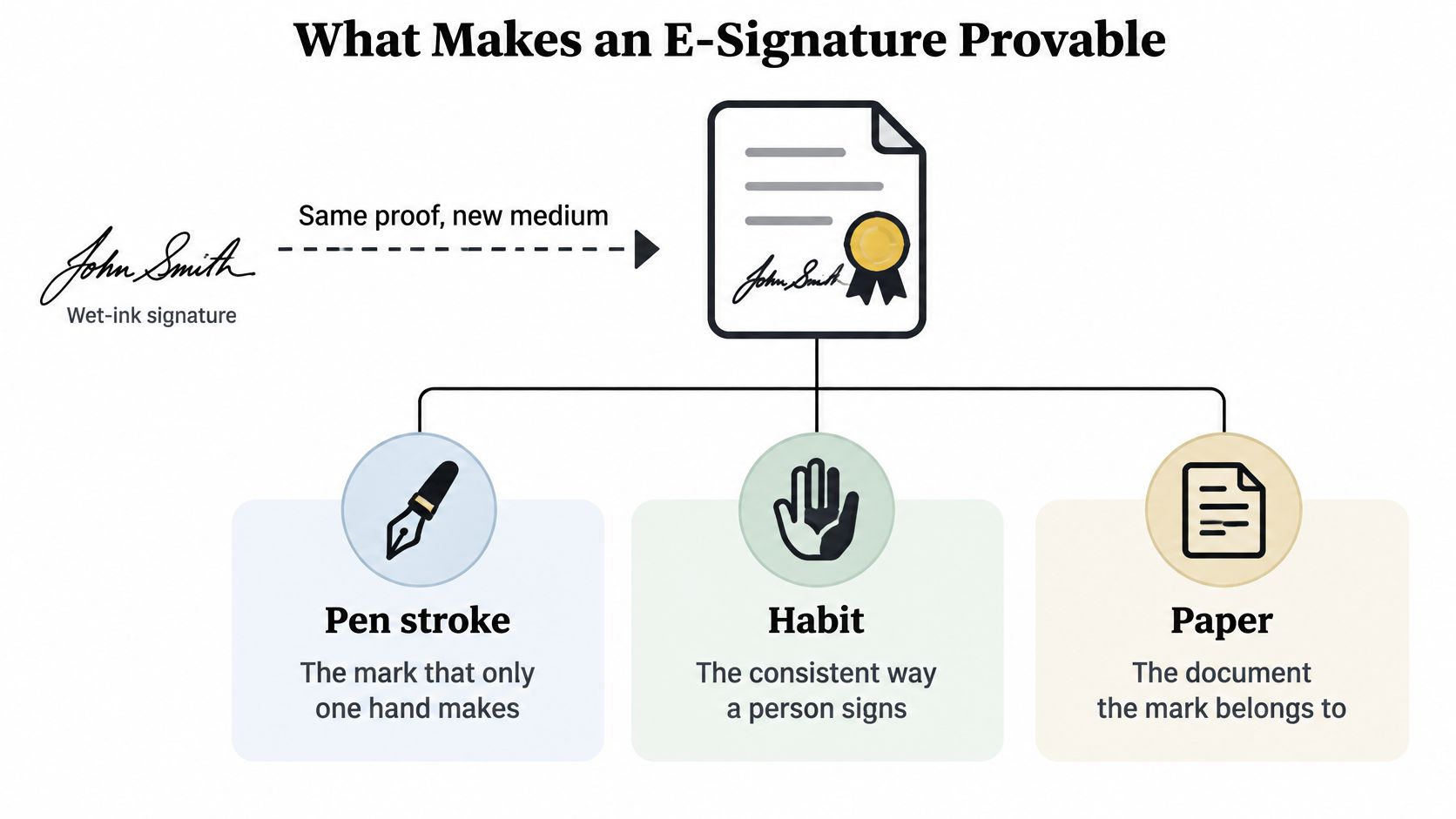
A signed PDF can look complete and still lose in a dispute. The deciding questions are narrower: who acted, what terms were on screen, and whether the document stayed the same after the click.
Three things the law actually looks for
The European Commission eSignature FAQ treats an electronic signature as legally usable when it shows the signer's intent to be bound, attribution to that person, and a reliable association between the signature and the signed data. eIDAS Article 25 stops a court from rejecting a signature only because it is electronic, or only because it isn't a qualified electronic signature. Admissibility is the floor. Weight comes from authentication and integrity controls.
Intent means the person saw the terms and chose to accept them. Say a staffing firm sends an offer letter. The candidate opens the PDF, checks the pay rate and the start date, and clicks "I agree." That click is the intent record. A name dropped into a footer, with no chance to review the terms, tells a weaker story.
Attribution ties the act to a specific person. A verified email plus a one-time passcode is a common pairing for everyday offers. Higher-risk files can add stronger identity proofing. The same FAQ notes that advanced signatures add a unique link to the signer, signer control over the signature-creation data, and a way to detect later changes.
Association means the signature stays stuck to the exact content. If someone edits the pay rate after the click, the record should show it. Keep the original signed artifact rather than a re-rendered copy.
A clean signature cannot repair a bad deal. Lack of authority, fraud, incapacity, or a missed statutory formality can still sink it. eIDAS doesn't replace national rules on contract validity or required form.
When someone says they never signed
A dispute usually turns on process evidence. A WTO event paper on electronic commerce puts the questions in a plain order: who acted, what document was presented, whether consent was given, and whether the record changed afterward. International guidance looks for signature-creation data linked to the signatory, control of that data by the signatory, and detectable alterations to both the signature and the signed information.
A non-qualified signature can still succeed when that surrounding evidence is persuasive. An audit trail is one part of the authentication story, not a magic shield. The direction is consistent: verified identity and process evidence carry more weight than the mere presence of an electronic mark.
Build the package item by item:
- Original signed PDF: Keep the completed file, not a screenshot or a re-exported copy.
- Identity events: Record the verified email, passcode, or stronger proofing step.
- Consent record: Save the "I agree" action and the text the signer saw.
- Timestamps and delivery: Note when the file went out and when signing finished.
- IP or device data: Capture it where your policy and local privacy rules allow.
- Immutable audit trail: Store a trail that shows each step and flags later edits.
BoloSign protects documents with end-to-end encryption from sender to signer, so the file isn't sitting open in transit while you collect that proof.
Say a seller later disputes a listing price. The trail shows a passcode sent to the verified phone, a completed-signature timestamp, and a document fingerprint that matches the original. That is a much stronger answer than "we have a PDF with a name on it." Teams that already handle regulated files can compare this package with e-sign practices used in financial services compliance.
A short test before you rely on the file
Ask three questions. Did the signer show intent by reviewing terms and agreeing? Can you attribute the act to that person? Can you show the signed content didn't change? If any answer is no, fix the workflow before the deal depends on it. Use stronger identity proofing when money, health data, housing, or repeat disputes raise the cost of being wrong, and keep routine low-risk approvals light.
How US, EU and Other Major Markets Recognize E-Signatures
Congress enacted the Electronic Signatures in Global and National Commerce Act (ESIGN) on June 30, 2000. The FTC report to Congress on ESIGN explains the federal rule. A signature, contract, or record related to interstate or foreign commerce can't be denied legal effect, validity, or enforceability solely because it is electronic. Electronic records can also satisfy a legal writing requirement when they can be retained and accurately reproduced later.
That is nondiscrimination, not a blanket guarantee. Consumer-consent rules still apply when legally required disclosures go out electronically. Record-retention rules still apply. Some matters stay outside the statute.
Most US states adopted the Uniform Electronic Transactions Act (UETA) so state-level deals follow the same idea alongside the federal statute.
One framework for cross-border EU deals
The eIDAS Regulation (EU) No. 910/2014 entered into force on September 17, 2014, and it replaced the 1999 electronic-signature directive, according to the EU summary of eSignature rules. Ordinary electronic signatures can still be binding and usable as evidence. A qualified electronic signature gets handwritten-signature equivalence when the formal requirements are met. For a team serving customers in more than one country, the job is to match signature type, identity assurance, audit evidence, and workflow to the governing law and the document's formal requirements.
| Jurisdiction | Main law | Core rule on e-signatures |
|---|---|---|
| United States (federal) | ESIGN Act, 2000 | Cannot deny legal effect solely because the signature or record is electronic |
| United States (states) | UETA, adopted by most states | Same principle applied to state-level transactions |
| European Union | eIDAS Regulation (EU) No 910/2014 | Electronic signature cannot be rejected solely for being electronic |
| Canada | Provincial electronic commerce and transactions laws | Electronic signatures generally valid where the province's law applies |
| Australia | Electronic Transactions Act 1999 (Cth) and state equivalents | Valid where the requirements of the law are met and the method is reliable |
| New Zealand | Electronic Transactions Act 2002 | Valid where the method identifies the signer, shows their approval and is reliable |
| UAE | Federal Decree-Law No. 46 of 2021 | Recognized, with trust service rules for higher assurance |
BoloSign's eSignatures are designed to comply with the ESIGN, UETA, and eIDAS eSignature laws, and the compliance set also includes GDPR, CCPA, and HIPAA. That still doesn't pick the right level for you. Confirm the local rule for the specific document type, especially where a province, state, or emirate adds its own formality.
Simple, Advanced and Qualified Signatures Compared
The European Commission describes three levels. Only the top one is written as the handwritten equivalent across every EU member state. The other two can still carry contracts when the proof fits the risk.
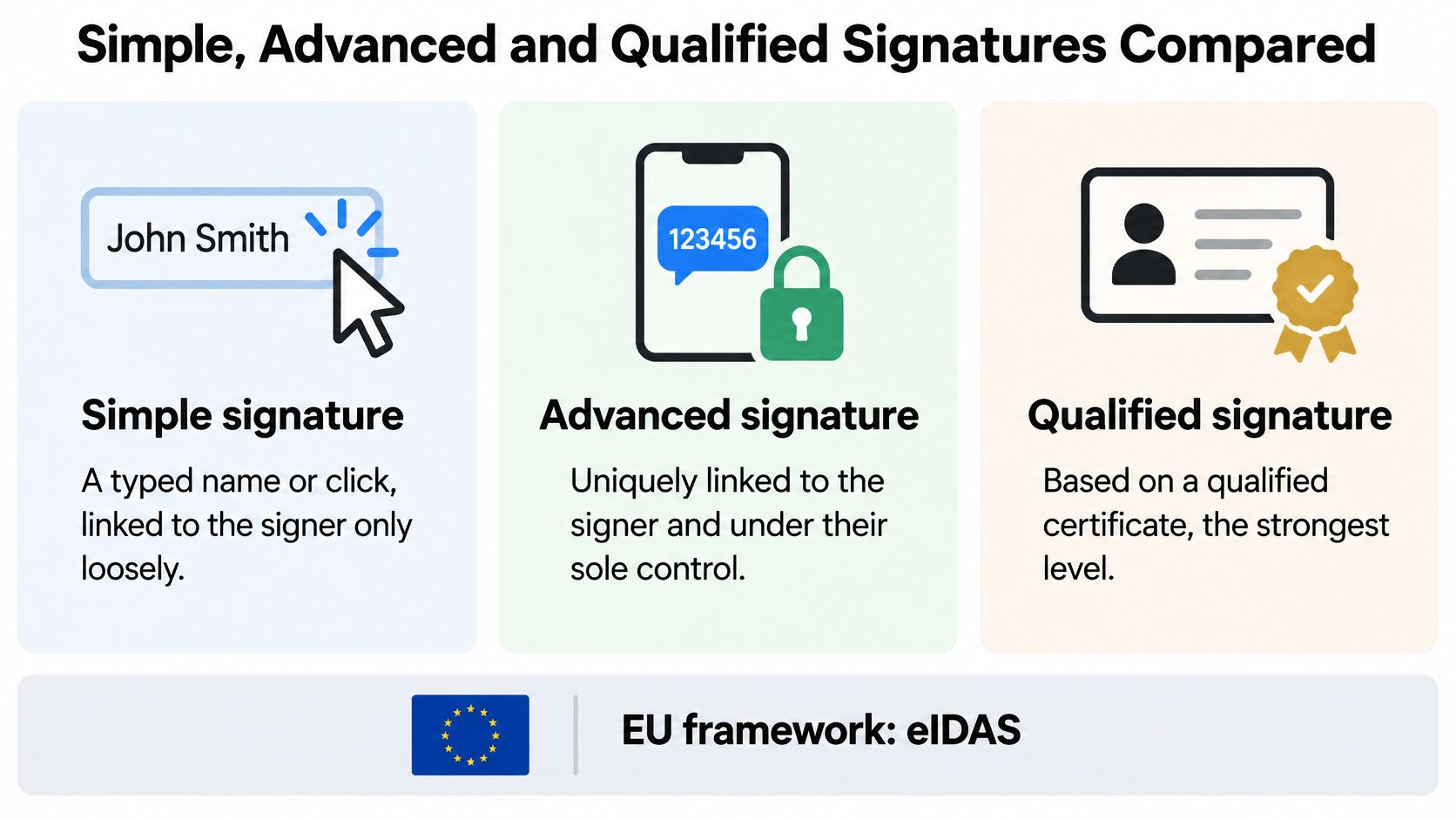
A simple signature is a typed name or a click, linked to the signer only loosely. An advanced signature is uniquely linked to the signer, stays under the signer's control, and makes a later change detectable. A qualified signature adds a qualified certificate from a qualified trust service provider.
This short video walks through how those levels show up when a team sends a file.
| Level | What it proves | Typical use | Legal strength |
|---|---|---|---|
| Simple | Signer clicked or typed a name; basic link to the signer | NDAs, offer letters, internal approvals | Admissible as evidence; strength depends on audit records |
| Advanced | Uniquely linked to the signer, under their control, changes detectable | Vendor agreements, healthcare consents, leases | Stronger evidence, supported by identity checks |
| Qualified (EU) | Advanced signature plus a qualified certificate from a qualified trust provider | Regulated filings and cross-border deals needing handwritten-equivalent force | Same legal effect as a handwritten signature across the EU |
Under Article 25 of the EU eIDAS framework, an electronic signature can't be denied legal effect or admissibility as evidence merely because it is electronic or because it isn't qualified. Ordinary and advanced eSignatures can support contracts, approvals, and business forms across EU member states. Evidentiary strength still tracks identity, intent, and recordkeeping. Qualified signatures get the strongest statutory treatment.
How to step up without overbuilding
Simple signatures are often enough for NDAs, offer letters, and internal approvals when the audit evidence is strong. A professional services firm sending a mutual NDA rarely needs a qualified certificate.
Advanced signatures fit vendor agreements, healthcare consent forms, and leases, where you care more about who clicked. The signer controls the signature data, and a later edit to the PDF should be detectable.
Qualified signatures make sense for regulated filings or cross-border deals that need handwritten-equivalent force inside the EU.
The level is a risk decision. Most documents don't need the highest tier. The proof package has to match the level you chose, or the extra certificate doesn't help you.
Documents and Situations Where E-Signatures Fall Short
The surprise for many operators is wills. Under US federal law, electronic signatures generally don't cover wills, codicils, and testamentary trusts. Those documents still follow state wet-ink and witness rules. A clean click-to-sign workflow doesn't override that exclusion.
Other papers aren't banned outright, but they need an extra step before you treat a click as enough.
| Document type | Typical rule | Practical step |
|---|---|---|
| Wills, codicils and testamentary trusts (US) | Excluded from ESIGN | Use wet ink and follow state witness rules |
| Divorce, adoption and custody papers | Often excluded or restricted | Confirm with the court before e-signing |
| Consumer disclosures (US) | Require prior consent to electronic delivery | Obtain and document consent first |
| Notarized documents | Notary requirement still applies | Use remote online notarization where state law permits |
| Real estate deeds and recordings | Governed by state recording rules | Check the county recorder's e-recording requirements |
What the extra step looks like
Family-law filings such as divorce, adoption, and custody papers are often restricted. Call the court clerk before you send a portal link. A rejected filing wastes more time than a wet-ink appointment.
Consumer disclosures need documented, affirmative consent before electronic delivery. A pre-checked box buried in a footer is a weak consent record. Ask for a clear yes, and keep it with the file.
Notarized documents still need a notary. Remote online notarization can work where that state's law permits it. Don't assume every state treats a webcam session the same way.
Deeds and recordings follow the recording office, not your internal policy. A listing agreement may be fine electronically while the deed isn't. Check the county recorder's e-recording requirements before closing day.
These rules vary by state and country. For a high-stakes document, check with counsel before the file goes out for signature.
How Staffing, Healthcare and Real Estate Teams Apply the Rules
Each case below ends with a level and a proof package. The document, not the industry logo, sets the bar.
Staffing. An agency sends offer letters, timesheets, and worker agreements across several states. A simple signature with a verified email and a retained audit trail usually fits those everyday files. Multi-state employers should still read practical guidance on e-signature compliance for multi-state employers from Paradigm International Inc. before they standardize one workflow for every state form.
Healthcare. A clinic collects intake forms, authorizations, and records requests. The HHS safeguards guidance says documentation that needs a signature may be a scanned image of signed paperwork or an electronic document with an electronic signature, provided that signature is legally valid. HHS also recognizes electronically executed requests through a secure web portal when they include an electronic signature. Validity doesn't remove privacy and access safeguards. Use an advanced signature with identity checks for sensitive consents. Shine Above captured 150+ caregiver consents digitally with BoloSign, cutting document turnaround from 5 days to 1 day.
Real estate. Agents send listing agreements and disclosures under the federal and state electronic-signature statutes, while deeds and recordings follow state and county rules. A practical split is in this note on the electronic signature for real estate. Keep the listing file's audit trail, and don't send the deed through the same simple click path.
Logistics. A carrier sends delivery agreements and driver contracts across borders. Advanced signatures and identity checks earn their keep when the signer may be challenged months later at a loading dock in another country.
Education. A school sends enrollment forms and permission slips. A simple signature with parent verification usually fits. Justin, who collects those slips electronically, put it this way: "I can now get permission slips signed by parents electronically, which saves me a lot of time and hassle." Any consent involving minors should follow the school's own rules.
Professional services. A firm circulates a statement of work and a mutual NDA. A simple signature plus the retained PDF is usually enough when scope, fees, and dates were visible before the click.
Before anyone hits send, run three checks: document type, signature level, and proof package.
Confirm Your Next E-Signature Is Enforceable Before You Send
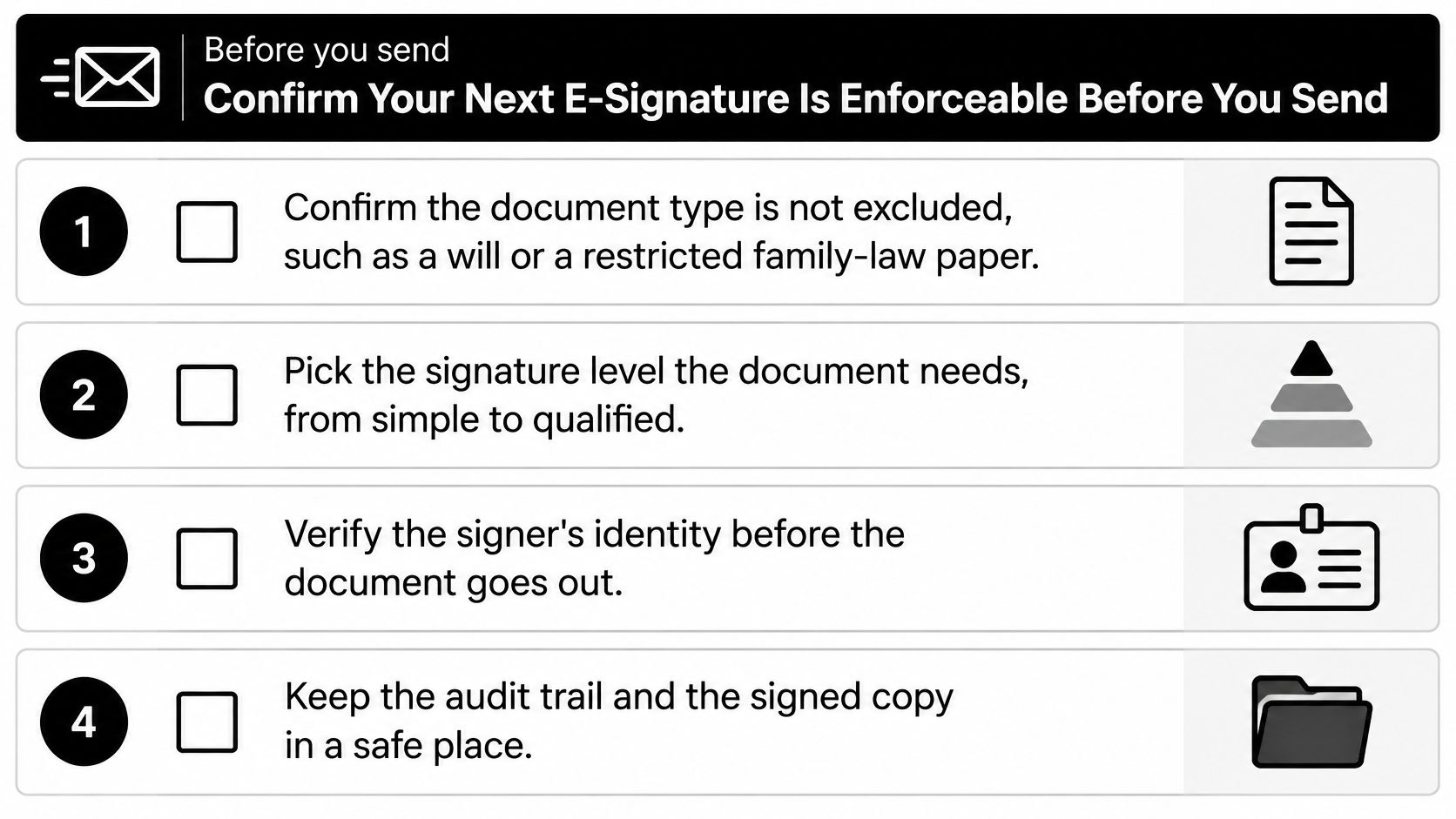
An e-signature is only as strong as the proof around it. Treat it like a wet signature plus a security camera: the mark shows agreement, and the record shows who clicked, what they saw, and whether the file changed afterward.
Run this list before the file leaves your outbox.
- Confirm the document type is allowed electronically, and keep wills, some family-law papers, and other excluded filings out of the e-sign path.
- Match the signature level to the risk: simple for NDAs and offer letters, advanced for vendor agreements and healthcare consents, qualified for EU regulated filings.
- Collect documented consent wherever electronic delivery is legally required.
- Verify the signer with at least a verified email, and add a one-time passcode when a deal may be challenged later.
- Keep the original signed PDF and the full audit trail for the period the law requires.
- Store everything in one system so the proof package can be produced quickly.
Recipients can open, review, and sign using any standard email address, without needing a Google Account. BoloSign customers sign more than 150K documents per month, so the workflow has to hold up as a routine habit rather than a one-off PDF.
If clause risk is beyond an operations check, read Kons Law's note on when to call outside contract counsel before treating software as a substitute for advice. For the signing path itself, BoloSign combines contract lifecycle management, eSignatures, and AI in one platform; its AI can turn contract fields into dynamic questionnaires that business teams complete to provide contract inputs without legal back-and-forth, then route the file to the right signer. To see whether a simple or advanced path fits your next contract, visit BoloSign and run a live document through its digital signing workflow.

Paresh Deshmukh
Co-Founder, BoloForms
17 Nov, 2026
Take a Look at Our Featured Articles
These articles will guide you on how to simplify office work, boost your efficiency, and concentrate on expanding your business.