
Your Guide to Enterprise Document Management Simplified
Discover how enterprise document management streamlines workflows. Learn key features, security benefits, and how to choose the right system for your business.

Tired of nonsense pricing of DocuSign?
Start taking digital signatures with BoloSign and save money.
Picture your business like a library. But instead of neat, organized shelves, your critical documents are scattered everywhere—stuffed in random file cabinets, piled on desks, and buried deep within endless email threads. An Enterprise Document Management (EDM) system is the expert librarian that steps in to tame this chaos. It's a smart system built to manage the entire life of your business documents, from the moment they’re created and reviewed to when they're securely signed and archived.
Why Enterprise Document Management Matters
Don't mistake an EDM for just another cloud storage folder. While tools like Google Drive are great for simply holding files, an EDM is engineered to manage the processes that revolve around those files. It creates a single, secure, and searchable home for all your critical information, finally putting an end to the madness of scattered documents.
Just think about all the document-heavy tasks your team handles every day. A professional services firm juggles client contracts, a healthcare provider processes patient intake forms, and a logistics company manages proof-of-delivery receipts. Without a proper system, these workflows are painfully slow, riddled with human error, and full of security holes.
The Shift from Manual to Automated
The real power of an enterprise document management system is its ability to automate and lock down these critical workflows. Forget manually emailing a contract for review, then chasing a signature, and finally remembering to save it to the right shared drive. An EDM handles that entire sequence for you.
This structured approach is exactly why the global market for these systems is exploding. The enterprise document management system market is expected to hit a staggering $29.78 billion by 2034, as large companies race to invest in data security, workflow automation, and solutions that can grow with them. You can learn more about these market findings to see the trend for yourself.
To get a clearer picture, let's compare the old way with the new way.
Manual vs Enterprise Document Management Workflows
The difference between wrestling with manual tasks and using an automated EDM system is night and day. One is a recipe for delays and mistakes, while the other is built for speed and accuracy. This table breaks down just how much changes when you make the switch.
| Task | Manual Process (Without EDM) | Automated Process (With EDM) |
|---|---|---|
| Contract Approval | Emailing the contract back and forth to multiple people, losing track of versions. | The contract is automatically routed to approvers in a set order with deadline reminders. |
| Invoice Processing | Printing invoices, physically walking them to the finance department, and manually entering data. | Invoices are scanned, data is automatically extracted, and they are routed for approval digitally. |
| Onboarding New Hires | HR sends a dozen separate emails with forms to fill out, sign, and return. | A new hire receives one link to a secure portal with all forms ready for e-signature. |
| Document Retrieval | Searching through multiple shared drives, email inboxes, and local folders, hoping to find the right version. | A quick keyword search in a central repository instantly pulls up the correct, most recent document. |
| Compliance Audit | Manually pulling together documents from various locations and trying to prove who did what, and when. | An unchangeable audit trail is automatically generated for every document, ready for auditors in seconds. |
As you can see, an EDM doesn't just store files; it fundamentally changes how work gets done, eliminating bottlenecks and freeing up your team to focus on what really matters.
A modern EDM platform helps your business:
- Improve Efficiency: Automate the boring stuff like document routing, approval requests, and notifications. Your team gets more time back for high-impact work.
- Enhance Security: Use granular access controls to make sure only the right people can see or edit sensitive information—a must-have in fields like healthcare and finance.
- Ensure Compliance: Keep a complete, tamper-proof audit trail of every single document interaction, from creation to signing, to meet standards like HIPAA, GDPR, and ESIGN.
- Eliminate Version Control Issues: Create a single source of truth for every document. Your team will always be working on the most up-to-date version, no questions asked.
This shift isn't just about going paperless; it's about making your information work for you. An EDM turns your static files into dynamic assets that drive business processes forward, securely and efficiently.
Ultimately, adopting an enterprise document management strategy is about regaining control. Platforms like BoloSign make this transition smooth by offering a powerful yet affordable solution. With BoloSign, you can easily create, send, and sign PDFs online, all while getting the benefits of AI-powered automation and enterprise-grade security. It’s designed to bring order to your document chaos without the sticker shock or complexity of older systems.
The Core Features of a Modern EDM System
To really get what an enterprise document management system does, you have to look beyond the idea of just "digital storage." A modern EDM isn't a passive digital filing cabinet; it’s an active, intelligent platform that manages the entire lifecycle of your documents. From the moment a file is created to the final, secure signature, these core features are what turn a simple repository into a command center for efficiency and control.
Think of it as the shift from a chaotic, messy desk to a perfectly organized, secure workspace where everything is exactly where it needs to be.
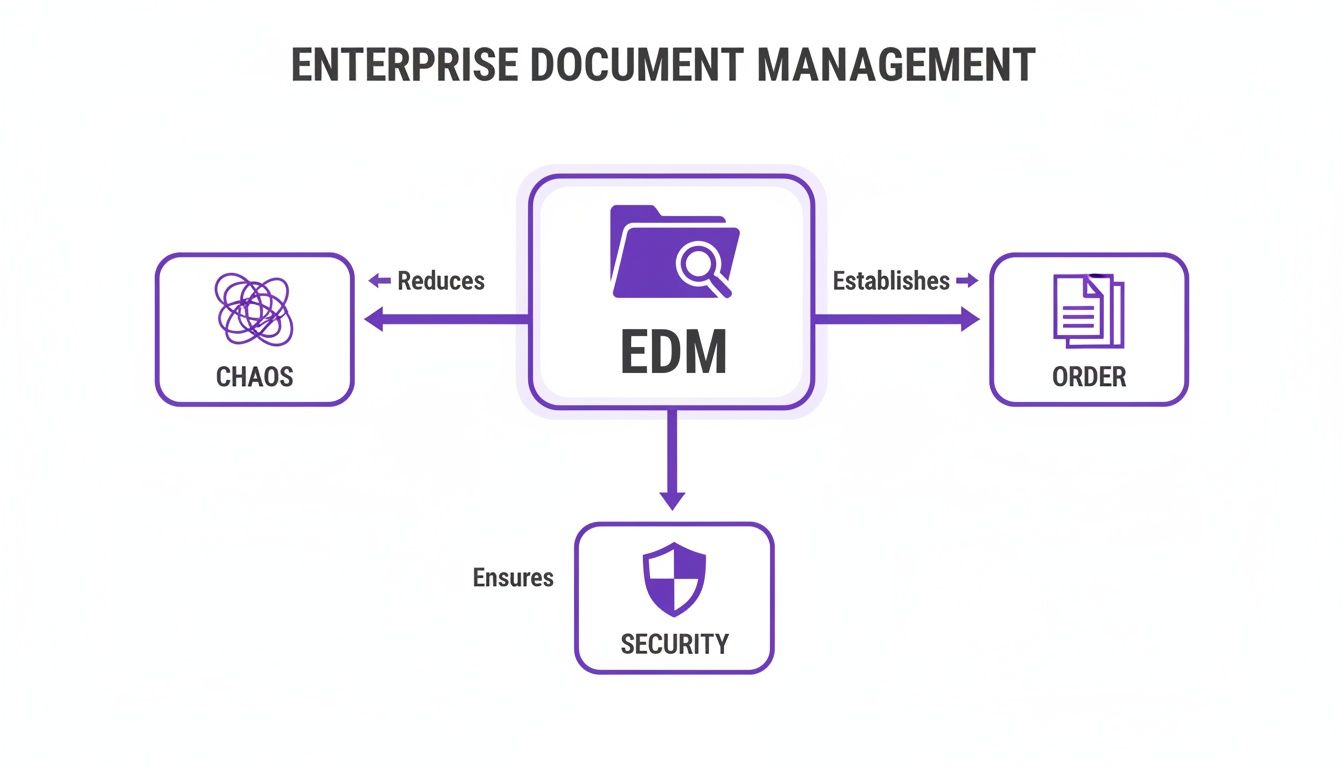
This is the fundamental promise of an EDM: transforming disorganized, vulnerable files into a centralized system that enforces order and protects your most sensitive information. Let's dig into the key features that make this happen.
Version Control and Audit Trails
Have you ever wasted half an hour digging through emails for "contract_final_FINAL_v3.docx"? Version control puts an end to that nightmare. It makes sure everyone is working from the single, most current version of a document while keeping a complete history of every single edit.
This is a game-changer for collaborative projects. Imagine a real estate firm managing a purchase agreement. They can track every single change made by the buyer, seller, and their lawyers. Each tweak is logged, creating a clean, undisputed record of the entire negotiation.
Just as critical are audit trails. A solid EDM gives you a detailed, unchangeable log of every action taken on a document—who viewed it, who edited it, who signed it, and exactly when. This creates an ironclad record for compliance. In BoloSign, for example, every document comes with a comprehensive audit trail that meets strict legal standards like ESIGN and eIDAS, giving you a full history of every interaction.
Secure Access and Permissions
Not everyone in your company should see every file. That’s just common sense. Modern EDM systems give you granular control, letting you define precisely who can view, edit, share, or delete specific files or entire folders. For any industry handling sensitive information, this isn't just a nice-to-have; it's non-negotiable.
- Healthcare providers can lock down patient records so only authorized medical staff can see them, ensuring HIPAA compliance.
- A professional services firm can restrict access to confidential client data to only the assigned project team.
- Education institutions can control who sees student records, protecting privacy under regulations like FERPA.
This level of control stops accidental data leaks in their tracks and protects your organization from both internal and external threats.
Advanced Search and Retrieval
When your documents are scattered across shared drives, email inboxes, and local computers, finding what you need feels like a treasure hunt without a map. An effective EDM system changes all that with powerful search tools that go way beyond just looking at filenames.
A centralized system with advanced search turns your document archive from a "needle-in-a-haystack" problem into a powerful, accessible knowledge base.
You can search by keywords inside the document itself (full-text search), by metadata like the author or creation date, or by custom tags you create. This means a logistics manager can instantly find all proof-of-delivery slips from a specific client in a particular month, saving hours of tedious manual searching.
Automation and Digital Signing Solutions
The real magic of a modern EDM lies in workflow automation. This is where the system starts doing the work for you, automatically routing documents for review, approval, and signature. Platforms like BoloSign are built for this, letting you create, send, and sign PDFs, templates, and forms quickly.
For instance, a staffing agency can automate its entire onboarding process. When a new hire accepts an offer, the system automatically sends them the full packet of forms to fill out and sign. With BoloSign, they can easily sign PDFs online with a legally binding eSignature, and the system automatically pings HR when everything is complete. This is just one of many capabilities you can explore in the BoloSign feature set.
How Automated Workflows Transform Your Organization
The real power of an enterprise document management system isn't just about storing files—it's about making those files move. This is where we shift from features to organization-wide impact, seeing how an effective EDM strategy becomes the engine driving your efficiency. Automation is the key that unlocks this potential, turning slow, manual processes into fast, intelligent, and reliable workflows.
Think of your document processes as a relay race. Without automation, every handoff is manual. Someone has to physically or digitally pass a document to the next person, explain what's needed, and then just… wait. If one person drops the baton—gets busy, misses an email, or forgets—the entire race grinds to a halt.
Automated workflows act like a perfectly synchronized team, where the baton is passed instantly and accurately, every single time.
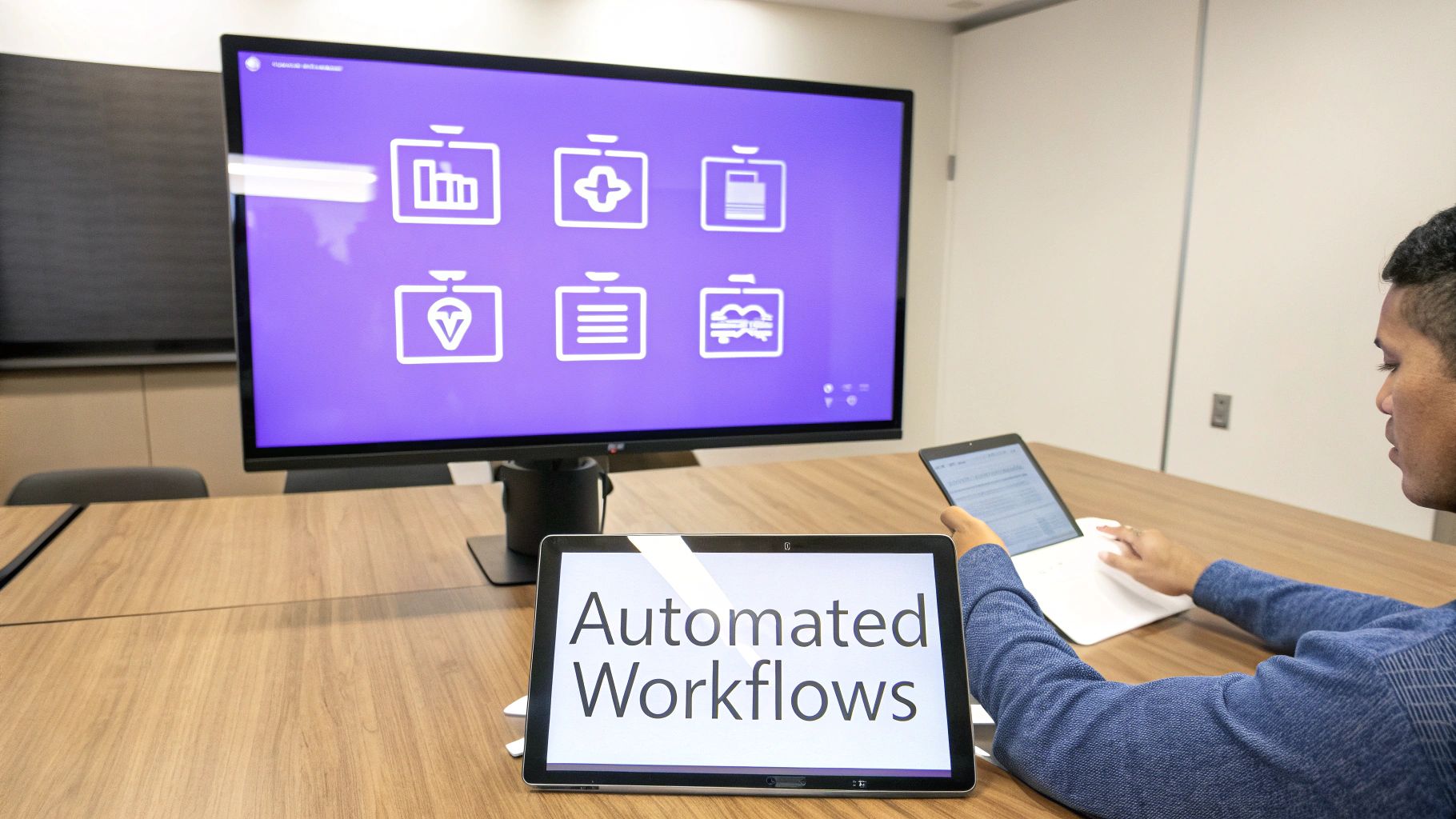
This isn't just a minor improvement; it’s a fundamental change in how work gets done. The ability to automatically route documents for approvals, collect eSignatures, and send notifications vaporizes bottlenecks and human error.
Putting Automation into Practice
Let's look at how this plays out in a few high-demand sectors. These examples show how a digital signing solution can completely reshape day-to-day operations.
- Staffing Agencies: Onboarding a new candidate involves a mountain of paperwork—contracts, tax forms, policy acknowledgments. Instead of juggling a dozen separate attachments, an agency can trigger an automated workflow. The moment a candidate is marked as hired, a complete onboarding packet is sent out, with automatic reminders ensuring nothing falls through the cracks.
- Logistics Companies: Proof-of-delivery (POD) documents are the lifeblood of logistics. A driver gets a signature on a mobile device, and the signed POD is instantly uploaded, filed, and sent to the finance department to trigger an invoice. That one automated step accelerates the entire cash flow cycle.
- Healthcare Providers: Patient intake is critical but often painfully slow. With an automated workflow, patients can fill out and sign all necessary consent and history forms securely online before their appointment. The completed forms are then automatically filed in their electronic health record, ready and waiting for the doctor.
In every scenario, automation does more than just speed things up. It creates a consistent, repeatable process that ensures compliance and frees your team from the thankless job of chasing paperwork.
From Simple Routing to Intelligent Action
Modern contract automation goes far beyond just sending a document from point A to point B. It’s about building intelligence into the process itself.
For instance, you can design a workflow where a contract is first sent to the legal team for review. Once they approve it, it automatically goes to the finance department. Only after finance gives the green light is it routed to the client for their eSignature.
Automation is the difference between having a digital library and having a team of digital librarians who work 24/7 to manage your processes, ensure accuracy, and keep your business moving forward.
This level of control is why the market for business document workflow management is exploding. Valued at USD 4.53 billion in 2025, this market segment is projected to climb to an incredible USD 16.08 billion by 2035. This rapid growth is fueled by enterprises shifting to paperless, remote-first models and standardizing their core processes.
Platforms like BoloSign are at the forefront of this shift, offering smart, AI-powered automation that makes setting up these workflows surprisingly simple. You can create reusable templates and fire off multi-recipient signature requests in just a few clicks. You can even connect tools you already use, like learning how to add signature to Google Form to capture signed agreements effortlessly. The whole experience is designed to be intuitive, allowing you to build a powerful automated approval workflow system without needing a team of developers.
By bringing these automated systems on board, you're not just buying software; you're investing in a more efficient, secure, and strategic way of operating.
Ensuring Ironclad Security and Compliance
When it comes to enterprise document management, security and compliance aren't just features—they're the bedrock of the entire system. You're handling everything from sensitive client contracts to private patient records, and that requires a platform that actively shields your data from prying eyes while keeping you on the right side of strict regulations. Without that, your digital files become a massive liability.
Think of it like a bank vault. You wouldn't store priceless assets in a simple lockbox with one flimsy key. No, you’d demand multiple layers of protection: reinforced walls (encryption), constant surveillance (access logs), and a meticulous record of everyone who comes and goes (audit trails). A modern EDM system is the digital equivalent of that vault for your most critical information.
This level of protection is non-negotiable for navigating today's complex web of global regulations. And it's not just about the final system; ensuring airtight security during implementation or migration is just as crucial. If you're moving platforms, this battle-hardened guide to SharePoint migration security is a must-read for understanding what a secure transition truly involves.
Demystifying Key Compliance Standards
Worrying about regulatory standards can feel overwhelming, but a good EDM platform takes the pressure off by baking the rules right into its DNA. Here’s a quick rundown of what some of the big ones mean for your documents.
- ESIGN & eIDAS: These are the legal frameworks that make electronic signatures legit in the United States and the European Union. A compliant platform ensures every eSignature is captured with a secure, verifiable audit trail, giving it the same legal clout as a pen-and-ink signature.
- HIPAA: The Health Insurance Portability and Accountability Act is the gold standard for protecting patient health information in the US. For anyone in healthcare, an EDM system must have rock-solid access controls and end-to-end encryption to prevent costly data breaches.
- GDPR: The General Data Protection Regulation dictates data privacy for EU citizens. This means your document system has to manage personal data securely, honor "right to be forgotten" requests, and meticulously track every single action taken with that data.
A truly compliant system handles all these technical details in the background, so you can just focus on getting your work done.
With the right platform, top-tier compliance isn't a costly, complex add-on; it's a core, built-in feature that protects your business from day one.
How BoloSign Delivers Enterprise-Grade Security Affordably
This is exactly where BoloSign changes the game. We built it from the ground up understanding that world-class security and compliance are non-negotiable, whether you're a growing staffing agency in Canada or a major university in the UAE. BoloSign offers a complete digital signing solution that meets major global standards like ESIGN, eIDAS, HIPAA, and GDPR.
Every document you run through BoloSign is guarded by AI-powered automation and secure workflows. This includes a complete, unchangeable audit trail that logs every single interaction—from who viewed it and when, to who edited it, to the final signature. This makes proving compliance dead simple and gives you an ironclad record for any legal or regulatory challenge.
But here’s the best part: this enterprise-level security is included at one straightforward price. Unlike legacy tools that hide these essential features behind outrageously expensive enterprise plans, BoloSign makes them available to everyone. This approach makes it up to 90% more affordable without ever cutting corners on the security your business relies on.
Ready to see how simple and secure document management can be? Start your 7-day free trial of BoloSign today and experience firsthand how easy it is to protect your critical information.
How to Choose the Right EDM Solution
Picking the right enterprise document management system can feel like a huge undertaking. But if you break it down, the whole process gets a lot clearer. It’s not just about a long list of features; it's about finding a system that actually fits your budget, plays nice with the tools you already use, and can grow with you without sending your costs through the roof.
Your goal is to find a platform that solves problems, not one that creates new ones with confusing pricing or a massive learning curve. The right tool should feel like a natural extension of your team, making everyone’s job easier from day one.
Look Beyond the Feature List
Sure, things like version control and automated workflows are non-negotiable. But the real value is in how a system solves your specific business challenges. A platform can have every bell and whistle imaginable, but if it's a nightmare to use or gets wildly expensive as you scale, it's not going to work.
Instead, focus on these practical points:
- Ease of Use: Can your team jump in and start using it with minimal hand-holding? A clean, intuitive interface is everything for quick adoption.
- Scalability: Will the system keep up as you grow? You need a platform that can handle more documents and more complex workflows without a sudden, painful price hike.
- Integration Capabilities: Does it connect with the software you rely on every day? Smooth integrations with tools like Salesforce, HubSpot, and Google Drive are vital for keeping information flowing across your whole company.
Unmasking the True Cost of Ownership
Pricing is a massive factor, but it’s often the murkiest part of the deal. Many traditional EDM vendors use pricing models that look great upfront but get expensive fast as your team or document volume grows.
Watch out for these common pricing traps:
- Per-User Fees: This model basically punishes you for hiring. Every new team member adds another recurring cost.
- Per-Envelope or Per-Signature Fees: This approach makes your costs totally unpredictable. It can even make your team hesitant to use the system to its full potential for fear of racking up a huge bill.
This is exactly where BoloSign offers a completely different, refreshingly clear approach. We believe in simple, transparent pricing. BoloSign gives you unlimited documents, unlimited team members, and unlimited templates for one flat, fixed price. This straightforward model makes it up to 90% more affordable than the old-school tools and gives you total freedom to use the platform without ever worrying about surprise costs.
The best EDM solution empowers your growth, it doesn't penalize it. A predictable, fixed-cost model eliminates budget surprises and allows you to scale your operations with confidence.
The Power of a Unified Platform
The enterprise document management market is exploding for a good reason. Large companies, which make up nearly 67% of the market, are investing heavily in scalable and secure workflows. As the global market expands from USD 7.68 billion in 2024 to a projected USD 18.17 billion by 2030, the need for powerful yet affordable alternatives for growing businesses is more critical than ever. You can get more insights on this trend in this article on enterprise document management systems and see why smart tools are essential to stay competitive.
Choosing a platform that combines core EDM functions with a powerful eSignature capability is a huge strategic advantage. Instead of paying for separate tools for document storage, workflow automation, and digital signing, a unified solution like BoloSign gives you everything in one spot. You can create, send, and sign PDFs online with a legally binding signature, all inside a single, secure environment. This doesn't just save you money; it simplifies your tech stack and removes friction for your team.
At the end of the day, the right choice comes down to real value. By prioritizing a transparent pricing model, seamless integrations, and a user-friendly interface, you can find an EDM solution that genuinely helps your business thrive.
Ready to see how a simple, affordable, and secure platform can change your document workflows? Start your 7-day free trial of BoloSign and experience the difference for yourself.
Getting Started with Your New Document System
Rolling out a new enterprise document management system might seem like a huge undertaking, but it doesn't have to be. With a clear plan, it's a surprisingly smooth and manageable process. A great launch is about more than just technology—it's about getting your team and your data ready for a much smarter way to work.
The whole journey really starts with a solid plan. Before you even think about moving a single file, you need to map out your document migration, figure out who gets access to what, and create a training plan that actually gets people excited to use the new tools. Nailing this upfront planning is the secret to getting everyone on board quickly and successfully.
A Simple Roadmap for a Smooth Transition
The best way to tackle implementation is to break it down into smaller, more digestible steps. This approach takes the overwhelm out of the equation and makes sure no detail gets missed. Think of it as a logical path, moving from planning and setup to training and, finally, measuring your success.
Here’s a practical, step-by-step approach to guide your rollout:
Plan Your Document Migration: The first thing you need to do is decide what's coming with you. Let’s be honest, not every old file needs to make the trip. Focus on what’s active and essential—things like current contracts, key client files, and important HR records. For platforms like BoloSign, this is incredibly straightforward. You can use the one-click import feature to bring your existing DocuSign templates over instantly, which saves countless hours of manual setup.
Set Up User Roles and Permissions: Next, define who needs access to what. A healthcare administrator obviously needs different permissions than a sales rep. Setting up these roles from the very beginning is crucial for keeping your data secure and your workflows clean and organized.
Train Your Team for Quick Adoption: Forget long, boring training sessions. Schedule short, hands-on meetings that focus on real-world tasks. Show your team exactly how to create, send, and sign PDFs online in a way that’s relevant to their day-to-day job. A user-friendly platform makes a world of difference here, dramatically cutting down the learning curve.
The real goal of implementation isn't just to launch a new piece of software. It's to embed a more efficient way of working right into your company's DNA.
Once you’re up and running, you have to track your progress. Start measuring key metrics like how long it takes to get documents signed or how many contracts you process each week. When you see those numbers improve, you've got clear proof of your ROI, which helps build momentum across the company.
With a platform like BoloSign, this whole process is designed to be as painless as possible. Its intuitive design and powerful features mean you can get started without all the usual headaches. Ready to see for yourself? Start your 7-day free trial today and discover a simpler, more affordable, and secure way to handle your documents.
Frequently Asked Questions
Jumping into the world of enterprise document management can feel like learning a new language. Let's clear up some of the most common questions with straightforward answers to help you figure out how these systems work and what really matters in a modern platform.
How Is an EDM System Different from Cloud Storage?
Think of cloud storage like Google Drive as a digital filing cabinet—it’s great for holding files. An enterprise document management (EDM) system is more like an intelligent office manager for those files.
It doesn't just store documents; it manages their entire lifecycle. This means adding smarts with things like automated workflows, iron-clad version control, granular security permissions, and legally binding audit trails. A platform like BoloSign can work with your cloud storage, but it turns those static files into active, manageable business assets.
Are EDM Systems Affordable for Small Businesses?
They absolutely are now. The old, clunky systems were notorious for their hefty price tags, but modern solutions have completely changed the game.
For instance, BoloSign was built to be both powerful and budget-friendly. We break the mold with a simple fixed-price model that includes unlimited documents, team members, and templates. This gets rid of the unpredictable per-user fees that make other tools so expensive, finally putting enterprise-level features in reach for businesses of any size.
How Long Does It Take to Implement an EDM System?
Forget the long, drawn-out IT projects of the past. With today's cloud-based platforms, you can be up and running incredibly fast.
An intuitive system like BoloSign is designed so you can get started in minutes, not months. We built it for simplicity, and features like one-click template imports from other services make the switch feel almost effortless. A great system should slide right into your existing workflow, not blow it up.
What Security Features Should I Look For?
This is non-negotiable. Always look for enterprise-grade security that covers all the bases: data encryption (both when it's moving and when it's stored), secure access controls, and compliance with major global standards like ESIGN, HIPAA, and GDPR.
A complete, unchangeable audit trail is also critical. It’s what makes your documents legally admissible and is a cornerstone of any trustworthy digital signing solution.
The right platform doesn't treat security as an expensive add-on. It should provide all these protections as standard, ensuring your documents are safe without forcing you to pay extra for the essentials.
BoloSign includes all of these security measures as part of its core platform, giving you peace of mind from day one.
Ready to see how a simple, affordable, and secure platform can completely change your document workflows? With BoloSign, you and your entire team can create, send, and sign unlimited documents for one flat price.
Experience the future of enterprise document management by starting your 7-day free trial today.

Paresh Deshmukh
Co-Founder, BoloForms
14 Feb, 2026
Take a Look at Our Featured Articles
These articles will guide you on how to simplify office work, boost your efficiency, and concentrate on expanding your business.