

Compliance Management: A Practical Guide for 2026
Learn how compliance management works: frameworks, workflows, roles, metrics, and how CLM and eSignatures like BoloSign keep contracts audit-ready.

Tired of nonsense pricing of DocuSign?
Start taking digital signatures with BoloSign and save money.
A staffing agency sends temporary-worker agreements for signature every week. Each file needs the right-to-work check, the right data-processing terms, and a renewal date someone will actually monitor. If those details live in separate inboxes and spreadsheets, a missed step can put a client relationship or the business at risk.
That's the practical challenge behind compliance management: turning obligations into routine work that has a clear owner and reliable proof. The aim isn't to make every employee a legal expert. It's to help people complete the right checks, at the right time, and leave a record showing what happened.
What Compliance Management Means in Practice
Compliance management is the repeatable system an organization uses to turn legal, contractual, and internal obligations into owned tasks, operational controls, and evidence. Think of a building inspector. The building code sets the standard, but the inspection record for each floor helps show whether the standard was followed. A policy alone is like the code on the shelf. The everyday checks and records make it operational.
The system has three connected parts:
- Obligations: What must be true, based on laws, contracts, and internal policy. A staffing agency may need to verify worker eligibility, protect personal information, and track agreement renewals.
- Controls: The work steps that help make those obligations true. For example, a required review of data-processing terms before a client agreement can be sent.
- Evidence: The record showing a control happened. That might be a timestamped approval, a completed check, a signed agreement, or a documented exception.
If one part is missing, the chain weakens. A requirement with no owner can be forgotten. A control with no evidence is hard to verify. And evidence that isn't connected to the relevant agreement may not help anyone answer an audit question.
Compliance is part of the operating budget
Compliance work doesn't sit only with lawyers or a dedicated compliance team. HR checks worker documents, procurement reviews vendors, sales handles customer terms, and operations follows process controls. The OECD analysis of regulatory compliance costs and productivity found that regulation-related tasks consumed 4.2% of U.S. wage expenditure in 2024, compared with 4.0% in 2012. Its comparable employment-based indicator for Europe increased from 3.7% in 2011 to 3.9% in 2023, while Australia remained approximately stable at 4.5%.
Those figures make compliance a measurable operating cost, not a side task that appears only when a regulator asks questions. When teams rely on manual checks and repeat work across disconnected systems, that effort can scale with the business. A well-designed process aims to make the work clearer and more consistent, while improving the quality of records teams keep.
Quick test: Name one obligation, the control that addresses it, and the evidence that proves the control happened. If any link is unclear, start there.
Frameworks That Set Your Obligations
| Framework | Region | Applies to | What it requires in practice |
|---|---|---|---|
| ESIGN Act | United States | Electronic signatures and records | Signatures can't be denied effect solely for being electronic; retained records must stay accurate and reproducible |
| eIDAS | European Union | Electronic signatures and trust services | Simple, advanced, and qualified signature levels have different legal weight |
| GDPR and UK GDPR | EU, EEA, and UK | Personal data of people in those markets | Lawful basis, processing terms, retention limits, and security measures |
| HIPAA | United States | Protected health information | Privacy and security safeguards, access controls, audit records, and business associate agreements |
| CCPA and CPRA | California, United States | Personal data of California residents | Privacy notices, opt-out rights, and service-provider contract terms |
| PIPEDA | Canada | Personal information in commercial activity | Consent, accountability, and appropriate safeguards |
| Privacy Act 1988 | Australia | Personal information held by covered entities | Australian Privacy Principles covering notice, security, access, and overseas disclosure |
| Privacy Act 2020 | New Zealand | Personal information | Information privacy principles and mandatory breach notification |
| SOC 2 | United States, AICPA | Service organizations handling customer data | Independent auditor report on security, availability, and confidentiality controls |
A useful way to find the frameworks that matter is to start with where you operate, then check your sector, then consider the personal or sensitive information you handle. A staffing firm in Toronto that serves EU clients may need to consider both Canadian privacy obligations and GDPR requirements. A Texas clinic handling patient records may need to account for HIPAA and applicable state privacy law. Businesses often have more than one framework to map.
Turn a rule into a daily requirement
The U.S. ESIGN Act says an electronic signature, contract, or record can't be denied legal effect solely because it's electronic. It also requires retained electronic records to accurately reflect the original information and remain accessible to entitled parties for the required retention period in a form that can be accurately reproduced.
In practice, that means a company sending an agreement as a PDF needs a process for preserving the completed document and its supporting records, not just a signature image. Consent, identity, access, and retention arrangements still need to fit the transaction and any other applicable rules. For an overview of how regulatory obligations can affect financial communications, Advisor Momentum's guide to regulatory compliance in bank marketing offers useful context.
Keep one framework register that names each applicable framework, the contracts and processes it touches, and the person accountable for keeping the mapping current. For a closer look at how privacy requirements can shape contract terms, see this guide to GDPR and contract management. Treat binding laws and regulations differently from voluntary standards such as ISO/IEC 27001:2022 and SOC 2, which customers may still expect a supplier to meet or demonstrate.
Who Owns Which Part of Compliance
Compliance breaks down when everyone assumes someone else owns the obligation. A clear role map names one accountable person for each task, even when several people contribute.
| Role | Accountable for | Evidence it produces |
|---|---|---|
| Executive sponsor (CEO, CFO, or General Counsel) | Budget, risk appetite, and final sign-off on exceptions | Board-approved policy and annual compliance attestation |
| Compliance officer | Obligation register, control design, and monitoring | Control test results and exception log |
| Legal counsel | Interpreting obligations and approving clause standards | Clause library versions and interpretation memos |
| Contract owner (business unit lead) | Accurate contract data, renewals, and post-signature obligations | Completed intake record and renewal decisions |
| HR and people team | Worker documents, training, and right-to-work checks | Onboarding files and training completion records |
| IT and security | Access control, encryption, logging, and incident response | Access review reports and log retention records |
| Procurement and vendor management | Third-party due diligence and vendor terms | Vendor risk assessments and signed data-processing agreements |
| Frontline employees | Following controls at the point of work | Timestamped approvals and submitted forms |
A healthcare vendor handoff
Say a clinic is bringing in a new billing vendor. The contract owner requests the agreement and identifies what the vendor will do. Legal reviews the business associate terms, procurement completes due diligence, IT checks how the vendor will access systems, and the practice manager approves the final signature. Each person completes a distinct part of the chain.
The compliance officer designs and tests the controls that make the handoff reliable. The contract owner remains responsible for keeping agreement details accurate after signing, including renewal information and ongoing commitments. Those responsibilities shouldn't disappear once the document is filed.
An executive sponsor sets the budget, defines the organization's risk appetite, and signs off on exceptions. In a small business, one person may perform several roles. That's workable if each responsibility is written down, attached to the relevant process, and connected to the evidence it produces.
If a role produces no evidence, you can't audit whether its control worked. Fix the missing record or the missing ownership first.
The table is more than an organization chart. It's a practical test of whether each handoff ends with a record someone else can find and review. If an approval happens in a conversation but no one records the decision, the next person may not know whether to proceed, pause, or escalate.
How to Run a Compliance Workflow Step by Step
A compliance workflow is a loop, not a one-time project. The roles in the previous section give the work owners; these steps turn ownership into repeatable actions.
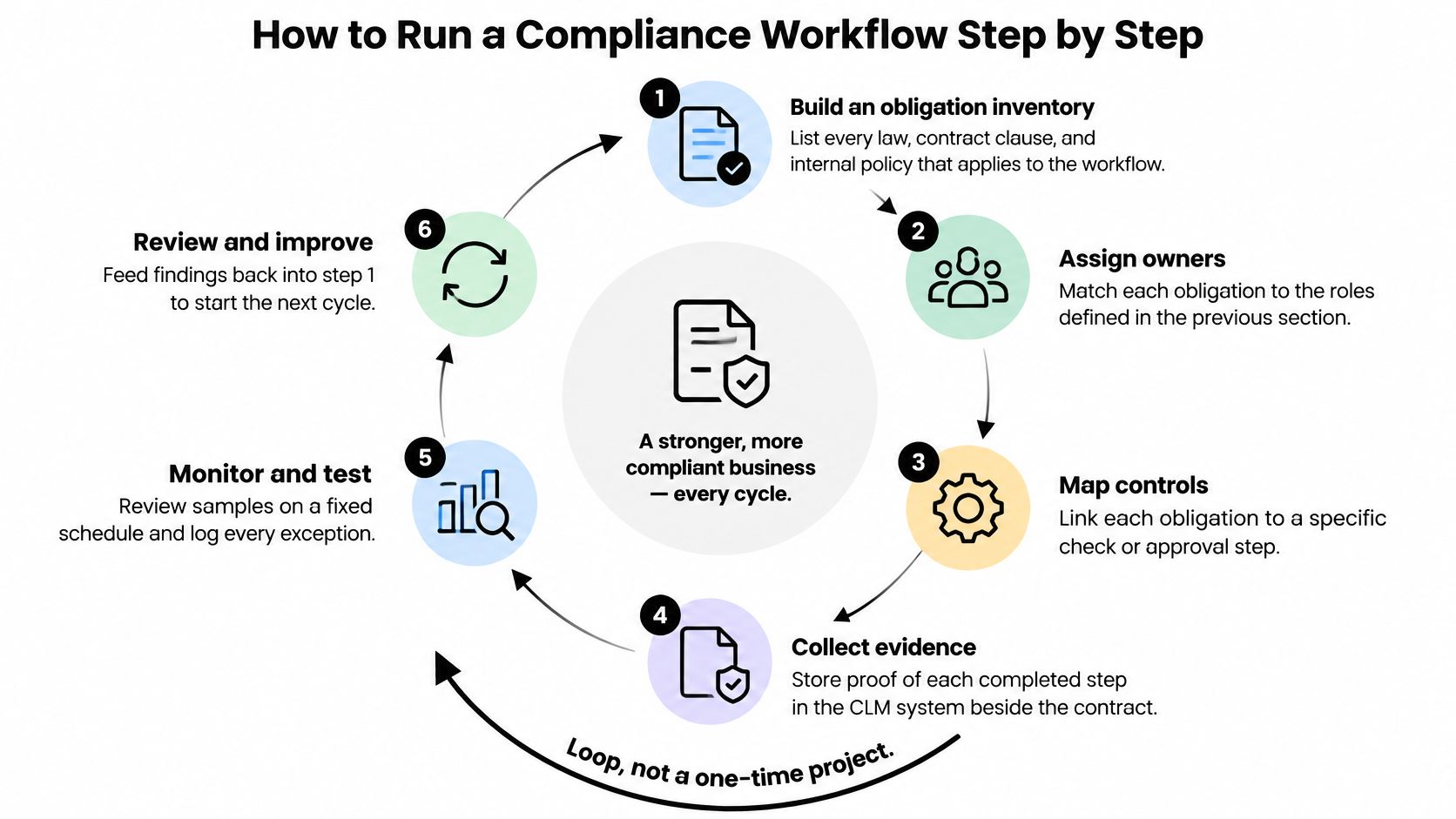
Build an obligation register. List each requirement, where it comes from, and which processes it affects. A logistics company might map carrier contracts to insurance checks, service terms, and data-handling requirements. A common mistake is recording the obligation without noting the process where it must be checked.
Assign one named owner to each obligation. Use the role map to choose an accountable person, not a general team name. A group can help, but one person needs to see that the task is completed and evidence is kept.
Translate each obligation into a control where the work happens. For example, require a check of safety or insurance terms before a logistics carrier agreement is sent. A policy that says “review vendor terms” is too vague if no one knows when the review happens.
Capture evidence at the moment of action. Record the date, approver, document version, and decision while the check is taking place. Reconstructing those details later is slower and less dependable.
Monitor continuously. Use expiry alerts, access reviews, and an exception queue to keep upcoming obligations visible. IBM's 2025 cost-of-a-data-breach analysis found an average global breach cost of $4.44 million across surveyed organizations. It also found that approximately one-third of organizations paid a regulatory fine after a breach, and 48% of those fines exceeded $100,000.
Escalate exceptions with a deadline. If a real estate agent's required disclosure form is missing, route it to the broker for a defined response, such as within one business day. An alert without an owner or deadline can sit untouched.
Review and update the process. Revisit the register regularly and revise it when laws, vendors, or templates change. Check whether controls are working, not just whether the process exists.
Steps five through seven turn monitoring into action. A continuous-monitoring cycle sets a strategy, establishes baselines, collects and reviews results, responds to deficiencies, and checks whether controls remain effective. A yearly audit can identify a problem after a deadline has passed; ongoing alerts and exception handling help a team spot it while there's still time to respond.
How CLM and eSignatures Support Compliance
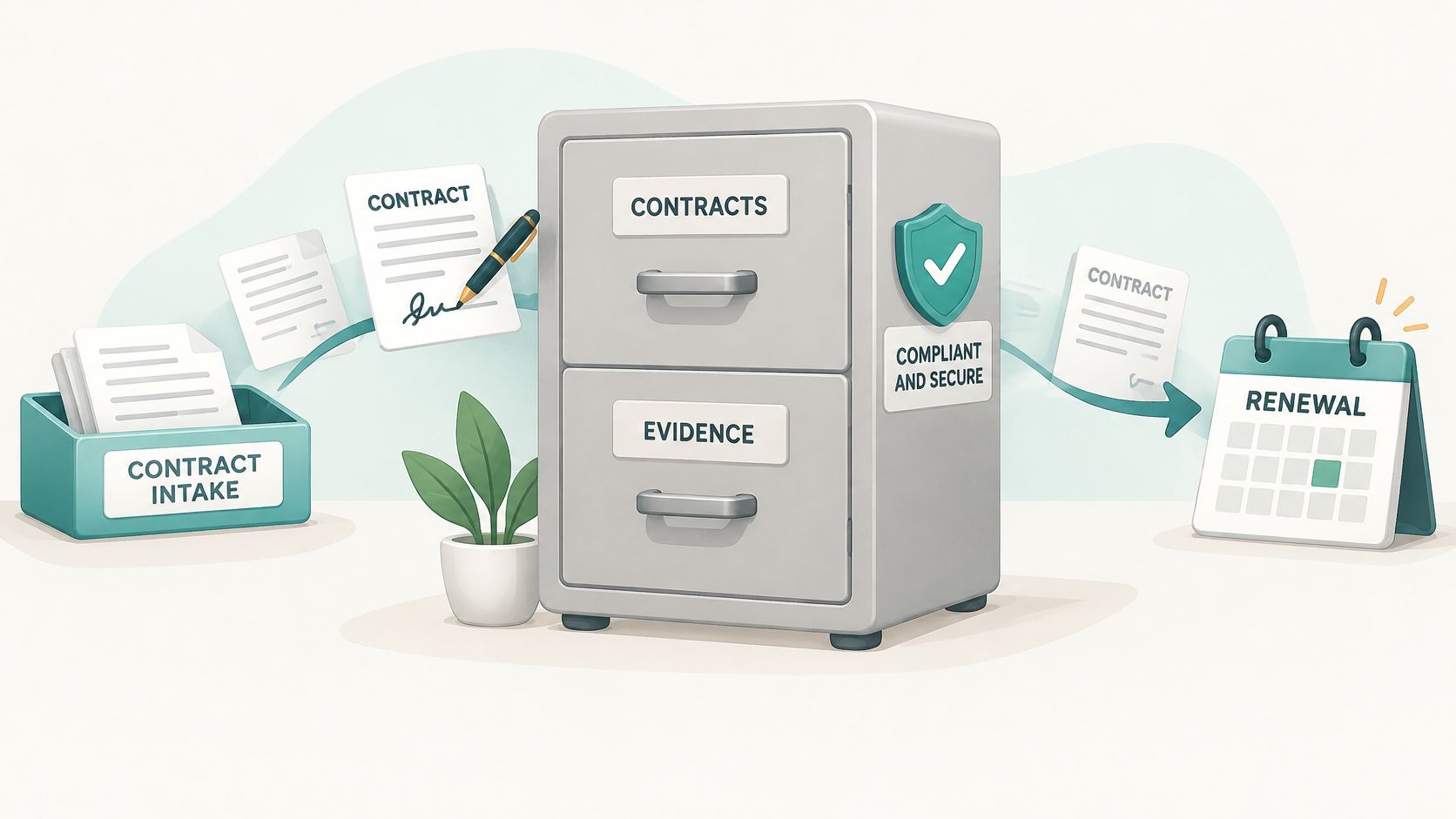
A signed agreement rarely proves much by itself. Auditors and managers usually need the chain around it: which obligation applied, which clause or form satisfied it, who approved any exception, who signed, and where the record lives. CLM works like a chain of custody for those decisions, keeping draft, approval, signature, and renewal evidence tied to the same agreement.
Consider an education provider that collects enrolment details through a Google Form. A student's submission can start a workflow that prepares an enrolment agreement, routes it for review only when answers trip a rule, and sends the PDF for signature. The signed copy and audit record then sit with the agreement, so staff can answer from the record when someone asks who approved and signed it.
The same sequence helps staffing teams create worker agreements from approved templates, healthcare providers route patient or vendor forms for signature, logistics operators track service agreements and renewal dates, and professional-services firms keep client terms connected to approval and execution records. In regulated workflows such as account opening or loan paperwork, e-signatures for financial services compliance follow the same logic: each step leaves evidence beside the document.
A CLM workflow can cover intake, drafting from approved clauses, review of non-standard language, approval routing, signature, storage, and renewal reminders. AI contract review can flag terms that differ from a playbook, but a person should review material findings before accepting a clause or changing a template. Contract intelligence is most useful when it helps reviewers find the relevant term and record the decision; legal judgment stays with named people.
Choose the signature level for the transaction
In the EU, eIDAS recognizes three signature categories, and their legal weight isn't identical. The European Commission's eSignature guidance says electronic signatures can't be rejected as evidence merely because they're electronic. A qualified electronic signature (QES) uses a qualified signature-creation device and qualified certificate, and it's the category explicitly recognized as having the same legal effect as a handwritten signature throughout the EU.
| Signature level | What it proves | Typical use | Legal weight in the EU |
|---|---|---|---|
| Simple electronic signature | Intent to sign, such as a click or typed name | NDAs, internal approvals, and low-risk forms | Admissible as evidence; not automatically equal to a handwritten signature |
| Advanced electronic signature | Signer is uniquely linked and identifiable, and the record is tamper-evident | Employment agreements, vendor contracts, and many commercial deals | Stronger evidence; must meet eIDAS technical requirements |
| Qualified electronic signature (QES) | Signature made with a qualified device and a qualified certificate | Regulated filings, high-value cross-border transactions, and deeds where required | Same legal effect as a handwritten signature across the EU |
A click-to-accept NDA and a cross-border property deed may call for different signing methods. Match the signature level to the transaction, jurisdiction, and legal advice. The practical test is evidence: would the signed record show who signed, what they accepted, and whether the file changed afterward? For a non-contract example of the same discipline, reducing compliance risk for church funds shows why finance teams assign owners and keep approval records close to the transaction.
Risks Where Compliance Programs Break Down
A compliance program can have polished policies and still be hard to operate. The common problem is fragmented information: the obligation is in one system, the contract in another, and the proof of approval somewhere else.
PwC's 2025 Global Compliance Survey found that 63% of respondents said complex, disaggregated organizational data made compliance more difficult, rising to 70% in North America. Respondents also identified data reliability and quality (56%) and data availability (47%) as major difficulties.
Four warning signs to look for
- Obligations are scattered. Requirements sit in contracts, HR systems, CRMs, shared drives, ticketing tools, and vendor records, with no links between them. First fix: choose one workflow and map each requirement to the system or record where staff must act on it.
- Templates go stale. Staff keep using old clauses after the organization's approved wording changes. First fix: maintain a controlled clause library, assign a reviewer, and record which version is approved for use.
- Renewal dates live in personal calendars. A departure or busy week can hide a notice deadline. First fix: record the date on the contract and route reminders to a named owner.
- Email attachments bypass approvals. Staff send a PDF directly to a signer without the required checks. First fix: make intake and approval routing part of the normal sending process, and keep the final signed copy with its approval history.
The shared remedy is an evidence chain: obligation source, affected business process, contract or record, responsible owner, approval history, exception, remediation deadline, and audit-ready proof. If the pieces don't connect, buying more policy material may not help a team explain why a specific agreement met its requirements.
For teams reviewing supplier workflows, this practical guide to a vendor risk management framework can help frame the checks that belong in the process. Start with one question: Which link in your evidence chain can't you prove today? That's where your program is most exposed.
Metrics That Show Compliance Is Working
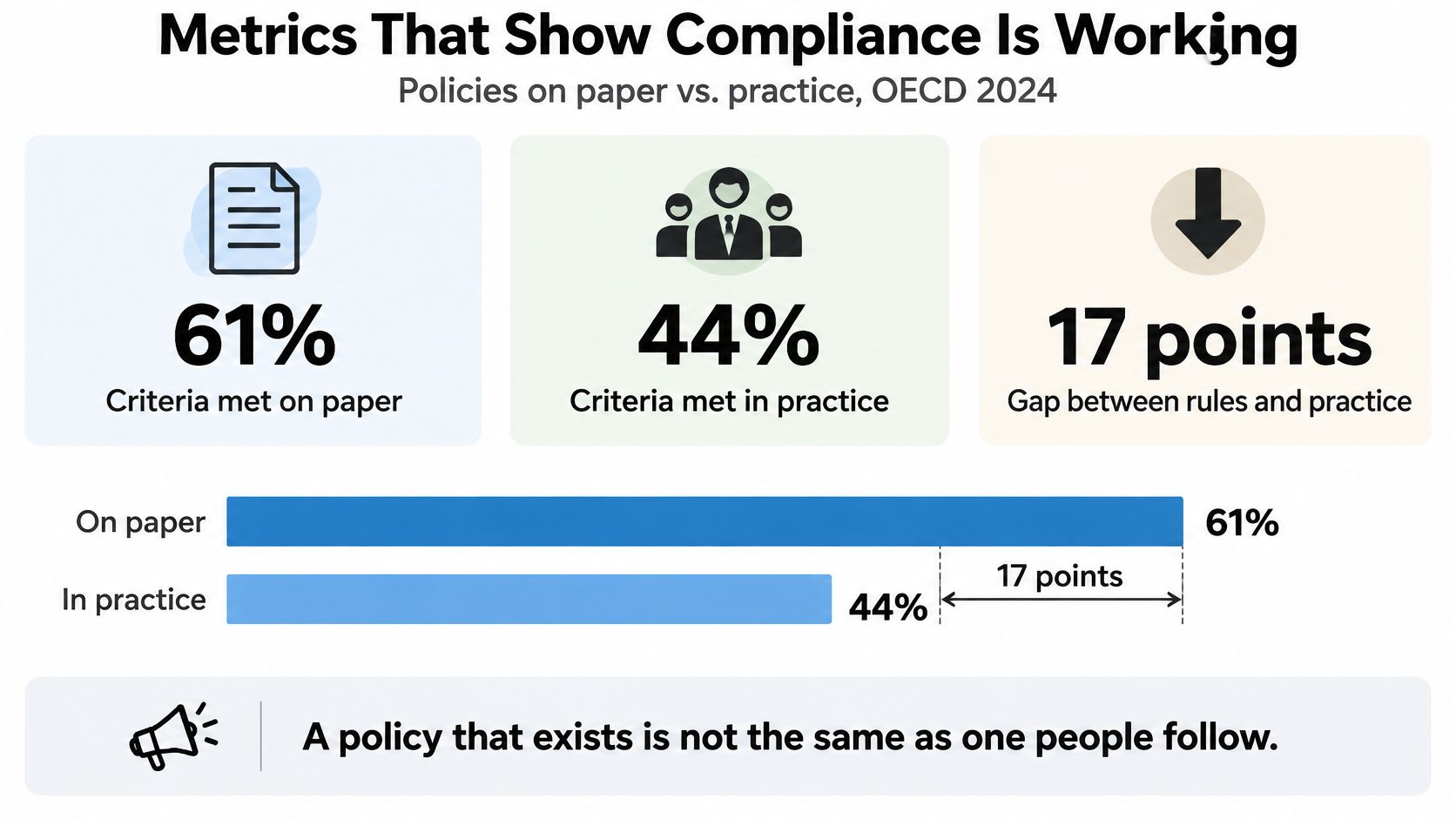
A policy that exists isn't the same as a control employees follow. The OECD's 2024 Anti-Corruption and Integrity Outlook reported that OECD countries met an average of 61% of established regulatory criteria, while implementation averaged 44%, a 17-percentage-point gap. Use that gap as a reminder to measure execution, not just documentation.
| Metric | How to calculate | Target or benchmark | Review cadence |
|---|---|---|---|
| Control implementation rate | Controls verified as working divided by controls documented | Rising each quarter; investigate any drop | Quarterly |
| Contracts with a named owner | Active contracts with an owner divided by total active contracts | All active contracts have a named owner | Monthly |
| Missed renewals and notice dates | Obligations past due divided by obligations due | Zero for high-risk contracts | Weekly |
| Exception closure time | Median days from flag to closure | Set per risk tier, such as five business days for high-risk items | Monthly |
| Complete audit trail rate | Signed envelopes with a full audit record divided by total signed | All signed envelopes have a complete audit record | Monthly |
| Intake-to-signature cycle time | Median days from request to fully signed | Falls without skipping review steps | Quarterly |
| AI flag accuracy | Sampled AI flags confirmed by a reviewer divided by sampled flags | Track false positives and their trend | Monthly |
Make the measures useful to decision-makers
Give each metric a named owner. Review operational measures monthly and leadership measures quarterly, looking for changes over time rather than demanding perfection from every measure at once. A board update can focus on three headline figures: the control implementation rate, missed renewals, and exception closure time, supported by a chart that shows the trend.
AI-assisted review needs a measure of its own. Sample flagged clauses each month, record how many a qualified reviewer confirms, and track false positives rather than treating every alert as a finding. That tells managers whether the tool is helping reviewers focus or creating noise.
A complete audit trail rate is also practical to automate in an eSignature workflow. Each signed envelope should be connected to its signer, timestamps, document version, approvals, and final record. By contrast, counting training completions alone measures activity, not whether employees followed the control in their work.
Start With One High-Risk Workflow This Quarter
Don't try to rebuild the company's entire compliance program at once. Choose one workflow where a missed step would matter, such as vendor agreements, customer contracts, or worker onboarding, and make that process traceable from obligation to evidence.

A practical rollout can follow a 30-60-90 day plan:
- First 30 days: Build the obligation register for the chosen workflow and assign a named owner to every requirement. Identify where approvals, records, and renewal information currently live.
- By day 60: Load approved templates, set approval routes, and define how exceptions are recorded. Test the process using real scenarios, including a missing document or a non-standard clause.
- By day 90: Turn on monitoring alerts and begin tracking the operational measures your team selected, so the workflow produces evidence you can review rather than assurances you have to take on trust.
Automation needs governance, too. Grant Thornton's 2026 cyber and risk survey reported that only 40% of business leaders were applying AI to regulatory-change monitoring, while 13% had broadly or fully deployed AI for regulatory compliance. AI-generated interpretations and contract flags should support human review, not replace it. Require a legal or compliance reviewer to approve material interpretations, version every template change, and test the downstream workflow before it goes live.
BoloSign can support the workflow by helping teams create, send, and sign PDFs, templates, and forms; review clauses with AI assistance; and keep agreement records together. Its stated support for ESIGN, eIDAS, HIPAA, and GDPR can help teams configure cross-border document workflows. Each obligation in the register ends up tied to a signed record, a named owner, and a timestamp.
Keep the first rollout narrow: choose a workflow, name its owners, and make every required decision visible in the record. Run that one workflow from intake through signature in BoloSign and review how its evidence chain works for your team.
Try BoloSign on a single high-risk workflow end to end: create, send, and sign documents with AI-assisted clause review and a connected compliance record.

Paresh Deshmukh
Co-Founder, BoloForms
28 Oct, 2026
Take a Look at Our Featured Articles
These articles will guide you on how to simplify office work, boost your efficiency, and concentrate on expanding your business.