

Cease and Desist Template: How to Draft and Send
Use our cease and desist template to protect your rights. Learn how to draft, gather evidence, and send secure eSigned notices with BoloSign.

Tired of nonsense pricing of DocuSign?
Start taking digital signatures with BoloSign and save money.
Most advice about a cease and desist template starts with the wrong objective. It tells you to sound intimidating, threaten immediate litigation, and demand that the recipient “stop” without defining what that means. In practice, a private cease and desist letter is a pre-litigation enforcement instrument, not a court judgment. The USPTO's trademark litigation study describes demand letters as an early notice step that may lead to negotiation or a civil lawsuit, while also noting that reliable nationwide statistics on their use and outcomes aren't publicly available.
The useful question is therefore not, “How can I make this letter sound harsher?” It's, “How can I create a precise, evidence-backed record that gives the recipient a realistic way to comply?” That shift matters for staffing agencies addressing restrictive covenant issues, healthcare organizations protecting confidential information, real estate businesses dealing with brand misuse, and any operator who needs to sign PDFs online while preserving reliable delivery evidence.
Why Aggressive Wording Often Backfires
A forceful tone can feel satisfying when a competitor copies your branding, a former employee solicits clients, or an online account impersonates your company. It can also create avoidable exposure. A private letter doesn't require compliance by itself, establish that infringement occurred, or give you the authority of a court order. The USPTO presents these communications as demands that place an alleged violator on notice before settlement or litigation, not as binding judgments.
That distinction changes how the document should read. A measured letter identifies the conduct, states the rights or contractual basis, explains the requested correction, and preserves available remedies. An inflated letter may accuse the recipient of fraud, criminal conduct, or intentional wrongdoing without evidence. If the recipient forwards it to customers, investors, a platform, or the press, the language can become part of a separate reputational dispute.
Practical rule: Draft every sentence as though a judge, regulator, platform reviewer, or opposing lawyer may read it later.
Notice is not enforceability
The phrase “cease and desist” has both private and governmental uses. A business can send a private demand, while an agency can issue a formal administrative order after following a governmental process. Historical FTC annual-report records illustrate that formal agency orders carry a legally distinct authority from a private template. Your document should never blur those categories.
This is especially important for small businesses and creators. A letter that demands removal of every mention of a mark may reach lawful commentary, descriptive use, comparative advertising, parody, or an authorized reseller. The recipient may respond with a declaratory-relief action, a counterclaim, or public criticism rather than compliance. Research on overreaching notices also identifies concern about coercive demands and emphasizes that a narrow, supportable request is safer than a sweeping threat. The Berkeley analysis of cease and desist practices is useful background for understanding that risk.
Make the business objective explicit
Before opening a template, decide what outcome you need:
- Removal: Delete a specific listing, page, account, advertisement, or file.
- Correction: Change a company name, domain, handle, product description, or public statement.
- Non-contact: Stop contacting named customers, workers, patients, vendors, or business partners where a valid obligation supports that demand.
- Preservation: Keep relevant records, screenshots, communications, and transaction data.
- Dialogue: Request clarification, propose coexistence, or open settlement discussions.
A deadline should support that objective. “Respond immediately” is less useful than asking for written confirmation of defined actions by a reasonable date. The template becomes more credible when the recipient can tell exactly what compliance looks like.
Building an Evidence-Ready Notice Structure
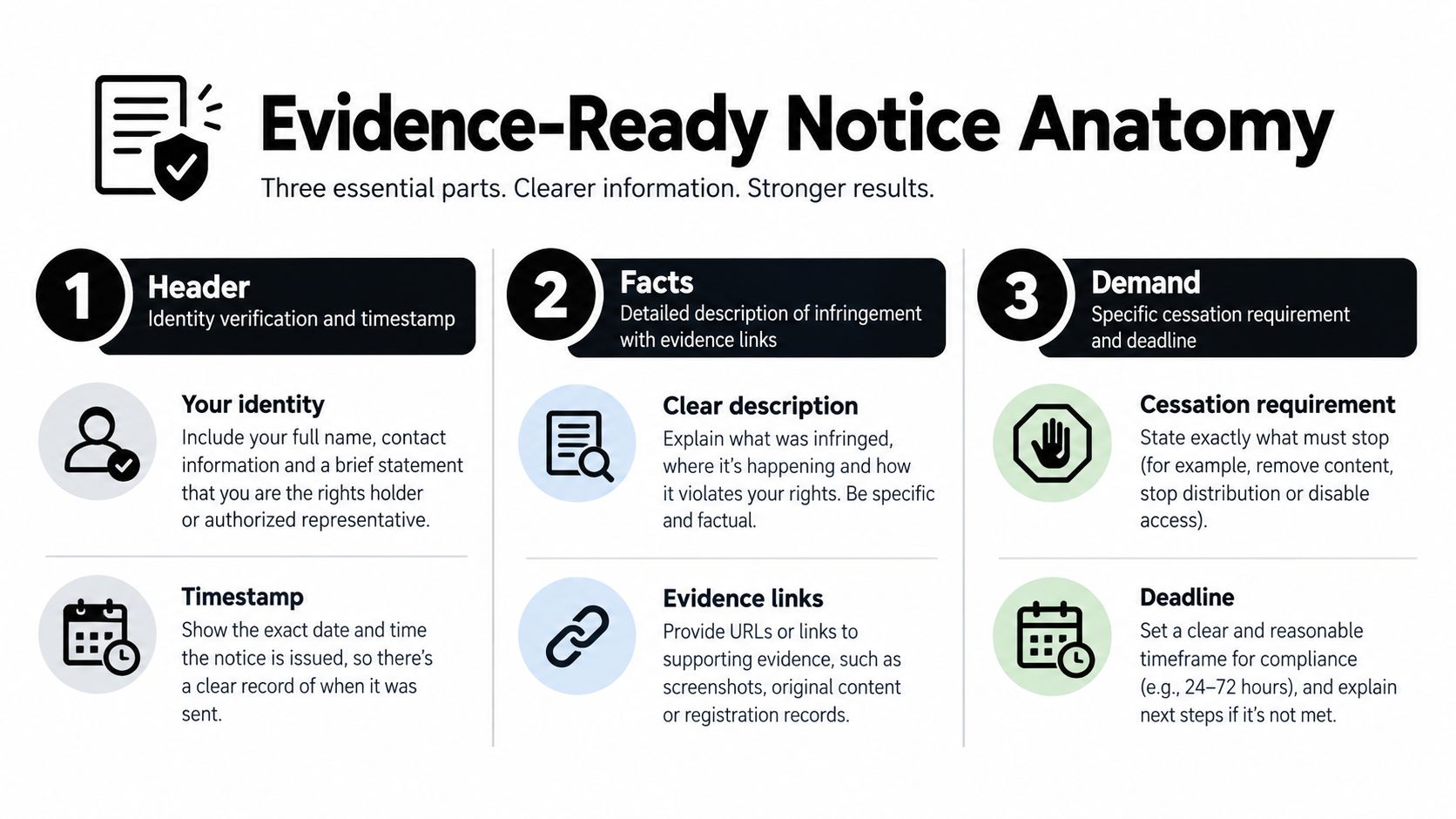
A reliable cease and desist template is a controlled record, not a collection of dramatic phrases. Build it so another lawyer or authorized manager can verify every material statement against the underlying documents. The sequence below works across trademark, copyright, confidentiality, contract, harassment, and certain debt-collection workflows, although the legal basis must be adapted to the jurisdiction and facts.
Start with identity and authority
Identify the sender using the exact legal name, address, and business role. If counsel is sending the notice, state the represented entity and the sender's authority. Identify the recipient precisely, including the relevant individual, legal entity, trading name, registered address, email address, domain, account, or platform handle.
Then identify the matter itself. Name the mark, copyrighted work, contract, confidential information, account, product, property, or conduct at issue. A vague reference to “your unlawful activity” gives the recipient room to claim confusion and makes later follow-up harder.
Establish the factual chronology
Describe what happened in chronological order. Use dates, locations, URLs, account identifiers, communications, transaction records, screenshots, and contract provisions where they support the statement. Separate observed facts from conclusions. For example, “the product page displayed the mark at this URL on this date” is stronger than “you deliberately stole our brand.”
Include an evidence schedule rather than burying every detail in the body. Label exhibits consistently, preserve the original files, and record when each screenshot or archive was captured. Procedures such as Paradigm International HR procedures can help operational teams standardize evidence handling and retention.
Connect facts to a defined legal basis
State the relevant right, law, contract clause, license restriction, or platform rule briefly. A private demand isn't a court pleading, so a long legal memorandum can distract from the practical request. It should, however, show why the sender believes the conduct is actionable.
The legal theory also needs qualification when facts remain incomplete. Language such as “based on the information currently available” can preserve accuracy while the review continues. Don't assert ownership, intent, registration status, or exclusivity unless your records support it. Counsel should review clauses that could create admissions, waive claims, or expose the sender to a counterclaim.
Define the prohibited conduct and the remedy
“Cease infringement” is too abstract for a modern workflow. Specify the action required:
- Remove the identified product page, post, advertisement, or file.
- Stop using a named mark in a domain, handle, email address, metadata field, or search term.
- Return or destroy identified materials, subject to preservation obligations.
- Stop contacting named customers or workers under an applicable agreement.
- Correct a specific public statement or branding use.
- Confirm completion in writing and identify any remaining instances.
Set a response deadline that fits the urgency and complexity of the matter. Reserve rights without promising an unsupported result. Keep a complete copy of the final PDF, approval record, exhibits, delivery evidence, and response history. Consistent document version control prevents a team from sending an unapproved draft or losing track of which factual record supported the final demand.
Customizing Language for Digital Assets and Industry Use Cases
A traditional letter may describe one physical product or storefront. Modern disputes rarely stay that simple. A trademark demand can involve a product page, social-media profile, account handle, HTML code, email address, search-engine query term, domain name, or marketplace listing. A useful template names each asset separately instead of asking the recipient to “stop using our brand online.”
Write takedown actions that someone can verify
For a digital dispute, attach or reference an evidence schedule containing:
- The exact URL, account ID, domain, or marketplace listing.
- Screenshots showing the relevant content and surrounding context.
- The capture date and, where available, an archived copy.
- The precise image, phrase, logo, product description, or metadata to remove.
- Any related email address, handle, redirect, or linked page.
- A requested confirmation describing what changed.
Separate the recipient's obligations from requests to intermediaries. A hosting provider, registrar, social platform, marketplace, and search engine may each have a different process. The recipient may be able to change an account name but not control a cached search result. Your demand should reflect that operational reality.
Preserve evidence before requesting deletion. Otherwise, the very takedown you seek may remove material needed to prove what appeared, when it appeared, and who controlled it. Narrow demands also protect lawful activity. Comparative advertising, commentary, parody, descriptive use, and authorized resale may require a different remedy than a direct request to remove branding.
Apply the same discipline to different industries
A staffing agency dealing with a former worker's solicitation should identify the relevant non-solicitation or confidentiality clause, the specific clients or candidates involved, and the communications that support the allegation. The request might be limited to stopping solicitation under the agreement and preserving relevant outreach records. It shouldn't demand that the individual stop working in an entire profession unless the contract and applicable law support that scope.
A healthcare provider faces a different problem. A notice concerning unauthorized disclosure should identify the information, recipient, disclosure channel, and required containment steps without unnecessarily reproducing sensitive patient data. The workflow should route the matter to privacy and legal reviewers, with access restricted to people who need the record.
For a real estate agency, the disputed asset may be a brokerage name, listing copy, property photograph, domain, or social profile. The demand should identify each listing and distinguish an unauthorized affiliation claim from ordinary descriptive references to a property. Logistics companies may need notices concerning confidential routes, customer lists, shipment data, or unauthorized use of vehicle branding. Education and professional-services teams often need similarly narrow language for course content, client materials, or confidential methods.
The template is only the starting point. The facts, remedy, recipient, platform, and evidence schedule determine whether the notice is useful.
Executing and Delivering the Notice Securely
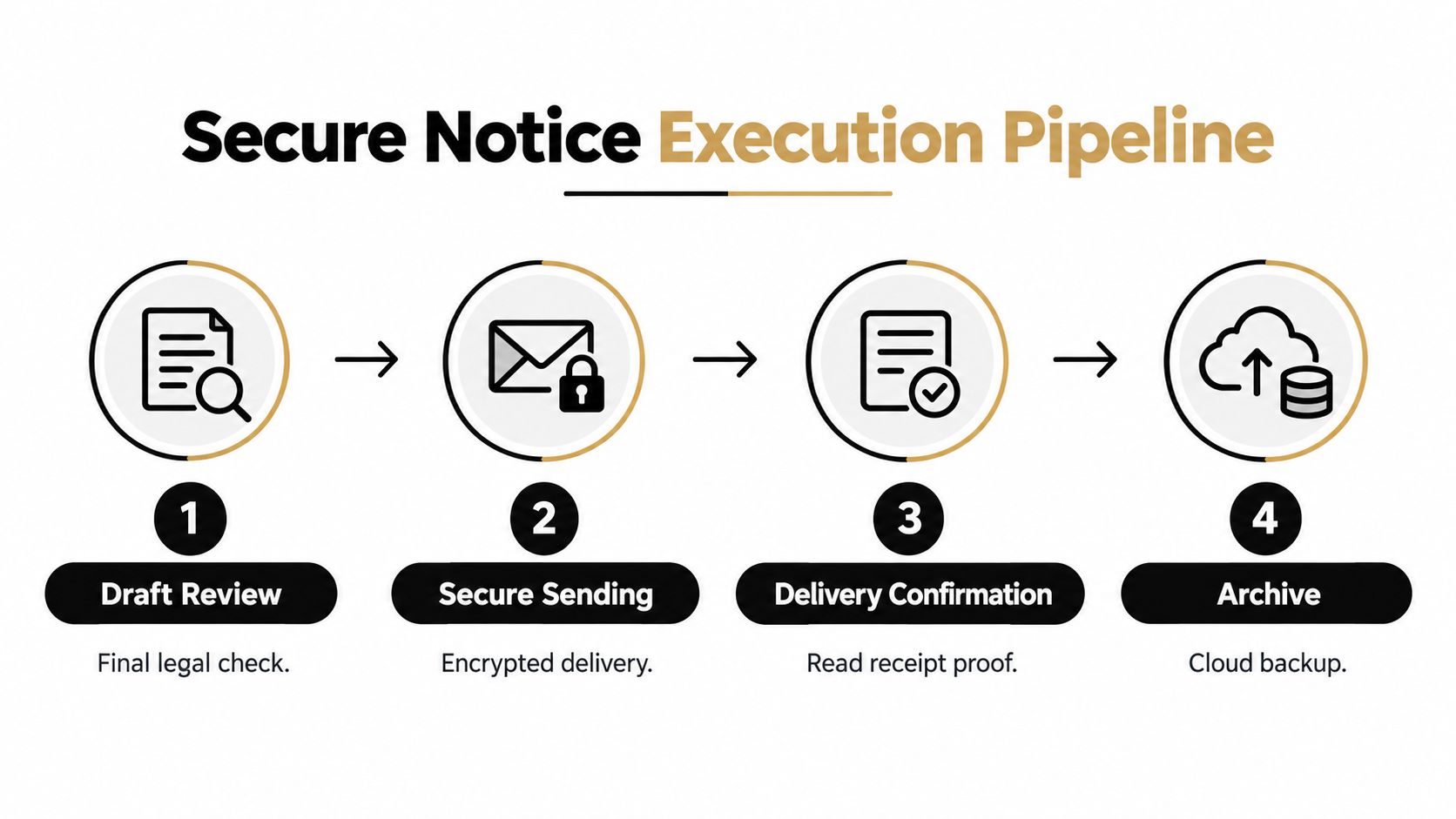
A forceful notice is still weak if the business cannot prove which version was approved, who signed it, when it was sent, or whether delivery occurred. Treat execution as part of the legal record, not as an administrative afterthought. Keep the source document, approved PDF, signature evidence, delivery confirmation, and later correspondence together in one controlled matter file.
Review before sending
Set an approval route that answers four practical questions:
- Has counsel or an authorized reviewer verified the parties and factual assertions?
- Does the requested remedy match the available evidence and legal basis?
- Is the deadline reasonable for the conduct and chosen delivery method?
- Has the team preserved original evidence before requesting removal or destruction?
Create the final PDF from a controlled template, route it to the correct signer, and record each approval. BoloSign supports workflows for creating and sending PDFs, templates, and forms, with structured approvals and execution records. Teams can combine digital signing with certified mail, courier delivery, or process service when the dispute calls for additional proof. Follow documented electronic signature best practices so identity checks, signer authority, timestamps, and completed copies match the matter's risk.
Under the EU eIDAS electronic-signature framework, electronic documents and signatures cannot be denied legal effect solely because they are electronic. The framework recognizes simple, advanced, and qualified signatures. Qualified electronic signatures receive the same legal effect as handwritten signatures across the EU. Select the appropriate level based on the document, identity requirements, risk, and governing process.
Match delivery to the proof you need
Email is fast, but the recipient may challenge delivery if the address was unmonitored, the message entered a spam folder, or the recipient denies opening it. For a high-stakes matter, choose a channel that produces dependable receipt evidence. Certified mail with return receipt is commonly recommended for U.S. debt-collection cease-communication instructions because it creates an effective-date record.
That recommendation applies to a specific legal setting. Under the Fair Debt Collection Practices Act, a consumer's written request to stop communications generally requires a debt collector to stop communicating about the debt after receipt, subject to narrow exceptions. A cease-contact letter is not automatically a debt-dispute or validation request. It does not establish that the debt is invalid or eliminate the debt. Identify the consumer, collector, account, instruction, date, signature, and delivery evidence in the notice record.
Healthcare organizations need another recordkeeping control. HHS guidance on electronic signatures and authorizations explains that electronic execution may be used in covered contexts, while HIPAA still requires the individual or personal representative to receive a copy of a signed authorization. Generate and provide the complete copy, rather than recording only that signing occurred.
Teams that still use fax should review modern fax encryption tips and compare them with the matter's confidentiality, audit, and retention requirements.
Recordkeeping standard: Keep the signed notice, final PDF, approval history, delivery record, source evidence, and response log in one controlled matter file.
Strategic Next Steps When the Recipient Ignores You
Delivery is a milestone, not a result. The recipient may comply, ask questions, deny the allegations, stay silent, or respond with a threat of their own. Your next move should depend on the evidence and business objective, not on frustration.
Begin with the delivery record. Confirm the address, timestamp, receipt evidence, signer identity, and exact version delivered. Then monitor the conduct that the notice addressed. Check the relevant website, marketplace listing, social account, customer outreach, physical inventory, or public statement. Record changes without editing or overwriting the earlier evidence.
Use a proportionate decision path
If the recipient complies, verify the promised action. A changed domain may leave active redirects, a deleted listing may remain in a seller account, and a removed social post may be copied elsewhere. Ask for written confirmation that describes the completed steps, then retain the confirmation with the matter record.
If the recipient stays silent, don't automatically send repeated warnings. Check whether the deadline passed, whether delivery is provable, and whether continued conduct is causing harm. A controlled follow-up may clarify the record, but a third notice can give the other side more time without improving your position.
If the recipient denies the claim, identify the issue that separates the parties. It may be ownership, permission, fair use, contract scope, identity, or the factual chronology. A focused response or negotiation may resolve that fault line more efficiently than repeating the original letter.
If the recipient threatens action, stop escalating rhetorically. Recheck the original language, evidence, forum risks, and available remedies with counsel. An overbroad demand can invite a declaratory-relief action or a counterclaim, while a careful record can support a platform request, negotiated resolution, or litigation plan.
Preserve an immutable matter record
Your file should contain the source documents, legal review, final PDF, signature or approval record, delivery proof, exhibits, recipient response, call logs, and timestamps. Don't let staff overwrite screenshots, replace drafts without version history, or store critical responses only in personal inboxes.
Contract automation can help keep the sequence visible, but it doesn't replace legal judgment. If the parties agree on a resolution, document the precise acts to stop, verification requirements, payment or release terms if applicable, and consequences of noncompliance. If the conduct continues, counsel can evaluate platform removal, a negotiated settlement, an injunction application, or a civil complaint.
A related workflow may be useful when the dispute shifts from notice to agreement. For example, teams handling negotiated exits can use a controlled process for canceling a contract, while keeping the original agreement, notice, approvals, and termination record connected.
The distinction between a private demand and an official administrative order remains important at this stage. A private template documents notice and creates an opportunity to resolve the dispute. It doesn't become a government order because the recipient ignores it.
Automating Your Enforcement Workflow with BoloSign
Manual enforcement often breaks at the handoffs. One employee updates a spreadsheet, another edits a Word file, counsel approves an attachment in email, and a manager sends an older PDF. A more reliable process treats the notice as a controlled asset from intake through archive.
A practical workflow looks like this:
- Intake: Capture the sender, recipient, matter type, relevant asset, urgency, and business objective.
- Evidence: Store screenshots, contracts, registrations, communications, URLs, and timestamps before any takedown request.
- Drafting: Use a structured template with fields for facts, legal basis, prohibited conduct, remedy, deadline, reservation of rights, and signature.
- Review: Route the draft for clause-level legal review and authorized approval. AI contract review can flag unsupported assertions, inconsistent names, missing fields, and unusually broad demands, but counsel should decide whether the language is legally appropriate.
- Execution: Create the final PDF, request an eSignature, and preserve the executed copy and signing record.
- Delivery: Send through the selected channel, record receipt evidence, and link the response history to the matter.
- Monitoring: Track compliance, platform changes, follow-up dates, and escalation decisions.
BoloSign is an AI-powered contract management platform that supports drafting, review, negotiation, approvals, secure eSignature, and compliance tracking in a unified workflow. It can create, send, and sign PDFs, templates, and forms, while integrations such as its Document Signing API, embeddable components, WordPress options, and CRM connections support teams that need to sign PDFs online where work already happens. Its stated security and compliance coverage includes SOC 2 Type I and Type II, ISO 27001:2022, GDPR, eIDAS, the ESIGN Act, HIPAA, and CCPA.

The commercial model matters for teams with recurring notices, onboarding forms, vendor documents, and settlement paperwork. BoloSign offers unlimited documents, templates, and team members at one fixed price, and its published positioning states that it can be up to 90% more affordable than DocuSign or PandaDoc. That can make contract automation more predictable for staffing, healthcare, logistics, real estate, education, and professional-services teams that don't want usage-based friction.
AI should accelerate the workflow, not manufacture legal certainty. Use it to organize intake, compare versions, identify missing information, and surface review points. Keep the final factual and legal decisions with an authorized professional.
For a practical overview of how a digital signing workflow can fit into broader contract operations, review the following product walkthrough:
A cease and desist template works best when it produces a defensible record, not merely an intimidating impression. Build the facts carefully, define the remedy precisely, choose delivery based on proof, and preserve every version and response.
Start a 7-day free trial of BoloSign to create, review, send, and eSign cease and desist PDFs alongside your wider contract workflow. Centralize approvals, execution evidence, and compliance records so your next notice is easier to manage and easier to verify.

Paresh Deshmukh
Co-Founder, BoloForms
6 Oct, 2026
Take a Look at Our Featured Articles
These articles will guide you on how to simplify office work, boost your efficiency, and concentrate on expanding your business.