

Request for Proposal Cover Letter: A Guide to Winning More Contracts
Discover a proven approach with a request for proposal cover letter to win more contracts. Tips, templates, and examples to boost response success.

Tired of nonsense pricing of DocuSign?
Start taking digital signatures with BoloSign and save money.
A request for proposal cover letter is your first—and often most important—chance to make an impression on a potential client. It’s a single-page document that goes right on top of your full proposal, acting as a strategic handshake. It introduces your company, shows you understand what the client needs, and sets a confident tone for why you’re the best choice for the job.
Why Your RFP Cover Letter Is Your First Impression
Picture this: a client is staring at a mountain of proposals. The very first thing they see from you is your cover letter. It’s so much more than a formality; it's your opening move in a high-stakes game.
A powerful cover letter immediately cuts through the noise and separates you from the competition. It proves you’ve done your homework. It frames your entire proposal by demonstrating a deep understanding of the client's problem before they even get to the nitty-gritty technical details.
Think of it as the introduction that opens the door to a winning partnership. Sending a generic, boilerplate letter is like showing up with a weak handshake—it just signals a lack of genuine interest. A thoughtful, personalized letter, on the other hand, builds instant rapport and makes the case for why your solution is the only one they need to seriously consider.
The Strategic Value of a Strong Opening
A well-crafted cover letter accomplishes several critical business goals right out of the gate. It doesn’t just introduce your proposal; it kicks off the persuasion process by directly connecting your company's strengths to the client's specific pain points.
For instance, if a healthcare provider is looking for a new patient management system, they want to see that you understand their challenges with things like HIPAA compliance and secure document workflows. Your cover letter can hit this head-on, immediately showcasing your expertise in that area. Or if you're bidding for a logistics company in the UAE or Australia, they need to know you grasp the incredible complexities of their global supply chain.
A great cover letter isn't about listing your accomplishments. It's about telling the client, "We understand your specific problem, and here’s precisely why we are uniquely equipped to solve it." This client-first approach turns a simple introduction into a powerful sales tool.
Building Credibility Before They Even Turn the Page
Your cover letter is where you can start winning them over from the very first sentence. It’s your chance to:
- Establish a Real Connection: Address the letter to a specific person. It’s a small detail that shows you’ve done your research.
- Reinforce Your Brand: Use a confident, professional tone that feels like your company.
- Highlight What Makes You Different: Briefly touch on what makes you stand out without giving away your whole proposal.
Ultimately, this one-page document ensures your detailed proposal gets the serious attention it deserves. It primes the reader to view your submission in a positive light, making them far more receptive to the comprehensive solution you're about to present. It’s a small document that has a massive impact on your win rate.
The Anatomy of a Compelling RFP Cover Letter
A winning request for proposal cover letter isn't just a formality—it’s a strategic document. Every section has a job to do. Think of it less like a simple introduction and more like the opening argument in your case for why you're the only choice. To move beyond a generic template, you need to understand how each piece builds on the last to create a powerful first impression.
It all starts at the top with a professional header. Your company branding and contact info immediately establish your legitimacy. Right after that comes the salutation. Please, do everything you can to avoid the dreaded “To Whom It May Concern.” A few minutes of research to find the name of the procurement lead or project manager shows you’ve put in the effort and creates an instant, personal connection.
This infographic breaks down how building that rapport and showing your value from the very first sentence can set you up for a win.
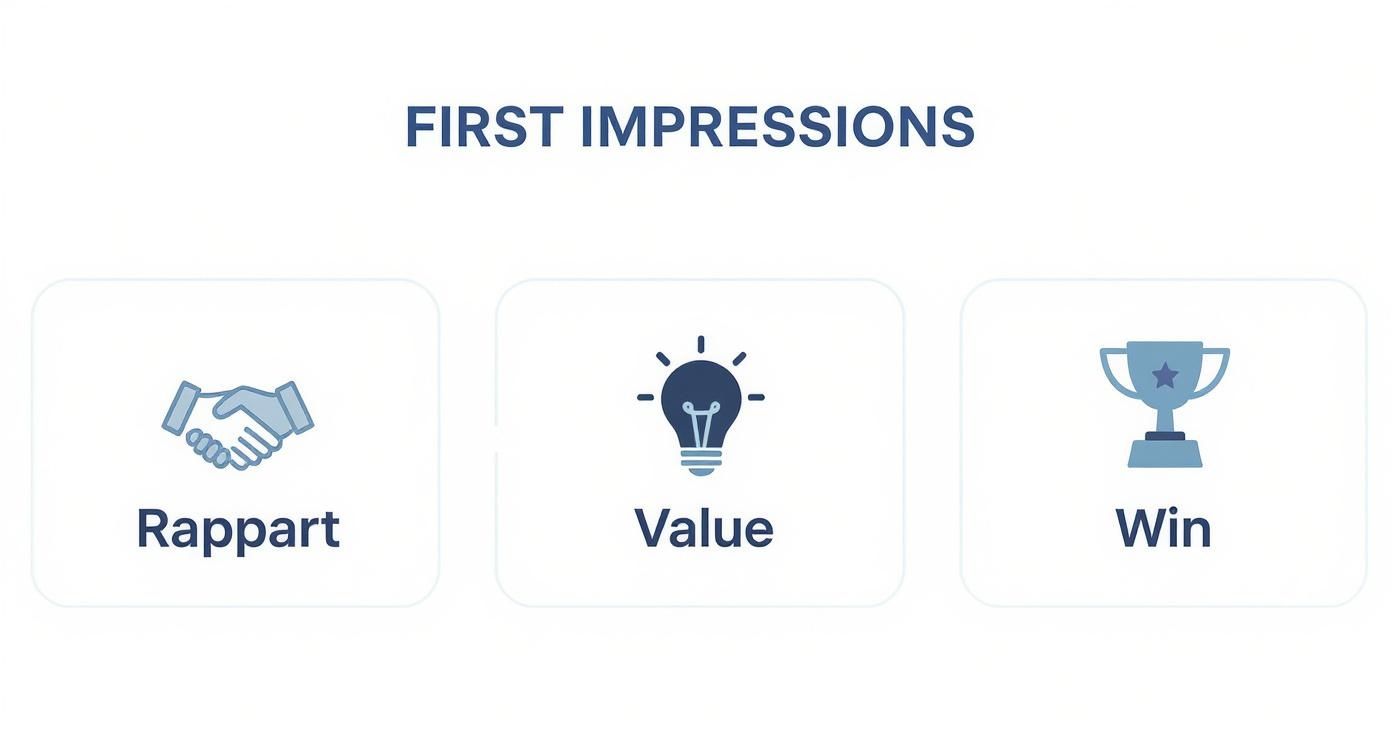
As you can see, every single element—from your greeting to your sign-off—plays a part in shaping that critical first impression. Get it right, and it can positively influence how they view your entire proposal.
To really nail this, let's break down the essential components, their purpose, and what you absolutely need to include.
Essential Components of an RFP Cover Letter
| Component | Purpose | What to Include |
|---|---|---|
| Header & Salutation | To establish professionalism and create an immediate personal connection. | Your company logo, contact information, the date, and the recipient’s name and title. |
| Opening Hook | To grab the reader's attention and prove you understand their specific needs. | A direct reference to their project or a specific challenge mentioned in the RFP. |
| Summary of Needs | To demonstrate you've listened and fully grasp the problem they're trying to solve. | A concise restatement of their key challenges in your own words. Show empathy. |
| Your Solution Snapshot | To connect their problem directly to your unique solution and value proposition. | A high-level overview of how your approach solves their problem. What makes you different? |
| Brief Company Intro | To position your company as the perfect partner for this specific project. | A quick, relevant mention of your experience or expertise that directly applies to their needs. |
| Closing & Call to Action | To confidently guide the next steps and maintain momentum in the sales process. | A clear, proactive statement about what's next (e.g., scheduling a call) and your signature. |
Each part of this structure is designed to draw the reader in, build trust, and make a compelling case before they even get to page one of the full proposal.
Crafting a Hook-Worthy Opening
Your first sentence is your hook. It has one job: grab their attention. The best way to do that is by speaking directly to their world—mention their project by name or acknowledge a specific pain point from the RFP. This instantly proves you’ve done your homework.
For instance, a staffing agency in the US wouldn't just say they provide great candidates. They might open with: “Addressing the critical shortage of certified technicians in the logistics sector requires a partner who understands both the urgency and the intricacies of the talent pipeline.”
See the difference? It shows industry awareness and immediately positions them as a specialist, not a generalist.
The Core Narrative Structure
Once you’ve hooked them, the body of your letter needs to tell a story. This isn't the time for a long-winded company history. Instead, guide them through a logical narrative that flows like this:
Show You Get It: Start by restating their problem in your own words. It shows you’ve actually listened and understand what’s at stake, whether it's a real estate firm in Canada needing a new CRM or a university in New Zealand seeking a digital learning platform.
Connect the Dots: Immediately link their need to your solution. Give them a high-level snapshot of how you’ll solve their problem, emphasizing the unique value you bring to the table.
Introduce Yourself (Briefly!): Now, introduce your company—but only in the context of their project. Mention relevant experience or expertise that makes you the obvious choice for this particular job.
The goal is to create a seamless story that starts with their problem and logically concludes with your company as the undeniable solution. Each section should build on the last, creating a persuasive and compelling case before they even reach your full proposal.
The Professional Closing and Signature
Finally, end with a strong, confident closing. You need a clear call to action that tells them what you want to happen next. Something like, "We look forward to scheduling a brief call next week to walk you through the key points of our proposal." This shows you're proactive and keeps the momentum going.
This is also where modern tools can add a final layer of professionalism. Once your cover letter and proposal are ready, you can bundle them into a secure document workflow. Platforms like BoloSign let you send everything for a legally binding eSignature, giving the entire submission a polished, efficient feel. It’s an AI-powered way to streamline the final, crucial step of contract automation.
Structuring Your Narrative for Maximum Impact
Let's be honest: generic, one-size-fits-all cover letters are headed straight for the trash bin. If you want your proposal to actually get read, you need a writing strategy that grabs attention and holds it. The single most effective way to do this is with the Problem-Solution format.
This isn't just about introducing your company. It’s about transforming your cover letter into a compelling story that frames your business as the only logical answer to the client’s problem. You have to stop listing services and start building a narrative around their specific challenges. It means digging deep into their pain points and showing you genuinely understand what keeps them up at night.

Identify the Core Problem
Before a single word hits the page, you have to play detective and diagnose the client's real problem. This goes way beyond what they’ve spelled out in the RFP.
Think about it. A healthcare provider isn't just shopping for software; they're wrestling with patient data compliance under HIPAA and need a system that's both secure and auditable. A logistics firm isn't just looking for a new vendor; they're getting killed by costly supply chain delays and need a partner who can guarantee efficiency.
Your job is to frame their challenge in a way that proves you've been paying attention. A staffing agency, for instance, could tackle hiring bottlenecks by saying, "We understand the critical need to slash your time-to-hire for specialized roles from 60 days to under 30." That’s specific. That gets noticed.
Present Your Solution as the Inevitable Answer
Once you've laid out the problem clearly, your solution should feel like the obvious next step. This is where you draw a straight line from their pain to your unique capabilities. Don't just list features—present your solution with tangible outcomes and real benefits.
Here’s how this plays out in different industries:
- Professional Services: A marketing firm might say, "To solve your challenge of declining lead quality, our targeted content strategy will boost marketing-qualified leads by 30% within six months." See? It’s all about the result, not the process.
- Education: An ed-tech company could propose, "Our platform directly addresses low student engagement by providing interactive modules that have proven to lift participation rates by 40% in similar institutions."
This whole approach is the heart of value selling. It allows you to build a narrative that highlights the ultimate benefits, which is how you secure bigger and better deals. You're making your proposal a direct, irresistible response to their needs.
Quantify Your Value Proposition
The Problem-Solution format consistently outperforms generic, biographical styles across almost every industry. People’s preferences have shifted, too. Recent analysis shows that 66% of people prefer cover letters that are half a page or less, which forces us to be concise and impactful.
The trick is to back up your solution with specific examples and hard numbers, then wrap it all up with a clear value proposition. What, exactly, will you deliver?
The most persuasive proposals don't just promise results—they prove them. By structuring your request for proposal cover letter around the client's problem, you shift the conversation from what you do to what you can do for them.
This narrative structure is so powerful because it's completely client-focused. You’re not just another company submitting a bid; you’re positioning yourself as a strategic partner with a clear plan to solve their most pressing issues.
Common Mistakes That Get Your Proposal Ignored
Your proposal could be brilliant, but a weak cover letter can sink it before it ever gets a fair shake. I've seen it happen time and time again. The smallest missteps signal a lack of attention to detail, getting your bid tossed aside before anyone reads past the first page.
Think of your request for proposal cover letter as the gatekeeper. A simple, careless error can slam that gate shut for good.
One of the most common—and frankly, laziest—mistakes is using a generic salutation like “To Whom It May Concern.” It’s an immediate red flag that you haven’t done your homework. Taking five extra minutes to find the right contact person’s name on LinkedIn or the company website makes a world of difference. It shows you're genuinely invested.

This initial document carries more weight than you might think. Don't believe me? Research shows that a staggering 81% of recruiters have rejected applicants based solely on their cover letters. While that's for jobs, the principle is the same for RFPs. This first impression is critical. Eliminating these unforced errors is the first step to getting your proposal seriously considered.
Forgetting Who the Letter Is For
Here’s another frequent blunder: making the letter all about your company. A cover letter that reads like a company history lesson is a surefire way to lose the reader's interest. They don't care about your founding story; they care about their problems and how you’re going to solve them.
Your letter must stay laser-focused on the client's needs. Instead of just listing your accomplishments, you need to connect your experience directly to their specific challenges.
- Before (Self-Focused): "Our company has been a leader in the industry for 20 years, winning numerous awards for our innovative solutions."
- After (Client-Focused): "Your challenge with supply chain visibility is something we've successfully solved for clients like X and Y, resulting in a 15% reduction in shipping delays."
See the difference? This simple shift in perspective transforms your letter from a generic sales pitch into a strategic partnership proposal. It shows you've listened and that you're a problem-solver, not just another vendor trying to make a sale.
Neglecting Professionalism and Process
Finally, simple formatting and process errors can completely undermine your credibility. Dense paragraphs, unprofessional fonts, or typos scream carelessness. The submission process itself is also part of your presentation. Fumbling with attachments or using an insecure delivery method can make you look disorganized right out of the gate.
An unpolished cover letter suggests an unpolished proposal will follow. Maintain a confident, client-focused tone and ensure every detail, from font choice to final submission, is handled with absolute professionalism.
This is where having a smooth, repeatable process becomes a real competitive advantage. Using tools to manage an automated approval workflow system ensures every proposal that leaves your office is consistent and professional.
When you create, send, and sign PDFs online using a secure platform, you present a polished, modern image from start to finish. It’s all about eliminating every potential friction point that stands between you and your next big contract.
After you’ve poured all that time and effort into crafting the perfect proposal, the final submission can either be the cherry on top or a last-minute fumble. This is your chance to seal the deal with efficiency and a modern touch, moving beyond clunky attachments and the old-school print-sign-scan routine.
Think about it: what if you had a reusable request for proposal cover letter template that your team could quickly customize and send out through a secure, streamlined workflow? Suddenly, every submission is consistent, on-brand, and free from careless errors. It’s about building a system, not just writing another document.
The Power of Digital Submission and eSignatures
Sending your proposal through a digital signing solution isn’t just about being faster—it adds a critical layer of security and traceability that clients absolutely notice. When you manage your proposals digitally, you create a seamless, professional experience from the moment it hits their inbox to the final signature.
This approach subtly communicates that you’re serious about their business and your own operational excellence. Getting a handle on the legal value of digital signatures can seriously level up your RFP game, giving you and your client peace of mind.
Modernize Your Workflow with BoloSign
This is where a tool like BoloSign comes in to manage that entire final step. With AI-powered automation, it simplifies how you create, send, and get PDFs, forms, and templates signed. Its eSignature capabilities are fully compliant with global standards like ESIGN, eIDAS, HIPAA, and GDPR, which is non-negotiable in many sectors.
- For Staffing Agencies: Get client agreements and SOWs signed in minutes, not days, so you can place candidates faster.
- In Healthcare: Securely handle patient data forms and vendor contracts with full HIPAA compliance.
- For Real Estate: Push offers and closing documents through the pipeline quickly with legally binding signatures.
Using a dedicated platform for document management and signing transforms your proposal submission from a simple administrative chore into a final, powerful demonstration of your company's competence and professionalism.
This is where you can truly stand out. Instead of just attaching a PDF to an email, you're delivering a secure, professional, and easy-to-sign package that respects the client's time. You can learn more about how to sign PDFs online and make your process much more efficient.
The best part? It doesn’t have to break the bank. BoloSign offers unlimited documents, team members, and templates for one fixed price, making it 90% more affordable than many traditional tools out there. It’s a smart, scalable investment for any business looking to win more contracts.
Ready to see how a streamlined, secure signing process can improve your proposal win rate? Start your 7-day free trial of BoloSign today and experience the difference firsthand.
Your RFP Cover Letter Questions Answered
Even after you've nailed down the structure and strategy, a few nagging questions always seem to pop up when you're putting the final touches on a request for proposal cover letter. Getting these small details right can be the difference between a submission that feels polished and professional, and one that raises minor—but totally avoidable—red flags. Let's tackle some of the most common ones I hear.
How Long Should an RFP Cover Letter Be?
The answer here is simple and firm: one page. No exceptions.
Think of your cover letter as the introduction, not the proposal itself. Its only job is to be a concise, powerful handshake that convinces the reader to dive into the detailed document you’ve attached.
Sticking to a single page forces you to be disciplined with your message. It makes sure every single sentence serves a purpose, whether that’s showing you understand their problem or highlighting what makes you the best choice. Anything longer just buries your key points and subtly suggests you can't summarize effectively, which isn't the best first impression to make.
Should I Include Pricing in the Cover Letter?
Absolutely not. The cover letter is the worst place for any financial details. Its purpose is to build rapport and establish your company as a credible, insightful partner who gets their needs.
Dropping numbers in at this stage is just premature. It can easily distract from the value-driven story you're trying to build. You want them focused on the solution, not the price tag.
Instead, your letter should pique their interest and guide them toward the full proposal, where the financials are laid out with the proper context. You can give a subtle nod to it with a line like this:
“Our detailed proposal includes a comprehensive breakdown of the investment, demonstrating a clear return for [Client’s Company Name].”
This frames the cost as a strategic investment and points them to the right section without getting bogged down in numbers right out of the gate. For more tips on crafting compelling business documents, you can find a wealth of information in our BoloForms blog.
Who Do I Address the Letter To If No Name Is Provided?
Whatever you do, avoid the generic "To Whom It May Concern." It’s a last resort, and it feels lazy.
Before you give up, do a little detective work. A quick search on the company’s website or LinkedIn can often turn up the head of the relevant department, like the Director of Procurement or Head of IT. Addressing it to a specific person, even if they aren’t the final decision-maker, shows you put in the effort.
If you’ve searched high and low and genuinely can't find a name, your next best bet is to address it to a specific title or department. It's a much stronger alternative.
- Good: “Dear Head of Human Resources”
- Better: “Dear [Client Company Name] Selection Committee”
- Acceptable (if you must): “Dear [Client Company Name] Team”
This professional approach keeps a personal touch even when you don't have a specific contact, making sure your letter starts on the right foot.
Ready to streamline how you create, send, and sign all your business proposals? With BoloSign, you get unlimited documents, templates, and team members at one fixed price, making professional eSignatures 90% more affordable. Start your 7-day free trial today to experience a smarter document workflow.

Paresh Deshmukh
Co-Founder, BoloForms
20 Nov, 2025
Take a Look at Our Featured Articles
These articles will guide you on how to simplify office work, boost your efficiency, and concentrate on expanding your business.