
A Guide to Limitations of Liability Clauses
Understand limitations of liability clauses to manage risk. Our guide explains how to negotiate and enforce them with contract AI and eSignature solutions.

Tired of nonsense pricing of DocuSign?
Start taking digital signatures with BoloSign and save money.
A limitation of liability (LoL) clause is a contractual provision that puts a hard cap on the financial damages one party can recover from the other if things go south. Think of it as a financial safety net woven directly into an agreement. It defines the absolute maximum exposure a business faces, preventing a single dispute from spiraling into uncapped, potentially devastating losses. This clause is a cornerstone of modern commercial deals, making business relationships predictable and sustainable.
What Are Limitation of Liability Clauses
Imagine you're buying a comprehensive insurance policy for your business. It covers all sorts of risks, but it comes with a clear coverage limit—the maximum amount the insurer will ever pay out for a claim. A limitation of liability clause does the exact same job, just inside a contract. It’s a pre-negotiated ceiling on financial responsibility if one party fails to deliver on their promises.
Without this protection, companies would be taking on infinite risk with every deal they sign. A minor service glitch from a software provider, for instance, could theoretically trigger a lawsuit for millions in lost profits, a sum that could easily bankrupt the provider. That level of exposure would make it impossible for most businesses—especially small to medium-sized ones—to offer their services at a reasonable cost. To really get why they matter so much, it helps to first understand the fundamental principles of risk management.
To give you a quick overview, here are the core components you'll typically find inside an LoL clause.
Table: Key Elements Inside a Liability Clause
| Element | Its Role in Managing Your Risk |
|---|---|
| Liability Cap | This is the maximum dollar amount one party can be liable for. It's often tied to the contract's value (e.g., "12 months of fees paid"). |
| Consequential Damages Exclusion | This carves out indirect losses, like lost profits or business interruption, from being claimed. It's a critical piece of the puzzle. |
| Carve-Outs (Exceptions) | These are specific situations where the liability cap doesn't apply, like gross negligence, willful misconduct, or fraud. |
| Time Limits | Some clauses specify a timeframe within which a claim must be made, preventing indefinite exposure. |
| Mutuality | Determines if the liability cap applies to both parties equally or if it's one-sided (unilateral). |
Understanding these pieces is the first step to negotiating a clause that actually protects your interests instead of just creating the illusion of safety.
Balancing Accountability and Protection
The goal of a limitation of liability clause isn't to let someone off the hook completely. Far from it. Instead, it strikes a critical balance:
- Accountability: It ensures the party at fault is still held financially responsible for damages, but only up to an agreed-upon, reasonable amount.
- Protection: It shields businesses from existential threats that could arise from unforeseen or disproportionately massive claims, which in turn fosters innovation and commerce.
This balance is vital everywhere. A staffing agency needs to limit its liability in case a temp makes a costly mistake, just as a hospital in Canada needs clear terms when it brings in new medical software. Getting these agreements securely signed is just as important. With a platform like BoloSign, organizations can instantly create, send, and sign PDFs online using a secure and compliant digital signing solution, ensuring every hard-negotiated term is legally binding.
Decoding the Structure of Liability Clauses
Not all liability clauses are built the same. While they all serve the same core purpose—to manage financial risk—their effectiveness depends entirely on their structure. Getting the components right is critical for any business, whether you're a professional services firm in the UAE or a real estate agency in Australia.
Think of an LoL clause as a pre-built structure with three main pillars: the ceiling, the exceptions, and the exclusions. Each one plays a distinct role in defining the boundaries of financial responsibility. And getting these right is essential, as the financial stakes have never been higher. For example, casualty insurance rates in the US saw a 9% increase in Q2 2025, driven by a surge in "nuclear verdicts," or jury awards exceeding $10 million. You can explore more about these rising liability costs and their market impact to understand why tightly constructed clauses are so vital.
The Core Components of a Liability Clause
Let's break down the three most common structural elements you'll encounter.
Liability Caps: This is the most straightforward component. It sets the absolute maximum financial payout one party is responsible for. This "cap" is often tied directly to the contract's value—think "the total fees paid in the preceding 12 months." This ensures the potential liability is proportional to the revenue the deal generates.
Carve-Outs: These are specific, high-stakes actions that are "carved out" from the liability cap's protection. Common carve-outs include fraud, willful misconduct, gross negligence, or breaches of confidentiality. This means if a party acts in bad faith, the financial cap doesn't apply, and they could be on the hook for the full extent of the damages.
Damage Waivers: This element typically excludes consequential or indirect damages. These are the knock-on losses that don’t flow directly from the breach itself, like lost profits, reputational harm, or business interruption. By waiving these, both parties agree to limit claims to direct, foreseeable damages only.
The following flowchart shows how these pieces fit together to manage risk within a contract.
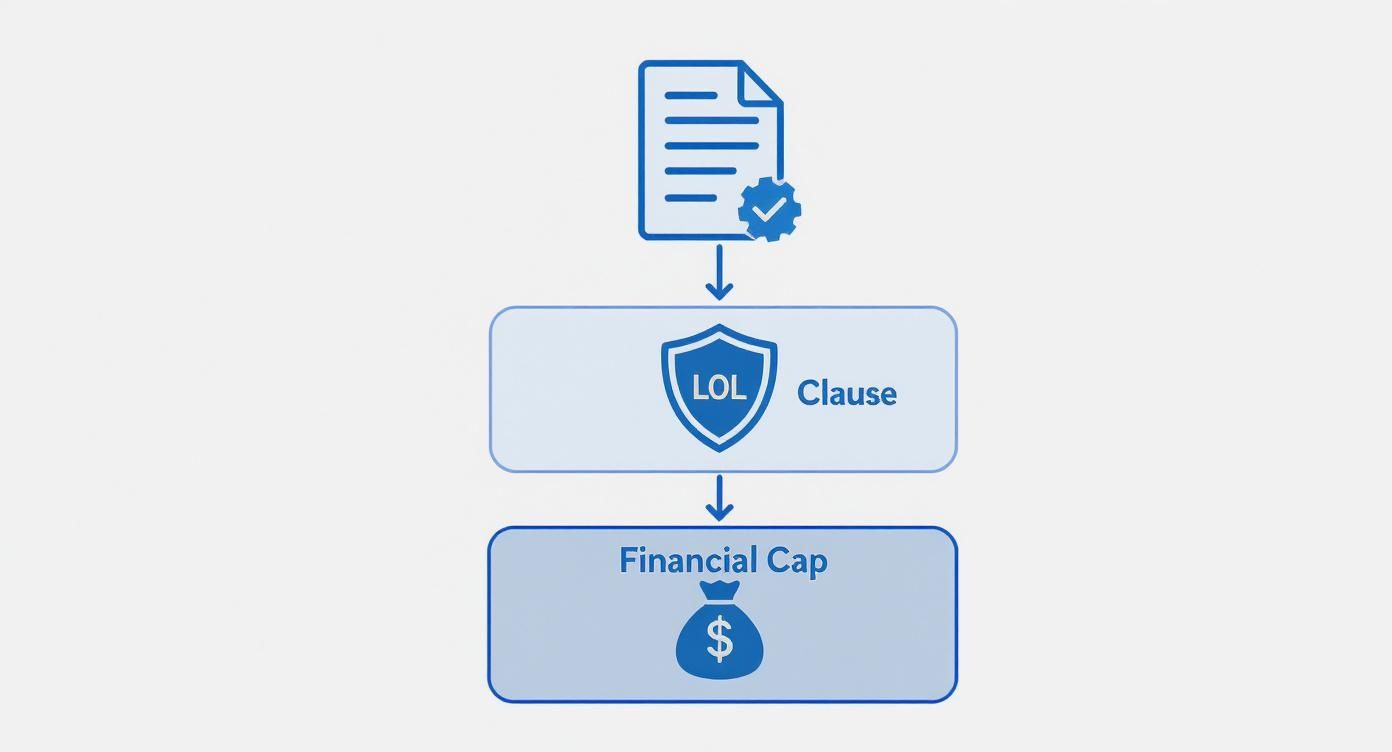
This visual makes it clear: the LoL clause acts as a protective shield, with the financial cap being the final layer of defense against predictable business risks.
Bringing It All Together with AI
Imagine a professional services firm signing a major client contract. Manually reviewing the agreement to ensure the liability cap is fair, the carve-outs are reasonable, and the damage waiver is present can take hours of expensive legal time.
This is where BoloSign’s AI contract review transforms the process. Instead of a painstaking manual read-through, our AI-powered automation instantly scans any PDF or form, identifies these critical structures, and flags any non-standard or risky language. This allows your team to sign PDFs online with complete confidence, knowing every key detail has been analyzed.
With BoloSign, you can instantly create, send, and sign unlimited documents and templates—all for one fixed price that's up to 90% more affordable than competitors like DocuSign or PandaDoc. Experience the power of AI-driven compliance firsthand.
Will Your Liability Clause Hold Up in Court?
A limitation of liability clause is only as strong as a court says it is. Just because you have one in your contract doesn't mean you're automatically protected—its language, fairness, and the context of the deal are constantly under a legal microscope.
This scrutiny is intensifying as litigation trends evolve. In fact, abuse of the legal system has driven over $230 billion in excess liability insurance losses in the last decade alone. Understanding how courts challenge these clauses is the first step to drafting one that will actually stand firm when tested. Discover more insights about this trend on iii.org.
The Legal Hurdles to Enforceability
Courts in jurisdictions like the US, Canada, and Australia generally respect these clauses, seeing them as a legitimate way for sophisticated businesses to allocate risk. But they won't hesitate to invalidate them under certain conditions.
Two key legal doctrines often come into play:
- Unconscionability: This is the legal system's "shock the conscience" test. A clause might be deemed unconscionable if it's ridiculously one-sided and unfair, especially when there's a massive gap in bargaining power. Think of a global corporation forcing an extreme liability waiver on a tiny small-business vendor.
- Public Policy: Some things just aren't up for negotiation. A clause will be struck down if it goes against public policy. The classic example is trying to limit your liability for gross negligence, reckless behavior, or intentionally causing harm. The law simply won't protect a party that acts with a flagrant disregard for its duties.
A logistics company can't just write in a clause that absolves it from all liability if its drivers recklessly damage a client's property. A court would almost certainly find that unenforceable because it encourages irresponsible behavior and undermines the public's interest in safe commercial practices.
Clarity Is Your Best Defense
Vague, fuzzy, or ambiguous language is an open invitation for a legal challenge. If a judge can't figure out exactly what risks are being limited or what the cap is supposed to be, they might interpret the clause narrowly against the party who wrote it—or just throw it out entirely.
This is why using clear, precise wording isn't just a best practice; it's a strategic necessity. And it’s precisely where modern contract automation shines. Tools like BoloSign allow you to build, send, and sign agreements using pre-approved templates filled with vetted, compliant language. This workflow ensures every contract your team executes with a secure eSignature contains clear, enforceable terms. Our platform helps you standardize your approach, drastically reducing the risk of a judge deeming your limitations of liability unenforceable down the road. You can explore our guide to contract law fundamentals for a deeper understanding of these key principles.
A Practical Playbook for Negotiating Liability
The limitation of liability clause is often where a deal hits the brakes—or the accelerator. It’s a delicate dance between managing risk and getting the sale over the line. Walking into this conversation with a clear, practical playbook helps both sides find a commercially reasonable middle ground without all the friction.
For sellers, the goal is to justify a reasonable cap, not just demand one. Frame the discussion around your pricing model and insurance coverage. Your pricing is based on a predictable level of risk; an uncapped or ridiculously high liability limit would force you to charge a lot more. Tying the cap to a multiple of the contract value (like 12-24 months of fees) gives you a logical, defensible position.
For buyers, the focus should be on securing essential carve-outs for those high-stakes, non-negotiable risks. While you might accept a general cap for performance issues, you absolutely need to push for unlimited liability for specific events where the potential damage is catastrophic and has nothing to do with the vendor's service fee.
Finding Middle Ground in High-Stakes Scenarios
Let's walk through a common scenario: a healthcare provider in the US is buying new patient management software.
The Buyer's Position: The hospital's procurement team is adamant about carve-outs for any data breach involving patient health information (PHI) and for intellectual property (IP) infringement claims. A PHI breach could trigger massive HIPAA fines and cause devastating reputational damage that dwarfs the software's annual cost.
The Seller's Position: The software vendor simply can’t accept unlimited liability for everything. They offer a standard liability cap equal to 18 months of subscription fees but agree that this cap won't apply to breaches caused by their own gross negligence.
The Compromise: Both parties land on a "super cap" for data breaches—a higher, separate liability limit (say, $2 million) that is covered by the vendor’s cyber insurance policy. For IP infringement, they agree the vendor will provide an unlimited indemnity, shielding the hospital from third-party lawsuits.
This compromise protects the hospital from its biggest worries while keeping the vendor’s exposure manageable and, crucially, insurable.
Smart negotiation isn't about one side winning. It's about both parties getting real about their risk tolerance and finding a fair, balanced way to allocate responsibility when things go wrong.
How Contract Automation Keeps Deals Moving
The endless back-and-forth over these critical clauses can be a major bottleneck. Manually tracking changes across different versions of a Word doc is a recipe for disaster, especially with legal, sales, and procurement all weighing in.
This is where BoloSign’s contract automation really shines. The platform centralizes the entire negotiation, creating a single source of truth. Every proposed change is tracked, building a perfect audit trail before the agreement is finalized for an eSignature. This doesn't just speed up the deal cycle; it ensures everyone is crystal clear on the final terms. To sharpen your own skills, it helps to understand how to redline a contract effectively with modern tools.
By managing this crucial phase in a structured environment, you can sidestep misunderstandings and get agreements signed faster, all while building a secure, auditable record of the entire negotiation.
Using AI to Manage Contract Risk at Scale
How do you keep track of your limitation of liability exposure across hundreds, or even thousands, of contracts? For most companies, the answer is a messy patchwork of spreadsheets and manual reviews. It's a system that's not just slow and expensive—it's dangerously prone to error. This reactive approach means you're often flying blind to your true financial risk until it's too late.
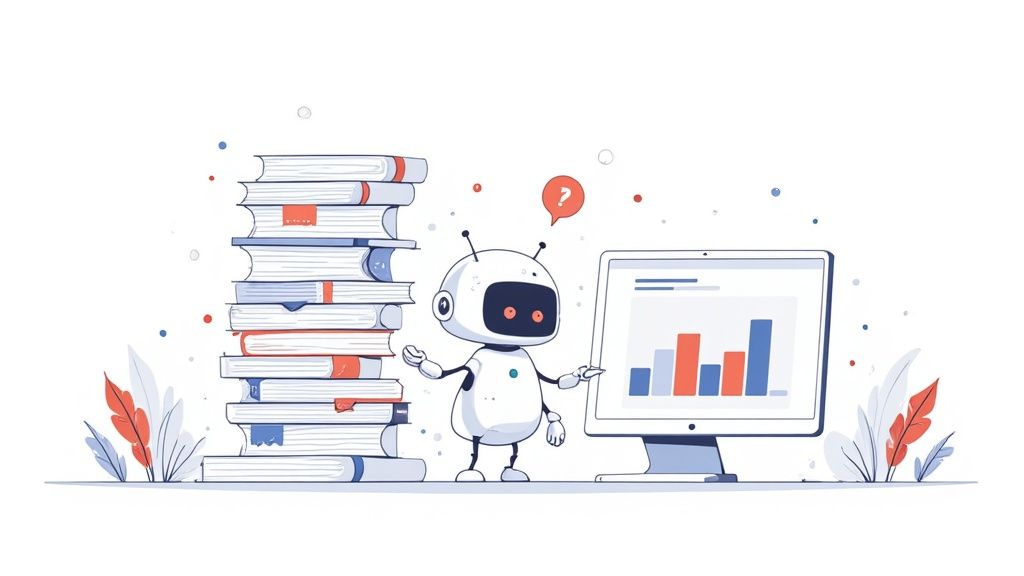
But technology is completely changing the game. Modern AI contract review tools can automatically pull out, analyze, and sort every LoL clause your company has ever agreed to. What was once a mountain of static documents becomes a live, dynamic risk dashboard. Making this shift from reactive fire-fighting to proactive risk management is critical, especially as liability costs keep climbing. For instance, in 2025, the average general liability claim size jumped to roughly $18,200, pushed up by rising legal fees and social inflation.
From Manual Effort to Automated Intelligence
Picture a real estate firm in Australia trying to get a handle on its total liability exposure across a massive portfolio of property management agreements. Doing that by hand would tie up a paralegal for weeks. With an AI platform, they can get a clear answer in minutes, instantly flagging contracts with non-standard caps or missing carve-outs for critical risks.
This kind of immediate insight allows businesses to:
- Quantify Aggregate Risk: Get an instant, accurate picture of your total potential liability across every active agreement.
- Identify Outliers: Quickly spot contracts with unusually high caps or other unfavorable terms that need a closer look.
- Standardize Future Agreements: Use data from past contracts to build a smarter negotiation playbook and strengthen your template language.
This proactive approach is a huge advantage. To manage contract risk effectively, it's essential to stay informed about the best AI tools for legal professionals that can give your team a strategic edge.
Making Enterprise-Grade AI Accessible
Not too long ago, this level of sophisticated AI contract review was only available to massive corporations with equally massive budgets. BoloSign is here to change that. We believe every business deserves access to tools that protect them from major financial risk.
Our platform offers unlimited document analysis, templates, and team members for one fixed price, making it up to 90% more affordable than alternatives like DocuSign or PandaDoc. You can create, send, and sign an unlimited number of PDFs and forms, all while our AI works in the background to keep you compliant and in control of your contractual obligations. And with full support for ESIGN, eIDAS, HIPAA, and GDPR, our digital signing solution ensures your workflows are secure and legally sound, no matter where you do business.
Ready to see how AI can transform your risk management strategy? Start a 7-day free trial today and experience BoloSign for yourself.
Your Essential Checklist for LoL Clauses
Let's be honest, staring down a dense limitation of liability clause can feel like deciphering a secret code. But it doesn't have to. A methodical approach transforms that wall of text into a manageable set of risk-control levers. This simple checklist pulls together everything we've covered, giving you a clear, repeatable framework for your next contract review.
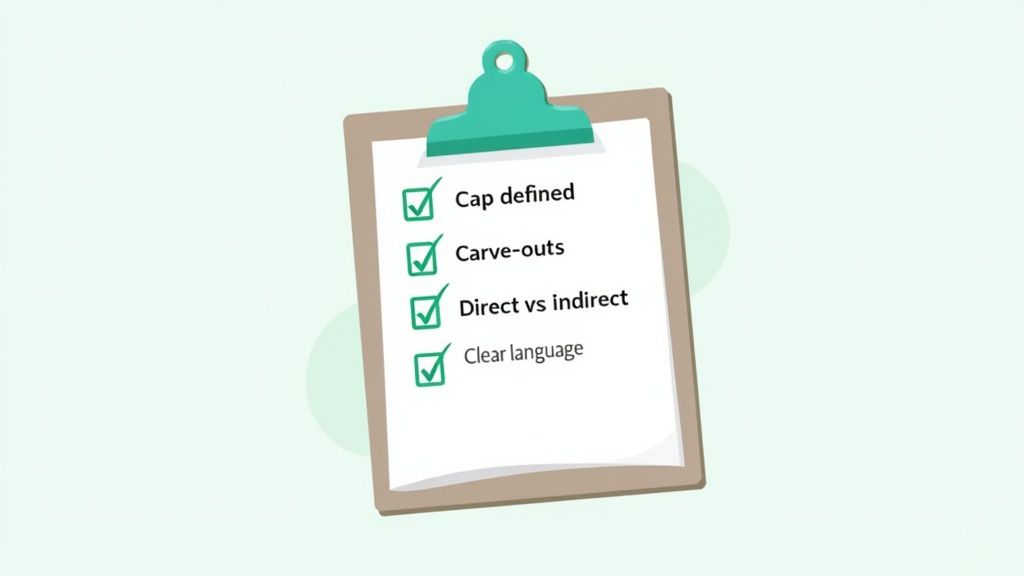
Before you sign off on any agreement, take a moment and run through these four crucial checkpoints:
- Is the liability cap clearly defined? Look for an unambiguous monetary ceiling. Is it a fixed dollar amount or tied directly to the contract's value? Vague language here is a red flag.
- Are key risks carved out? Your highest-stakes issues—things like data privacy breaches, IP infringement, and willful misconduct—should be explicitly excluded from the cap. Don't leave this to interpretation.
- Does it address both direct and indirect damages? A well-drafted clause almost always excludes indirect (or consequential) damages. This is a critical step to shield the business from unpredictable and sprawling financial exposure.
- Is the language clear and enforceable? Ambiguity is your enemy. The clause needs to be written with enough precision to stand up in court if it's ever challenged.
While this checklist is a fantastic manual tool, the most reliable way to enforce consistency across hundreds of agreements is with an integrated platform. Tools like BoloSign not only automate these checks using AI contract review but also connect the entire workflow, from drafting all the way to a secure eSignature. It’s the smart, affordable way to make complex contract management feel simple.
Ready to see how a connected workflow can change your process? Start your 7-day free trial today and experience BoloSign for yourself.
Frequently Asked Questions
When you're deep in negotiations, questions about limitation of liability clauses always come up. Here are a few of the most common ones we see, with practical answers to help you navigate these critical terms.
Can a Limitation of Liability Clause Eliminate All My Risk?
Not a chance. Think of it as a risk management tool, not a risk elimination tool. It’s designed to put a reasonable ceiling on potential damages, but it can't create a get-out-of-jail-free card.
Courts almost universally refuse to enforce limitations for things like intentional harm, fraud, or gross negligence. Doing so would go against public policy. The real goal is to make the risk from a standard breach of contract or simple mistake predictable and insurable, allowing businesses to operate without the fear of a single error leading to financial ruin.
What Is a Super Cap in a Liability Clause?
A “super cap” is just what it sounds like: a higher liability limit set for specific, high-risk events that are carved out from the general cap. This creates a smart, tiered structure for managing different kinds of risk within the same contract.
For instance, an agreement might have a general liability cap equal to 12 months' fees for most issues. But for something much more serious, like a data breach or a violation of intellectual property rights, it might have a “super cap” of several million dollars. This gives both sides extra protection where it matters most.
How Does Contract Automation Help Manage These Clauses?
This is where the game really changes. Contract automation platforms like BoloSign take the guesswork and inconsistency out of the equation. Instead of letting team members draft clauses from scratch, you can use pre-approved templates with compliant language, ensuring every agreement starts from a safe, standardized place.
During negotiations, the platform creates a clean, clear audit trail of every change and redline. After the deal is signed with a secure eSignature, AI-powered tools can instantly scan your entire contract portfolio, pull out every LoL clause, and put your total risk exposure on a live dashboard. It replaces hours of tedious, error-prone manual work with proactive, intelligent risk management.
Ready to stop guessing and start managing your contract risk with confidence? BoloSign makes it simple with unlimited documents, templates, and team members for one fixed price. Start your 7-day free trial today and see how AI-powered automation can protect your business.

Paresh Deshmukh
Co-Founder, BoloForms
6 Dec, 2025
Take a Look at Our Featured Articles
These articles will guide you on how to simplify office work, boost your efficiency, and concentrate on expanding your business.