

A Practical Guide to HR Document Management
Transform your HR workflow with a modern HR document management system. Learn how to boost efficiency, ensure compliance, and secure sensitive employee data.

Tired of nonsense pricing of DocuSign?
Start taking digital signatures with BoloSign and save money.
HR document management is the backbone of a modern people operations strategy. It's the systematic way you create, store, secure, and pull up every employee-related file—from offer letters and performance reviews to benefits forms and offboarding checklists. This isn't just about tidying up shared drives; it's about building a single, secure source of truth that drives compliance and efficiency.
Why Modern HR Document Management Matters More Than Ever
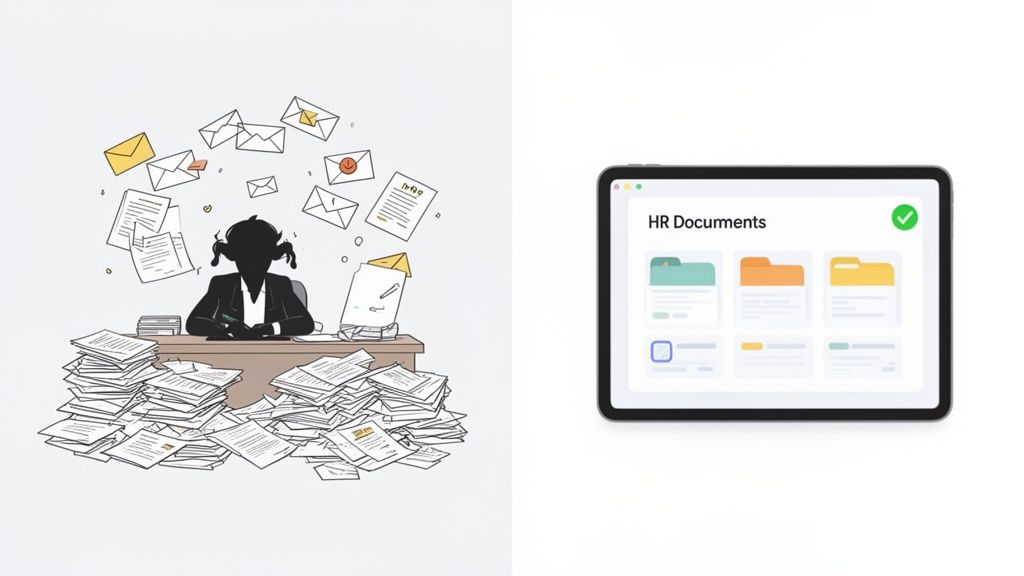
Let's be real: hunting through endless email threads and disorganized shared folders for employee files isn't just a waste of time—it's a huge business risk. In today's hybrid work world, the pressure on HR teams has never been greater. Manual, disconnected systems for handling offer letters, onboarding packets, and policy updates are a recipe for compliance disasters and legal headaches.
This isn't just about administrative friction; it has very real financial and legal consequences. Incomplete, inconsistent, or scattered documentation is a primary cause of legal disputes. In fact, research shows that a shocking 70% of employment lawsuits are tied to inadequate records. On the flip side, consistent documentation can slash those legal risks by as much as 40%.
The Shift from Paper Pushing to Strategic Partnering
The role of HR is no longer about managing paperwork. It’s evolved into a strategic function responsible for shaping talent acquisition, driving employee engagement, and building a strong organizational culture. A manual, outdated approach to document management actively undermines these critical goals.
When your team is spending its days chasing signatures, manually keying in data, or digging for a misplaced form, they have no time left for the high-impact work that truly matters.
Think about these common scenarios:
- A staffing agency has to onboard dozens of new contractors for a big project. A manual process creates bottlenecks, delaying placements and stalling revenue.
- A healthcare provider manages sensitive employee health records and must maintain strict HIPAA compliance. One misplaced file could trigger a severe data breach and massive fines.
- A real estate brokerage handles complex commission agreements that need timely, accurate signatures to ensure agents get paid correctly and on time.
In every case, old-school systems create friction, magnify risk, and pull focus from the company's core mission. This is where a centralized, automated system becomes a strategic necessity.
Beyond 'Going Paperless'
Bringing in a modern platform is about so much more than just scanning documents. It's a fundamental upgrade to how your entire HR operation functions, embedding efficiency and security into every step. You can see a full overview of this transformation in our guide to effective document management in HR.
Let's look at how automation changes the game.
Manual vs. Automated HR Document Management
| Process Area | Manual Approach (The Risk) | BoloSign's Automated Approach (The Solution) |
|---|---|---|
| Onboarding | Inconsistent document versions, missed signatures, and slow start times. | Standardized templates are sent, signed, and stored automatically. |
| Compliance | Scattered files, failed audits, and high risk of fines for HIPAA, GDPR, etc. | Centralized, access-controlled storage with clear audit trails. |
| Offboarding | Incomplete paperwork, security gaps, and lingering access permissions. | Automated workflows ensure all exit documents are signed and access is revoked. |
| Record Keeping | Lost documents, version control nightmares, and wasted time searching. | A single source of truth where documents are secure and instantly searchable. |
| Signatures | Printing, signing, scanning, and emailing creates massive delays. | Secure eSignatures are collected in minutes, not days. |
This comparison makes it clear: clinging to manual processes is no longer a viable option for a growing business.
An integrated platform with eSignature and contract automation isn't just another tool; it’s a completely new operational model. It minimizes risk, elevates the employee experience, and builds an HR department that’s ready for the future.
With a platform like BoloSign, you can create, send, and sign PDFs, templates, and forms instantly. Build reusable templates for offer letters or policy updates, then automate the entire workflow while ensuring compliance with standards like the ESIGN Act and GDPR. This is how you build an HR foundation that is resilient, efficient, and truly modern.
Building Your Smart Document Strategy
Bringing in a new system is about more than just buying software; it's about building a smarter, more intentional strategy from the ground up. This all starts with a practical blueprint for your HR documents—deciding what you need to keep, for how long, and why. Without a clear plan, even the best tools can't fix a chaotic process.
The first move is to classify your documents. Let's be honest, not all employee files are created equal, and you can't manage them effectively if you treat them that way.
Key Document Classifications
It helps to think in terms of the employee lifecycle. Most HR documents fall into one of these buckets:
- Recruitment and Hiring: This is everything from the first touchpoint, like applications and resumes, to interview notes and signed offer letters.
- Core Employment Records: These are the non-negotiables—the signed employment contracts, I-9 forms, and confidentiality agreements that form the legal basis of employment.
- Performance and Development: Think performance reviews, goal-setting documents, records of completed training, and any paperwork related to promotions.
- Payroll and Benefits: This covers all the financial paperwork, like W-4s, direct deposit authorizations, benefits enrollment forms, and compensation statements.
- Sensitive and Medical Information: Documents like FMLA requests, ADA accommodations, and other health-related files demand the highest level of security and must be stored with strictly limited access.
- Separation Records: When an employee leaves, you'll have resignation letters, notes from the exit interview, and final pay documentation to manage.
Once everything has a category, the next critical piece of the puzzle is your retention policy. This isn't just a "nice to have"—regulatory bodies dictate exactly how long you must legally keep certain documents.
For example, I-9 forms must be kept for three years after the date of hire or one year after employment ends, whichever is later. For a deeper dive into building out your policies, this ultimate guide to document management for business is a fantastic resource.
Your retention policy isn't just a guideline; it's your primary defense in an audit or legal dispute. Aligning it with regulations like GDPR, HIPAA, and local labor laws is non-negotiable for a compliant hr document management system.
This is where your industry really matters. A US-based healthcare organization must handle employee medical files with extreme care to maintain HIPAA compliance, which often means keeping them in a separate, more secure digital folder than general personnel files. A high-volume staffing agency, on the other hand, needs a rock-solid process for managing thousands of contractor agreements, each with its own expiration and renewal cycle.
Standardizing for Consistency and Compliance
Standardization is what makes an efficient document strategy actually work in the real world. Creating consistent templates for common documents—like offer letters, performance reviews, and policy acknowledgments—ensures every new file is compliant from the moment it’s created.
This is exactly what BoloSign’s template feature was built for. You can create, send, and sign PDFs, templates, and forms instantly, locking in your approved legal language and branding. This simple step eliminates the risk of a hiring manager grabbing an outdated offer letter from their desktop, guaranteeing every employee gets the correct, compliant paperwork, every single time.
By exploring these document management best practices, you can build a system that not only supports your organization’s growth but also protects it.
This strategic foundation—built on clear classification, legally sound retention policies, and standardized templates—is what transforms your HR function from a reactive administrative hub into a proactive, compliant, and efficient operation.
Automating Your Core HR Workflows
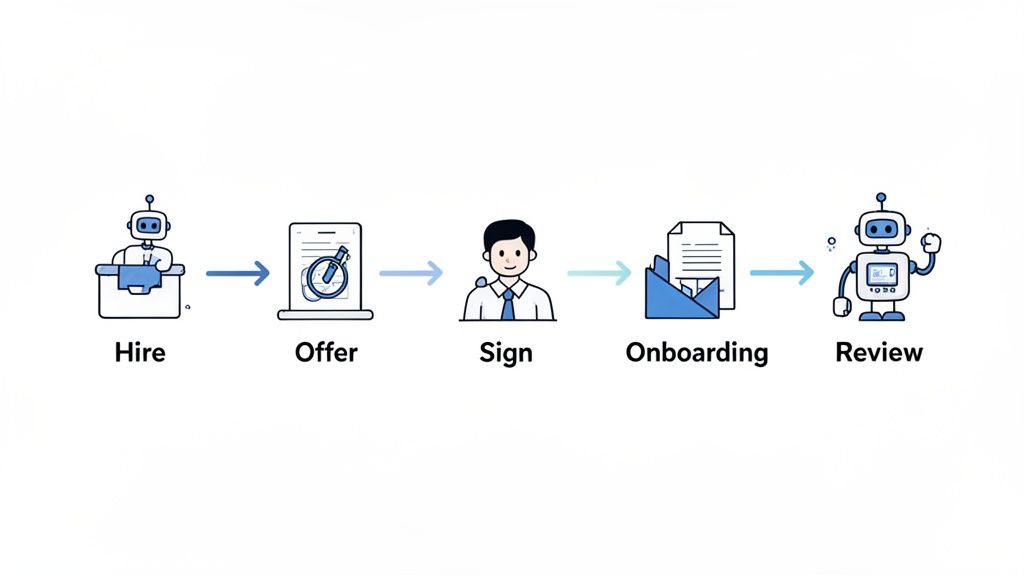
Once your document strategy is locked in, it’s time for the most impactful step: automating your core HR workflows. This is where you graduate from reactive, manual processes to a proactive and efficient system that touches the entire employee lifecycle.
Automation isn’t about replacing the human side of HR. It’s about freeing your team from the endless loop of repetitive tasks so they can actually focus on your people.
This shift is more than just a convenience; it's essential. By 2026, HR document management is expected to become an intelligent, AI-driven ecosystem, leaving outdated manual processes behind. Think of automated classification, where AI instantly analyzes and categorizes new documents—a critical capability for managing the sheer volume of data HR handles today.
From Onboarding to Offboarding
Consider the entire journey an employee takes with your company. Automation can smooth out every single touchpoint, creating a seamless and professional experience from day one.
Picture a new hire at a growing logistics firm. Instead of a messy email chain loaded with attachments, they get a single, secure link from BoloSign. Through that link, they can review and sign PDFs online—offer letter, policy acknowledgments, tax forms—all before they even walk in the door. It sets a great first impression.
The same clean efficiency applies to offboarding. When an employee at a professional services firm resigns, a pre-set workflow can automatically trigger and distribute exit interview forms, final pay stubs, and NDA reminders. It guarantees a complete and compliant separation every time.
Real-World Workflow Automation Examples
Automation delivers tangible results by slashing errors and accelerating turnaround times. Here are a few practical scenarios I’ve seen work wonders:
- Healthcare: A clinic manager uses a pre-approved BoloSign template for the annual HIPAA policy acknowledgment. The system automatically sends it to all staff, tracks who has signed, and nudges those who haven't. The result is a perfect audit trail with zero manual effort.
- Education: A school district automates its yearly teacher contract renewals. Teachers receive their new contracts via a secure link, sign them electronically, and the documents are instantly filed in their digital personnel folder. No printing, no scanning, no chasing signatures.
- Real Estate: A brokerage firm uses contract automation to generate agent commission agreements. When a new agent joins, their agreement is auto-populated and sent for an eSignature, getting them ready to close deals on their first day.
At its core, workflow automation is about creating reliable, repeatable processes. It ensures the right documents get to the right people at the right time, with every action tracked for compliance.
With BoloSign, you can manage unlimited documents and templates for your entire team at one fixed price, making these powerful workflows up to 90% more affordable than alternatives like DocuSign. We also offer more in-depth guides on building these processes in our article about HR document management solutions.
BoloSign’s AI-powered automation and contract intelligence even help you review contract clauses for compliance, adding another layer of security to your workflows. This integrated approach ensures your HR processes are not just faster, but smarter and safer.
Ready to see it in action? You can start transforming your HR processes with a 7-day free trial and experience it firsthand.
Integrating Your HR Tech Stack for Full Efficiency
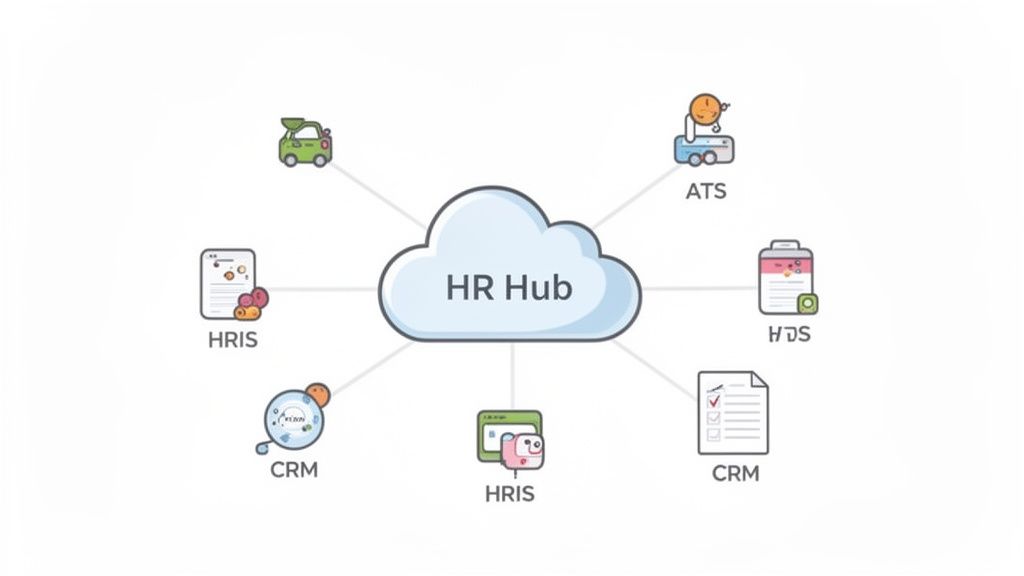
An HR document management system shouldn't be another island. To really get the most out of it, you have to connect it with the other tools your team lives in every day. When your tech stack is fully integrated, you create a single, reliable source of truth for all employee information, finally breaking down the data silos that cause errors and eat up valuable time.
Many companies invest in a powerful Human Resources Information System (HRIS) but never get around to connecting it with their document workflows. This gap is shockingly common. One study found that a staggering 82% of companies aren't using their HR software to its full potential for critical workflows, and 58% don't even see it as an essential tool. This is a massive missed opportunity. You can find more data on this tech gap and learn how businesses are leveraging HR statistics.
When you connect your systems, you turn disconnected data points into a seamless, intelligent network.
Connecting the Dots for Seamless Workflows
Think about all the manual data entry that happens every single day. A manager marks a candidate as "hired" in the Applicant Tracking System (ATS), then has to switch screens to manually create an offer letter, copy-paste the details, and send it out. That process is a perfect recipe for typos and delays.
Now, picture a connected workflow. The moment a candidate's status changes in the ATS, it automatically triggers BoloSign to generate the right offer letter from a pre-approved template. The system pulls the candidate’s name, salary, and start date, then sends the document for an eSignature—all without a single manual click.
Integrating your tech stack isn't just a technical upgrade; it's a strategic move to eliminate administrative drag. It ensures data consistency, reduces human error, and gives your team hours back each week.
Practical Integration Scenarios
The payoff from integration goes far beyond hiring. A connected system can support your entire business, no matter what industry you're in.
- Real Estate: Link your CRM with BoloSign so that when a new agent is added, their commission agreement is automatically generated and sent. Once signed, the legally binding document is stored centrally, ready for both HR and finance to access.
- Education: Connect your HRIS to your document platform to manage annual teacher contracts. When renewal season comes around, the system can bulk-send updated agreements and track their status in real time.
- Logistics: Integrate your payroll software with your digital signing solutions. When a driver completes their timesheet, it can be automatically routed for approval and signature, speeding up payment cycles and keeping drivers happy.
With BoloSign, you can create, send, and sign PDFs instantly as part of these automated workflows. Our platform is built to connect with the tools you already use, turning fragmented processes into a smooth, efficient operation. This level of contract automation is surprisingly affordable, too. We offer unlimited documents and team members for one fixed price, making it up to 90% more affordable than alternatives like PandaDoc or DocuSign.
Ready to connect your tools and build a truly efficient HR ecosystem? Start a 7-day free trial and see for yourself how seamless integration can transform your workflows.
Ensuring Rock-Solid Security and Compliance
When it comes to HR document management, security and compliance aren’t just features; they're the foundation. Think of them as non-negotiables that protect both your people and your organization from serious risk. Getting this right goes way beyond basic password protection—it means really understanding the legal landscape you're operating in.
Wading through regulations like the ESIGN Act, eIDAS, HIPAA, and GDPR can feel overwhelming, but what they ask for is actually pretty logical. They all boil down to safeguarding personal data, making sure your digital documents are legally sound, and keeping a clear, undeniable record of every action taken.
From Regulations to Daily Practice
The real challenge isn't knowing the laws exist; it's translating them into your day-to-day operations. This is exactly where a modern HR platform becomes essential, and it all starts with controlling who can see what.
A smart system lets you set up role-based access controls, which is a critical first step for managing sensitive employee information. For example, a hiring manager should absolutely have access to a candidate’s application and offer letter. But should they see the entire company's payroll or medical records? Of course not. This simple, granular control is a cornerstone of both HIPAA and GDPR compliance.
The other piece of the puzzle is a bulletproof audit trail. You need a detailed, unchangeable log that records every single touchpoint with a document—who viewed it, when they opened it, if they edited it, and the exact moment it was signed. This level of transparency is your best defense if a dispute or an audit ever comes up.
Peace of mind comes from knowing your HR platform is built on a foundation of enterprise-grade security. With certifications like SOC 2 and ISO 27001, BoloSign ensures your data is protected with the same rigor used by global financial institutions.
The Legal Power of eSignatures
The entire shift to digital HR workflows really hinges on one thing: the legal validity of your electronic signatures. A legally binding eSignature is what turns a simple digital file into an enforceable contract, whether it's an employment agreement, an NDA, or a benefits enrollment form.
This is where BoloSign gives you a clear, confident advantage. Every single document you create, send, and sign instantly through our platform is backed by those comprehensive audit trails and is fully compliant with major regulations like the ESIGN Act and eIDAS. It's the modern, defensible way to manage your HR strategy. We provide the tools you need to build trust and maintain a compliant workplace. For more advanced considerations, a comprehensive guide to navigating AI ethics, EPPA compliance, and risk management in Human Resources is invaluable.
By building these security and compliance features directly into your workflows, you can stop worrying and manage your HR responsibilities with confidence. This integrated approach—which is much more affordable than you might think—lets you focus on your people, not your paperwork.
Ready to see how a secure, compliant system can transform your HR operations? You can start a 7-day free trial and experience the BoloSign difference firsthand.
Making the Switch to Smarter HR Management
We’ve covered the groundwork—from setting a clear strategy to automating workflows and locking down compliance. Now comes the most important part: putting it all into practice. Transitioning to a modern HR document management system isn't just about efficiency; it's a strategic move that frees your team to focus on what actually matters: your people.
This is where a platform like BoloSign ties everything together. It’s not just another piece of software but a complete solution designed to handle the entire document lifecycle, from creation to secure storage.
A compliant HR process is built on a clear flow of access, storage, and auditing, which this visual breaks down nicely.
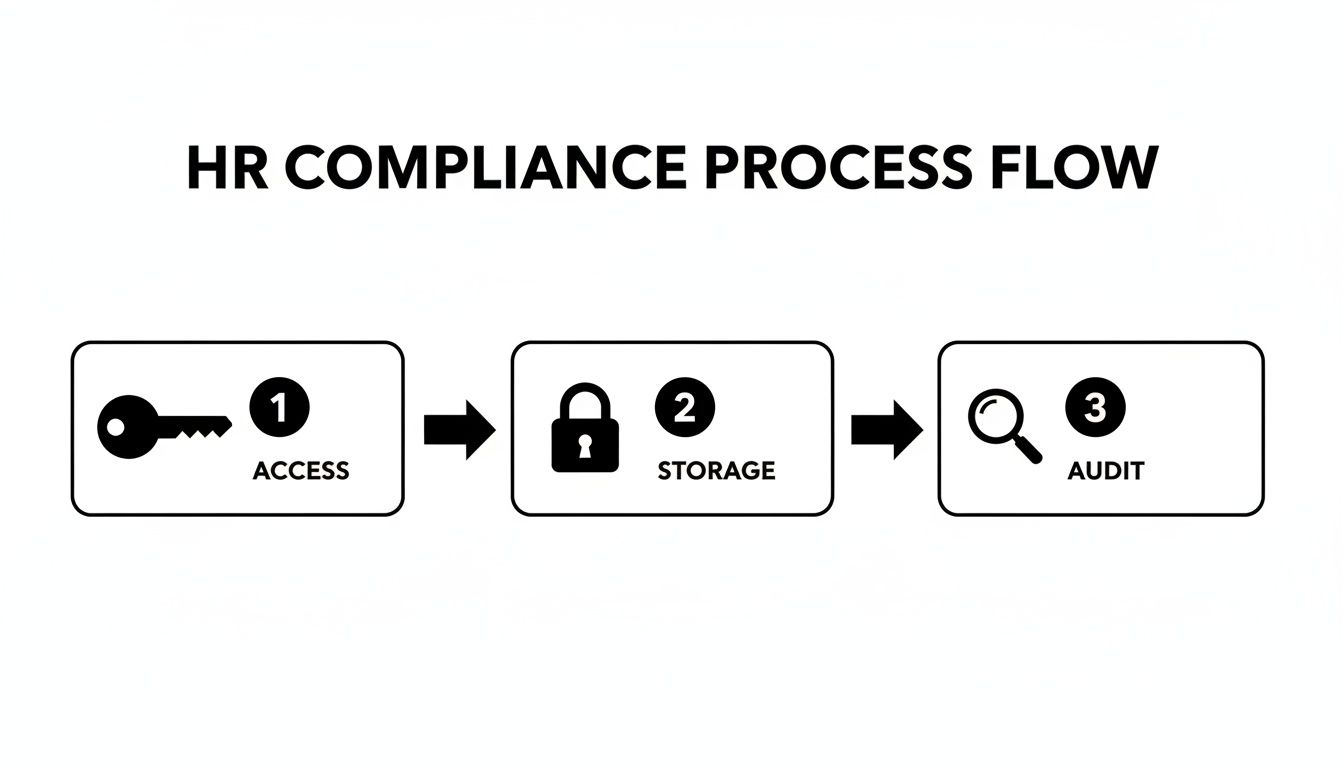
As you can see, a truly secure system is built in layers—controlling who gets in, how files are kept, and ensuring everything is auditable down the line.
Taking Action with BoloSign
The final step is seeing the impact for yourself. With BoloSign, you can create, send, and sign PDFs, templates, and forms instantly. It’s built to give your HR team the speed they need, whether you're a staffing agency onboarding hundreds of contractors or a healthcare provider managing highly sensitive employee files.
What really makes BoloSign a smart choice is its blend of powerful features and practical affordability:
- AI-Powered Automation: Speed up your workflows with intelligent features that cut down on manual tasks. Our AI contract review helps spot risks and keep your agreements consistent.
- Contract Intelligence: Get a deeper look into your HR documents. You can track key dates, ensure compliance with standards like ESIGN and GDPR, and manage obligations without digging through files.
- Unmatched Affordability: Get unlimited documents, templates, and team members for one fixed price. This makes BoloSign up to 90% more affordable than alternatives like DocuSign or PandaDoc, so cost is no longer a barrier to going digital.
By bringing all your processes into a single platform, you're not just getting more efficient—you’re building a stronger compliance foundation. The right digital signing solutions provide the security and audit trails you need to operate with total confidence.
Ready to modernize your HR processes and give your team the tools they deserve? See how BoloSign makes secure, efficient HR document management achievable for any business. Start your 7-day free trial to see it in action.

Paresh Deshmukh
Co-Founder, BoloForms
21 Jan, 2026
Take a Look at Our Featured Articles
These articles will guide you on how to simplify office work, boost your efficiency, and concentrate on expanding your business.