

How to Manage a Contingent Workforce: Your Guide to Scaling Efficiently
Learn how to manage contingent workforce with our guide on policy, onboarding, compliance, and automation. Scale your business and reduce risk effectively.

Tired of nonsense pricing of DocuSign?
Start taking digital signatures with BoloSign and save money.
Managing your contingent workforce effectively isn't just about paperwork; it's a strategic move that hinges on clear policies, smooth onboarding, and smart automation. Get this right, and you'll transform your flexible talent from an administrative headache into a serious competitive advantage.
The Strategic Shift to a Flexible Workforce
Modern business runs on agility, and contingent workers—freelancers, contractors, and temporary staff—are the fuel. Tapping into this talent pool gives you on-demand access to specialized skills, keeps costs flexible, and lets you scale operations at the drop of a hat. But this flexibility comes with a catch. Without a rock-solid management plan, you risk inconsistent results and serious compliance issues.

This isn’t a passing trend; it's a fundamental change in how work gets done. By 2025, contingent workers are expected to make up nearly half of the workforce, with freelancers alone representing a massive 46.6% of global talent. The market for managing these workers is set to hit $6 billion by 2032, which tells you everything you need to know about its importance.
Embracing a New Operational Model
To truly capitalize on a flexible workforce, you have to move beyond disconnected, ad-hoc processes. It's time to build a structured program that treats contingent workers as a valuable, integrated part of your overall talent strategy. Success rests on a few key pillars.
To lay a strong foundation, every contingent workforce program needs a clear structure. The table below outlines the essential pillars that turn ad-hoc hiring into a strategic advantage.
Key Pillars of Contingent Workforce Management
| Pillar | Objective | Key Challenge |
|---|---|---|
| Standardized Policies | Establish clear guidelines for worker classification, sourcing, and vetting. | Ensuring consistency and avoiding misclassification risks. |
| Efficient Onboarding | Create a smooth, fast, and compliant intake process for every contractor. | Reducing time-to-productivity without skipping compliance steps. |
| Automated Contract Management | Use technology to handle agreements from creation to signature. | Eliminating manual bottlenecks and standardizing legal terms. |
| Robust Compliance Controls | Implement safeguards to mitigate labor law and data security risks. | Keeping up with changing regulations across different regions. |
Focusing on these areas ensures that your program is not only efficient but also resilient and compliant from the ground up.
Building this out also means understanding the full range of common outsourced services you might bring in, which helps you tailor your program to fit specific operational needs.
The Role of Smart Automation
Manual processes are the enemy of an agile workforce strategy. Chasing signatures, tracking down documents, and reviewing contracts by hand create bottlenecks that slow you down and invite errors. This is where a digital signing solution becomes non-negotiable.
A centralized, automated system for contracts and onboarding isn't a luxury—it's the foundation for scaling your contingent workforce program without introducing unacceptable risk or administrative burden.
Platforms like BoloSign give you the tools to create, send, and sign PDFs online instantly. By using AI-powered automation and contract intelligence, you can standardize your agreements and ensure every engagement is compliant with global standards like ESIGN, eIDAS, and HIPAA.
This guide will walk you through building a strategy that makes your flexible workforce a true competitive strength.
Building Your Contingent Workforce Playbook
Managing a contingent workforce without a clear plan is like sailing without a map. You might stay afloat for a while, but you’re almost guaranteed to drift into costly compliance issues and administrative chaos.
A successful program starts with well-defined rules of engagement. Think of it as your playbook—a foundational guide that becomes your best defense against legal risks and operational headaches.
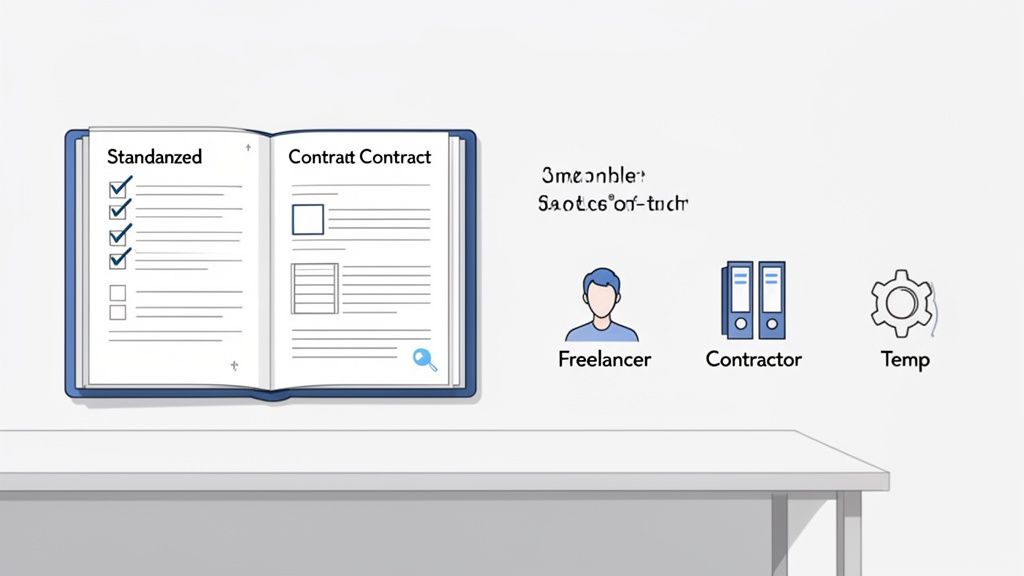
This isn’t about adding bureaucracy. It’s about creating a single source of truth for all worker data, contracts, and processes. When everyone from HR to procurement to hiring managers follows the same script, you gain the consistency, visibility, and control you need over your entire flexible workforce.
Defining Clear Worker Classifications
First things first: you absolutely must establish crystal-clear worker classifications. Getting this wrong is one of the most expensive mistakes a company can make. Misclassifying an employee as an independent contractor can lead to staggering fines, back taxes, and painful legal battles.
Your playbook needs to spell out the differences between non-permanent workers in plain language:
- Independent Contractors (Freelancers): These are individuals running their own business, hired for a specific project or outcome. The key distinction? They control how the work gets done.
- Temporary Workers: Usually sourced through a staffing agency, these workers fill short-term gaps, like covering for an employee on leave. In most cases, the agency is the employer of record.
- Statement of Work (SOW) Consultants: These are project-based workers, often from a consulting firm, brought on to deliver a specific, predefined scope of work.
Documenting these distinctions and training your managers is non-negotiable. It's a simple step that ensures every engagement starts on the right legal footing.
Standardizing Sourcing and Intake Processes
Once you've figured out who you're hiring, you need a consistent process for how you bring them on board. When different departments have their own ad-hoc methods for sourcing and vetting, you create massive inefficiencies and dangerous compliance blind spots.
A standardized intake process brings order to the chaos. It outlines the required steps for every single contingent hire, ensuring nothing critical gets missed. This also creates a professional and organized experience for the worker, which reflects well on your company's brand. To dig deeper into managing external partners, you can explore some of our detailed vendor management best practices.
A fragmented approach to hiring contingent workers is a recipe for disaster. By unifying the management of all non-permanent staff under one system, you gain visibility, reduce administrative overhead, and minimize compliance risks.
This is where contract automation tools become a game-changer. Take a staffing agency, for instance. They used to handle every contractor agreement manually—a slow, error-prone process. By implementing BoloSign, they created standardized, pre-approved templates for different worker types. That one change slashed their onboarding time by over 60% by allowing them to instantly create, send, and get agreements signed.
Creating a Centralized Documentation Hub
The real power of your playbook comes from centralization. Stop letting contracts live in one manager’s inbox, NDAs in another, and payment details in a third. All documentation needs to live in a single, secure location. This is non-negotiable for audits, performance reviews, and offboarding.
A modern digital signing solution like BoloSign is built for exactly this. It's more than just eSignatures; it's a secure repository for all your executed agreements. When you need to find a specific contract, you aren't digging through old emails—you're pulling it from a searchable, organized system with a complete audit trail.
This unified approach streamlines everything from start to finish:
- Creation: Build and store pre-approved contract templates in one place. This guarantees everyone is using the latest, compliant version.
- Execution: Send agreements and sign PDFs online in minutes, with automated reminders to keep the process moving.
- Storage & Retrieval: All signed documents are automatically filed, creating an instant, accessible archive for every contingent worker relationship.
By building your playbook around these core principles—clear classification, standardized intake, and centralized documentation—you create a resilient framework. It allows you to manage your contingent workforce with confidence, knowing your processes are efficient, consistent, and built to protect your business.
Streamlining Onboarding with Contract Automation
A clunky, paper-based onboarding process is the fastest way to sour a relationship with top talent before they even start. Think about it: that first impression sets the tone for the entire engagement. When you force a new contractor to navigate slow, confusing paperwork, it signals disorganization and can make them second-guess the partnership.
Efficient onboarding isn't just about ticking boxes; it's a critical step in building a positive, productive relationship right from day one.
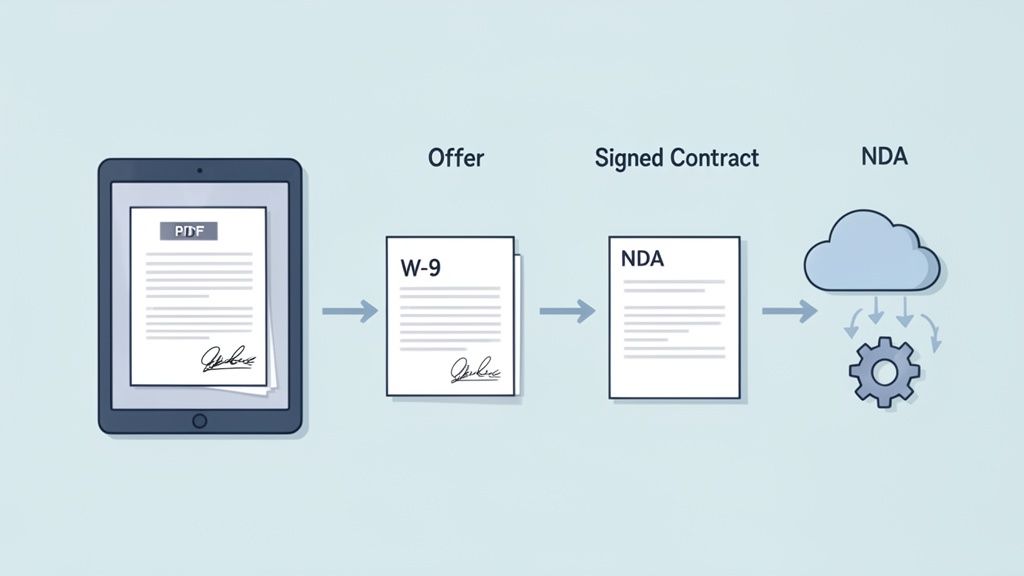
From sending the initial offer letter and independent contractor agreement to collecting W-9s and NDAs, technology is your best friend here. Manual methods are slow and notoriously prone to human error, which can open up serious compliance gaps. Automating this entire workflow is the key to managing your contingent workforce effectively and at scale.
The Ideal Onboarding Workflow
The goal is simple: get contractors productive as quickly as possible without cutting corners on compliance. A well-designed digital workflow removes friction for everyone involved—the contractor, the hiring manager, and your HR or procurement teams. The average time-to-fill for a role can hover around 41 days, so once you find the right person, you can't afford delays.
A modern, automated workflow should feel effortless. It typically includes:
- Centralized Templates: Store pre-approved templates for all your essential documents—contracts, SOWs, NDAs, and policy acknowledgments. This keeps everything consistent and compliant.
- Instant Document Delivery: The moment a candidate accepts, the entire onboarding packet should be sent to them automatically for review and signature.
- Simple Digital Signing: Workers should be able to sign PDFs online from any device in just a few clicks. No more printing, scanning, or mailing anything back.
- Automated Reminders: The system should automatically nudge workers who haven't completed their documents, saving your team from the headache of manual follow-ups.
- Secure Document Storage: All signed agreements and forms are instantly and securely filed in a central repository, creating a complete, easily accessible record for audits.
This approach transforms onboarding from a multi-day ordeal into a process that can be wrapped up in minutes.
How BoloSign Powers Efficient Onboarding
A powerful digital signing solution like BoloSign is built to handle this entire process from end to end. It’s much more than a simple tool to add a signature to a Google Form or PDF; it’s a comprehensive platform for contract automation.
With BoloSign, you can create, send, and get documents signed in a flash. The platform lets you build a library of reusable templates, ensuring every contractor receives the correct, legally vetted paperwork every single time. This is a lifesaver for companies managing workers across different regions or with varying project scopes.
A fast-tracked, professional onboarding experience is a competitive advantage. It demonstrates respect for a contractor's time and sets the stage for a successful working relationship, all while reinforcing your company's commitment to efficiency and compliance.
For example, a professional services firm can use BoloSign to onboard dozens of freelance consultants each quarter. They can set up a standardized onboarding "packet" right in the platform. With one click, they send the consulting agreement, NDA, and payment information form. The consultant can sign everything on their phone, and the signed documents are automatically filed, notifying the project manager that the consultant is officially ready to start.
Leveraging AI for Smarter Contracting
Beyond signatures, advanced platforms now incorporate AI contract review capabilities. This technology can be a massive asset when you manage a contingent workforce. BoloSign's AI-powered contract intelligence can scan agreements to flag non-standard clauses, identify potential risks, or ensure specific legal language is included.
This AI layer acts as a much-needed safety net, helping your team spot potential issues before they become real problems. For a staffing agency, this could mean quickly verifying that a new client's SOW aligns with their standard liability terms. For a healthcare clinic onboarding a temporary practitioner, it ensures all HIPAA compliance clauses are correctly stated. Exploring different types of CLM software can provide a clearer picture of how these advanced features fit into a broader contract management strategy.
The Affordability Advantage for Growing Businesses
Managing a contingent workforce often means dealing with a high volume of contracts. Traditional eSignature providers with per-document or "per-envelope" pricing models can become incredibly expensive, effectively punishing you for your own growth. This is where BoloSign offers a clear, refreshing advantage.
BoloSign operates on a simple, fixed-price model that includes unlimited documents, unlimited templates, and unlimited team members. This predictable pricing makes it up to 90% more affordable than platforms like DocuSign or PandaDoc, removing financial barriers to automation. You can onboard one contractor or one hundred without ever worrying about surprise costs, making it the ideal solution for scaling your flexible workforce program with confidence.
Ready to see how a streamlined onboarding process can transform your contingent worker management? Give BoloSign a try and experience the difference firsthand.
Navigating Compliance and Mitigating Risk
Hiring contingent workers gives you incredible agility, but it also opens up a complex world of legal and regulatory hurdles. Think of compliance not as a box to check, but as the essential framework that protects your business from steep fines, legal battles, and a damaged reputation. Ignoring these risks is a gamble no company can afford to take.
The biggest tripwires are almost always worker misclassification, co-employment risks, and data security. Each one demands careful planning and solid processes to keep your operations on the right side of the law. This is where having the right tools and a clear grasp of your obligations becomes non-negotiable.
The High Stakes of Worker Misclassification
Worker misclassification is easily the biggest compliance landmine in contingent workforce management. Labeling an employee as an independent contractor by mistake can unleash a storm of consequences, including back taxes, benefit liabilities, and other painful penalties. The line is often blurry and changes depending on where you operate, but it usually boils down to how much control you have over the worker.
Your first line of defense is a rock-solid, standardized contracting process. Your agreements and day-to-day working relationships have to clearly reflect the nature of the engagement. A digital signing solution like BoloSign lets you deploy pre-approved templates that spell out the terms of an independent contractor relationship, ensuring every agreement is consistent and creates a clear record of intent.
Avoiding Co-Employment Pitfalls
Co-employment risk pops up when your company and a staffing agency share so much control over a temporary worker that you're both legally considered employers. This can saddle you with unintended obligations around wages, benefits, and workplace safety. The secret to avoiding this is maintaining a crystal-clear separation of duties.
Your agreements with staffing agencies must explicitly define who is responsible for what. For instance, a professional services firm bringing on temporary project managers must ensure the agency handles payroll, benefits, and performance reviews. BoloSign helps solidify these boundaries by creating an unalterable, time-stamped record of these agreements, proving a clear and compliant relationship. A well-defined vendor risk management framework is a critical piece of this puzzle.
An airtight audit trail is your best defense in any compliance dispute. Every action taken on a document—from creation to signature—must be logged, verifiable, and secure to prove due diligence.
Upholding Global Compliance and Data Security
In today's connected world, a global contingent workforce means navigating a patchwork of international laws. Standards like the ESIGN Act in the U.S. and eIDAS in the EU provide the legal basis for eSignatures, but other rules like HIPAA and GDPR dictate how you handle data privacy and security.
Imagine a healthcare clinic managing contracts with traveling nurses and physicians. Every single document must be handled in a HIPAA-compliant way. Using a platform like BoloSign, built with enterprise-grade security and compliance certifications, gives you that peace of mind. All documents are encrypted and access is tightly controlled, ensuring sensitive information stays protected.
This is especially critical for industries handling sensitive data:
- Healthcare: Protecting patient data confidentiality in all contractor agreements and NDAs.
- Professional Services: Shielding client intellectual property and strategic plans when engaging external consultants.
- Logistics: Securing sensitive shipping and client data shared with contract drivers or third-party logistics partners.
BoloSign provides a verifiable audit trail for every document. This detailed log captures every view, edit, and signature, creating a powerful, legally defensible history of the agreement. It's not just a feature; it's a fundamental risk mitigation tool. With AI contract review, you can even automatically scan agreements for compliance-related clauses, adding another layer of protection.
Best of all, this enterprise-level compliance is actually accessible. BoloSign’s fixed-price model means you get unlimited documents, templates, and team members without the punishing per-envelope fees of competitors. It’s up to 90% more affordable than DocuSign or PandaDoc, making it possible for any organization to implement a secure, compliant contract automation system.
Ready to see how simple and secure managing contractor agreements can be? Start your 7-day free trial of BoloSign and experience firsthand how powerful, compliant eSignatures can protect your business.
Automating Workflows to Scale with Confidence
Once you've built a solid playbook and a compliant foundation, your focus naturally shifts to optimization and scale. Manual processes that worked just fine for a handful of contractors will quickly become painful bottlenecks as your program grows.
This is where automation comes in. It’s the key to transforming your ability to manage a contingent workforce, turning repetitive, error-prone tasks into seamless, efficient workflows.
True scalability isn't just about doing things faster; it comes from creating a connected ecosystem of tools. Integrating your eSignature platform—like BoloSign—with your CRM or HRIS via a Document Signing API eliminates tedious manual data entry and keeps information consistent across your entire tech stack. This creates powerful, automated sequences that save time and kill the risk of human error.
Imagine a real estate brokerage, for example. They can set up a workflow where closing a deal in their CRM automatically triggers a commission agreement to be sent from BoloSign for an eSignature. No delays, no forgotten paperwork—just a smooth, professional process that lets everyone get paid faster.
Key Performance Indicators to Track
You can't improve what you don't measure. To really understand the health and effectiveness of your contingent workforce program, you need to track the right Key Performance Indicators (KPIs). These metrics give you the data-driven insights needed to spot what’s working, fix what isn't, and make smarter decisions.
Don't overcomplicate it. Focus on a handful of high-impact KPIs:
- Time-to-Fill: This is the number of days from when a need is identified to when a contractor starts their assignment. A long time-to-fill can signal friction in your sourcing or onboarding process.
- Cost-per-Hire: This includes all costs tied to bringing a new contractor on board—agency fees, advertising, and administrative time. Automation drastically lowers this by slashing manual labor.
- Compliance Adherence: Track the percentage of contractors with fully executed, compliant contracts and all required documentation on file before their start date. This is a critical risk mitigation metric.
- Contractor Satisfaction: Use simple surveys to gauge the onboarding experience and overall satisfaction of your contingent workers. A positive experience is key to attracting and retaining top-tier freelance talent.
To get these workflows humming, exploring the best contractor management software can provide a huge lift and perfectly complement your eSignature solution.
Manual vs. Automated Contingent Worker Contracting
The difference between manual and automated contracting isn't just about speed; it's a night-and-day comparison in terms of cost, risk, and scalability. Manual workflows are slow, expensive, and riddled with opportunities for human error—the kinds of mistakes that lead to serious compliance gaps. Let's look at how a typical contracting process stacks up.
The image below breaks down the three biggest compliance risks that manual processes magnify: misclassification, co-employment, and data security.
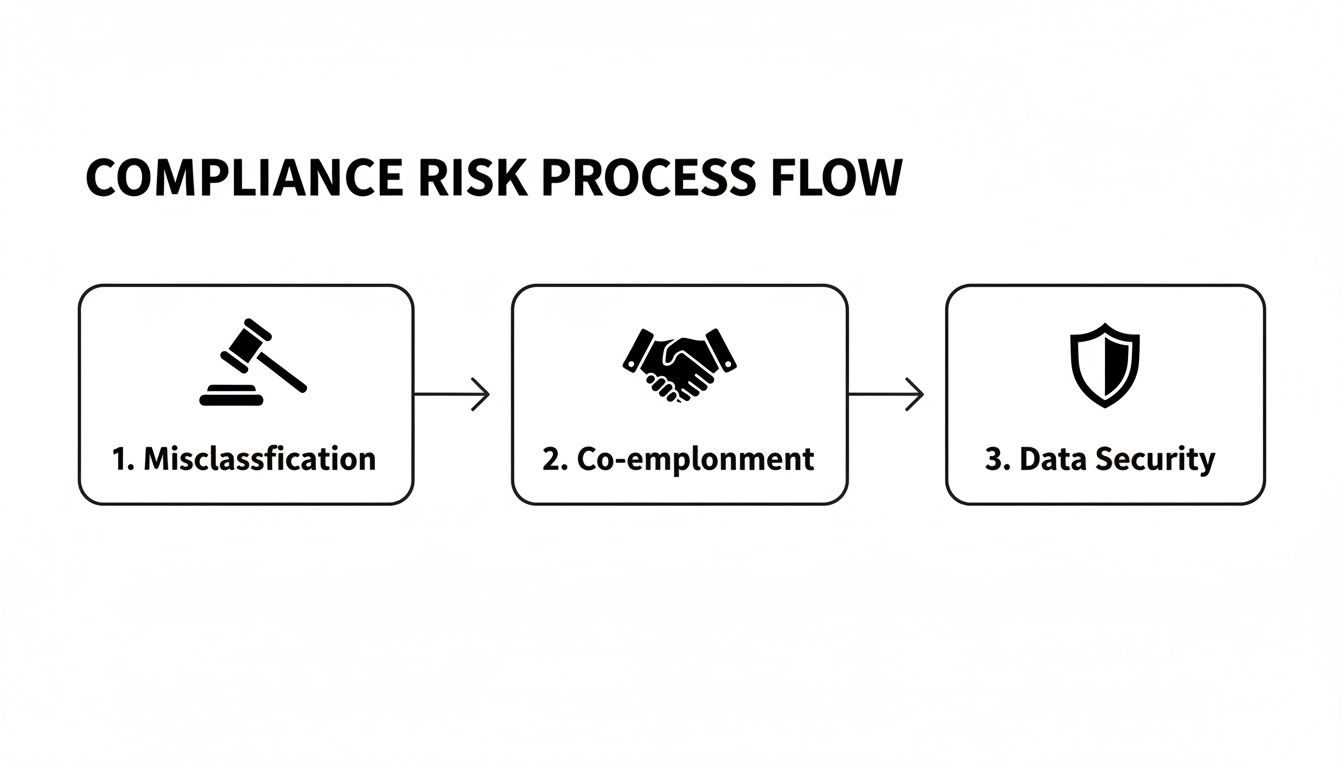
This visual makes it clear: every manual step is a potential failure point. Automation, on the other hand, builds standardized safeguards directly into the process to head off these common pitfalls.
| Task | Manual Process (Time & Risk) | Automated with BoloSign (Time & Benefit) |
|---|---|---|
| Contract Creation | 2-4 hours. Copy-pasting data from CRM/HRIS into a Word doc. High risk of using outdated templates or entering incorrect details. | Under 5 minutes. A pre-approved template auto-populates with synced data from your CRM. Zero data entry errors. |
| Internal Review & Approval | 1-3 days. Chasing approvals via email chains. No visibility into status; easy for requests to get lost in inboxes. | Minutes to hours. Automated approval workflows notify stakeholders instantly. Full visibility into the contract's status at all times. |
| Sending & Signing | 2-5 days. Emailing PDFs back and forth. No tracking, manual follow-ups needed. High friction for the contractor. | Immediate. Sent for eSignature with one click. Automated reminders ensure prompt signing. Contractors sign on any device in minutes. |
| Filing & Storage | 15-30 minutes. Manually downloading the signed PDF, renaming it, and uploading it to a shared drive. Risk of misfiling or loss. | Instant & Automatic. The fully executed contract is securely stored and indexed in a central repository. No manual effort required. |
As you can see, the choice is pretty clear. Automation doesn't just make the process faster; it makes it smarter, safer, and far more cost-effective.
How BoloSign Drives Scalable Automation
This is exactly where a platform like BoloSign shines. It’s built to eliminate the friction and risk that comes with manual contracting, allowing you to sign PDFs online and manage the entire lifecycle with ease.
BoloSign centralizes your entire contracting process:
- Create Instantly: Build a library of pre-approved contract templates for different roles, projects, and regions.
- Send Securely: Distribute agreements for eSignature with a single click, with automated reminders ensuring nothing falls through the cracks.
- Sign from Anywhere: Contractors can review and sign documents on any device, completing their onboarding in minutes instead of days.
Automation isn't about replacing human oversight. It's about freeing up your team to focus on strategic work by eliminating the soul-crushing, low-value, repetitive tasks. It's the engine for confident, compliant scaling.
The platform's AI contract review adds another layer of intelligence, helping to spot non-standard clauses that could introduce risk. This contract automation capability is crucial for organizations that need to move fast without sacrificing diligence.
Perhaps most importantly, BoloSign’s fixed-price model makes this powerful automation accessible. With unlimited documents, templates, and team members, you can scale your contingent workforce program without your costs spiraling out of control. It’s up to 90% more affordable than alternatives like DocuSign or PandaDoc, providing a clear path to a high-performance, cost-effective operation.
Your Path to Agile Workforce Management
Getting your contingent workforce management right isn't just an administrative chore anymore—it's a massive strategic advantage. When you build a clear, intentional framework, you turn flexibility from a source of risk into a real driver for growth and innovation.
The path forward is actually quite achievable. It all starts with a solid playbook that defines how you classify workers. From there, you can streamline the entire intake and onboarding process with smart contract automation. The key to scaling with confidence is prioritizing compliance with standards like the ESIGN Act and building smart, integrated workflows that remove friction. This is how you unlock the full potential of your external talent.
And this is exactly where the right tools make all the difference. BoloSign gives you a robust digital signing solution to create, send, and sign PDFs online in an instant.
With BoloSign, you get access to powerful, enterprise-grade features like AI contract review and a complete audit trail. Its fixed-price model for unlimited documents and users makes it up to 90% more affordable than other options, so you can scale your program without your costs spiraling out of control.
Ready to see just how simple and secure managing your contingent workforce can be? Start your 7-day free trial of BoloSign and feel the difference firsthand.
Still have a few questions about managing your contingent workforce? Let's tackle some of the most common ones I hear from legal and operations leaders.
What Is the Biggest Risk in Managing a Contingent Workforce?
Hands down, the single biggest risk is worker misclassification. Getting this wrong is a fast track to serious penalties, including back taxes, fines, and even being on the hook for employee benefits. It's a costly mistake.
Your best defense is a rock-solid management framework built on clear classification criteria. This isn't just a policy document sitting on a shelf; it's a living process supported by standardized contracts.
Using a secure eSignature platform like BoloSign is crucial here. It gives you an unshakeable audit trail, proving exactly what terms were agreed upon and when.
How Does Technology Help Manage Contingent Workers?
Think of technology as the engine that lets you scale your contingent workforce program without everything falling apart. An AI-powered platform like BoloSign can automate the entire contract lifecycle, from drafting the initial agreement to tucking it away in secure storage.
Instead of reinventing the wheel every time, you can use pre-approved templates to keep everything consistent. The platform's AI contract review can flag risks before they become problems, and you can collect legally binding eSignatures in minutes, not days.
This doesn't just cut down on mind-numbing admin work; it ensures you have a complete audit trail for compliance and gives your contractors a smooth, professional experience. Best of all, it can be up to 90% more affordable than some of the legacy alternatives out there.
Are Digital Signatures Legally Binding for Contractor Agreements?
Yes, absolutely. Modern digital signing solutions are not only legally binding but are the standard for nearly every type of business agreement today.
Platforms like BoloSign are fully compliant with global standards like the ESIGN Act in the U.S. and eIDAS in the EU. So whether you're finalizing a statement of work (SOW), a temporary staffing agreement, or a simple NDA, you have a completely valid and enforceable way to sign PDFs and forms online.
Ready to see how BoloSign can bring simplicity and security to your contingent workforce management? Experience the power of unlimited documents, smart templates, and AI-powered automation for yourself.

Paresh Deshmukh
Co-Founder, BoloForms
28 Jan, 2026
Take a Look at Our Featured Articles
These articles will guide you on how to simplify office work, boost your efficiency, and concentrate on expanding your business.