

How to Make a Contract That Protects Your Business
Learn how to make a contract from start to finish. Our guide covers drafting, negotiation, and e-signing with AI tools to streamline the entire process.


Tired of nonsense pricing of DocuSign?
Start taking digital signatures with BoloSign and save money.
Before you write a single clause, you need a blueprint. A great contract isn't just a jumble of legalese; it's a clear roadmap that defines expectations, responsibilities, and outcomes for everyone involved. Without this foundation, you’re inviting ambiguity, and ambiguity almost always leads to costly disputes.
Think of it like building a house. You wouldn’t start pouring concrete without architectural plans, right? Your contract needs the same level of foundational planning. This is where you figure out who’s involved, what the deal is actually about, and what each person is giving and getting in return.
The process is pretty straightforward when you break it down: identify the key players, define the purpose, and then build out the agreement's components.
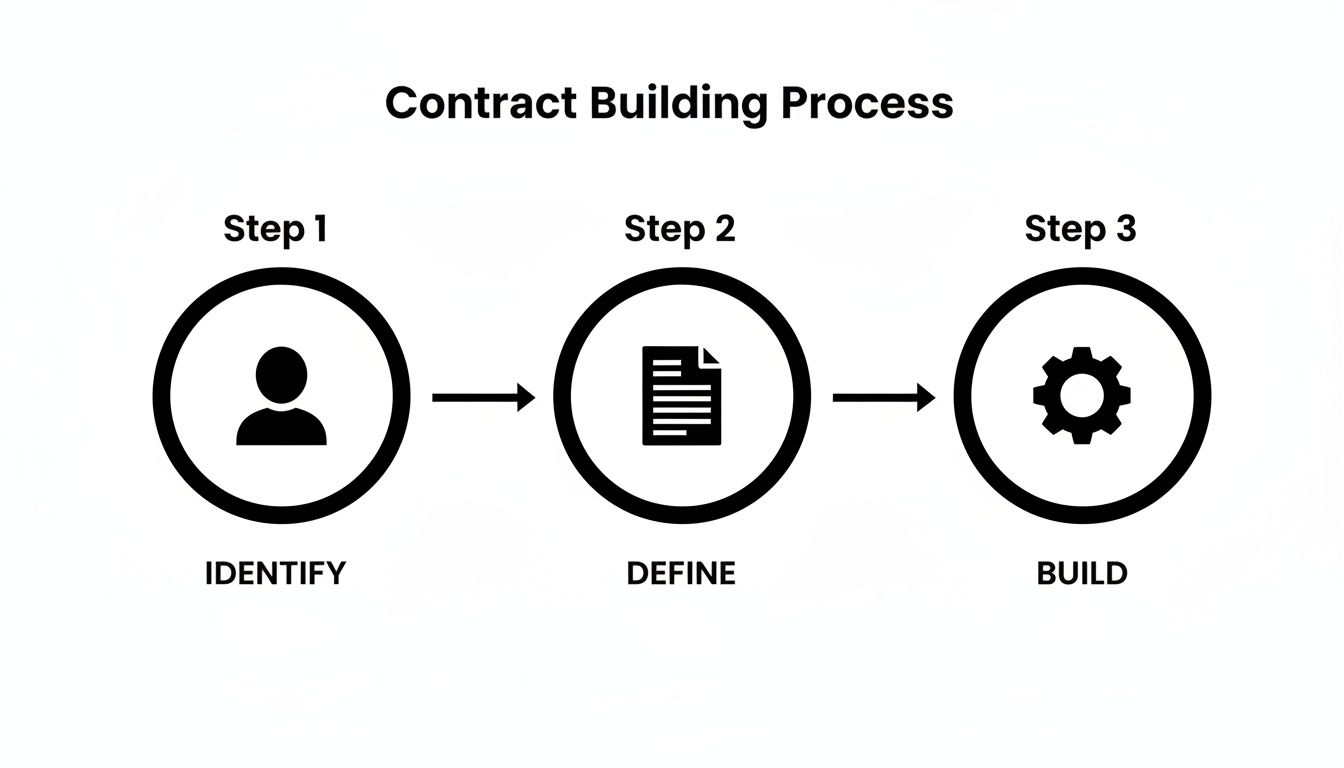
This simple flow—moving from the big picture to the nitty-gritty details—is the most reliable way to create a contract that actually holds up.
The 7 Essential Elements of a Valid Contract
Every legally binding contract, whether it's for a multi-million dollar acquisition or a simple freelance project, is built on the same core pillars. If you miss even one of these, the entire agreement could be worthless.
I've put together a quick-reference table to break down these absolute must-haves.
| Element | What It Means | Why It's Critical |
|---|---|---|
| Offer | One party proposes a deal with specific terms. | Without a clear offer, there's nothing for the other party to agree to. |
| Acceptance | The other party agrees to the offer's terms without any changes. | A counter-offer kills the original offer. Acceptance must be final. |
| Consideration | Something of value is exchanged (money, goods, services, a promise). | This proves it's a two-way deal, not just a gift or an empty promise. |
| Mutual Intent | All parties genuinely intend for the agreement to be legally binding. | Also known as a "meeting of the minds." It shows everyone is serious. |
| Capacity | The people signing must be legally able to make a contract (of legal age, sound mind). | Protects vulnerable individuals and ensures the agreement is enforceable. |
| Legality | The purpose of the contract must be legal. | You can't enforce a contract for something illegal, like hiring a getaway driver. |
| Certainty of Terms | The terms and obligations must be clear and specific, not vague. | If a court can't figure out what the parties agreed to, it can't enforce it. |
Getting these seven elements right is non-negotiable. They form the bedrock of any enforceable agreement.
From Blueprint to Actionable Document
Once you've nailed down these foundational pieces, you can start drafting. For professional services firms, this often starts with the client agreement. A solid legal retainer agreement template can give you a huge head start and save you from reinventing the wheel every time.
This is where modern tools really shine. Instead of staring at a blank page, you can lean on AI-powered automation to spin up an initial draft. A platform like BoloSign helps you create, send, and sign PDFs online by making sure these core components are baked in from the start. It's like having a safety net that catches common mistakes before they can weaken your contract down the line.
Drafting Clear Clauses and Defining Key Terms
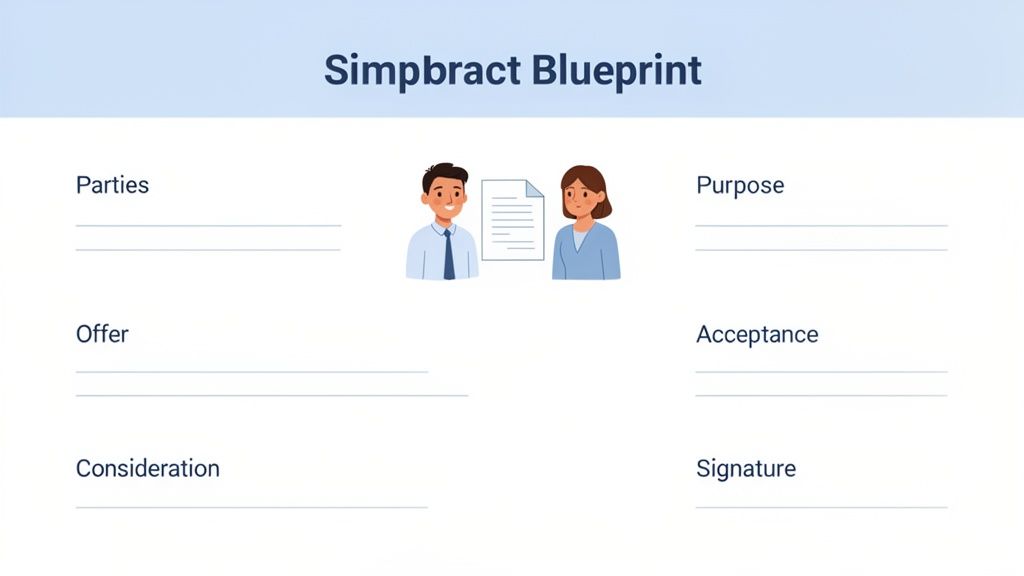
This is where the real work begins. A contract's true strength isn't in its length or fancy legal jargon—it's in its clarity. Vague, ambiguous language is more than just confusing; it’s a direct invitation for a dispute down the road.
Your goal here is simple: draft specific, unambiguous terms that leave zero room for misinterpretation. This is where you translate the big-picture handshake deal into the nitty-gritty details that actually govern the relationship, from payment schedules to project deliverables.
Crafting Industry-Specific Clauses
Generic, off-the-shelf language just won't cut it. The clauses you write have to reflect the unique risks and realities of your industry. A professional services firm and a logistics company operate in completely different worlds, and their contracts should show it.
Think about a few real-world scenarios:
- For a Logistics Company: A "Force Majeure" clause needs to go beyond "acts of God." It should explicitly list events common to shipping, like port closures, specific customs delays, or natural disasters known to disrupt key transit routes.
- For a Healthcare Provider: When drafting a Business Associate Agreement (BAA), the definition of "Protected Health Information" (PHI) must be painstakingly detailed, directly referencing HIPAA guidelines to ensure full compliance.
- For a Staffing Agency: The "Scope of Work" for a temporary hire can't be fuzzy. It must clearly outline the candidate's exact duties, the client’s responsibility to provide a safe work environment, and the precise terms for converting that placement to a full-time role.
Key Takeaway: The more specific your language, the less risk you carry. You need to think through every possible "what if" scenario relevant to your business and address it head-on in the contract's text.
The Role of AI in Achieving Clarity
Getting this level of detail right used to be a painful, manual process that demanded hours of a lawyer's time. Today, AI contract intelligence tools like BoloSign can act as your co-pilot, not just speeding up the process but actually improving the final product.
As you write, BoloSign’s AI analyzes your text in real time. It flags vague phrases, suggests more precise wording, and can even recommend entire clauses based on the type of agreement you’re building. This AI contract review function helps you create a professional, airtight document without the constant back-and-forth with legal counsel. If you need a refresher, you can learn more about the fundamental elements of a contract in our detailed guide.
Defining Your Most Important Terms
Never, ever assume everyone shares the same definition of a term. A "business day" in the US might be completely different from one in the UAE, which can have huge implications for deadlines and payments.
The best practice is to create a dedicated "Definitions" section right at the beginning of your contract. This is where you spell out exactly what you mean by key terms used throughout the document. It’s a simple step that prevents massive misunderstandings by creating a single source of truth for your agreement’s language.
This proactive approach ensures that when it’s finally time to sign PDFs online, everyone is on the exact same page. That leads to stronger business relationships and far fewer headaches.
Ironing Out the Details: Negotiation and Redlining
Once you’ve put together a solid first draft, the contract moves into its most critical and collaborative phase: negotiation. This is where a one-sided document gets hammered into a true mutual agreement. A smooth, transparent redlining process isn't just about efficiency; it's about building trust and getting to a "yes" without burning bridges.
Anyone who’s worked in procurement or real estate knows the old-school pain. You're juggling multiple versions of a Word document, trying to make sense of tracked changes from three different people, and chasing down approvals in an endless email loop. That manual back-and-forth is slow, ripe for error, and leaves you with a messy, unreliable audit trail.
A Better Way to Review and Finalize
The secret to a successful negotiation is getting everyone on the same page—literally. Instead of passing documents around and creating monsters like Vendor_Agreement_v4_Final_FINAL_2.docx, modern platforms bring all the parties into one shared, collaborative space.
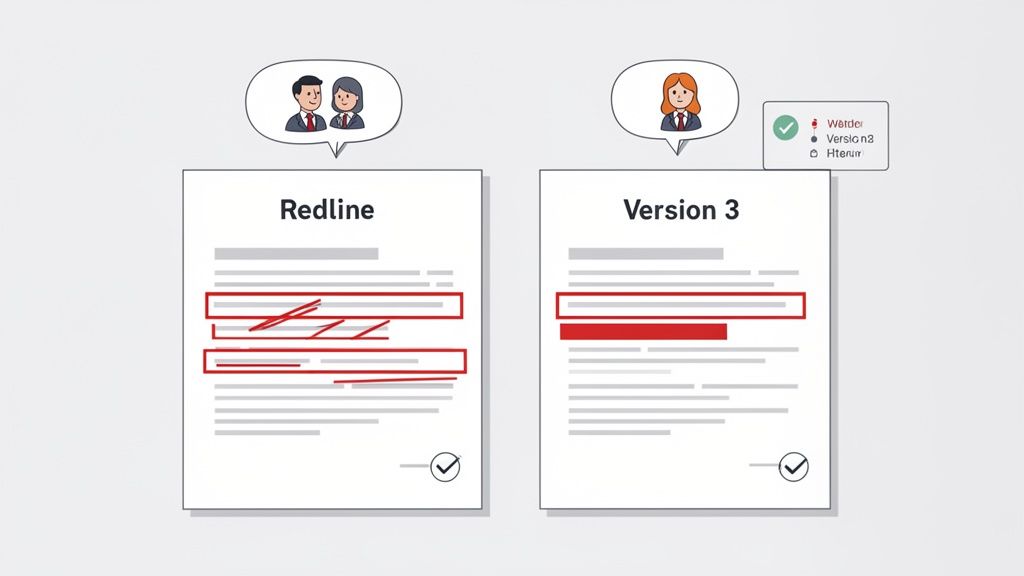
With a system like BoloSign, for example, everyone can comment, suggest edits, and review changes in real time, all inside a single version of the contract. This kills the version control chaos for good. Every single change is tracked, tagged to the person who made it, and time-stamped, building a clean, undeniable record of how you got to the final terms. For a logistics team managing dozens of carrier agreements, this means no more frantic searches to figure out which version is the actual final one.
Using AI to Negotiate Smarter, Not Harder
These days, negotiation isn't just about human intuition. AI contract intelligence can give you a serious upper hand by analyzing proposed edits and offering up data-backed insights. When your counterparty redlines a clause, BoloSign's AI doesn't just show you the change; it digs deeper to tell you what it actually means for your business.
It can:
- Spot New Risks: Instantly flag if a seemingly small edit opens you up to unfavorable liability or a compliance headache.
- Suggest Counter-Offers: Propose alternative wording that protects your interests while keeping the deal moving forward.
- Keep Everything Consistent: Check if a change in one section accidentally clashes with terms you agreed to elsewhere in the document.
This kind of AI contract review helps you respond to redlines faster and with more confidence. It’s like having a legal analyst baked right into your workflow, helping you understand the real-world impact of every tweak before you hit "accept." To really master this part of the process, check out our deep dive on how to redline a contract effectively.
Poor contract management isn't just a hassle; it's a massive expense. The contract management market is set to hit $12 billion by 2025, yet an incredible 51% of lawyers still haven't adopted automation. This gap has real costs, as automated platforms can cut negotiation cycles by up to 50%. Manual reviews miss an average of 9% of risky clauses, while AI tools catch them instantly, drastically cutting compliance risks. Learn more about these powerful contract management statistics.
Ultimately, a streamlined and intelligent negotiation process does more than just save a few hours. It builds a stronger foundation for the entire business relationship by making sure both sides arrive at an agreement that is clear, fair, and fully understood before anyone moves on to the digital signing stage.
Executing and Signing Contracts Securely Online
After all the drafting, redlining, and back-and-forth, you’ve finally reached the most critical moment: getting the contract signed. How an agreement is executed is just as important as the words inside it, because this step determines its legal standing and security. This is where modern digital signing solutions turn a potential bottleneck into a seamless, secure finish line.
Moving beyond wet ink signatures isn't just about saving time; it's about adding layers of security and creating an undeniable record of who agreed to what, and when. For businesses operating across borders—especially in the US, Canada, Australia, and the UAE—understanding the legal landscape is everything. Laws like the ESIGN Act in the United States and eIDAS in the European Union give electronic signatures the same legal weight as their handwritten counterparts, as long as they meet certain security and authentication standards.
From Final Draft to Signed Agreement Instantly
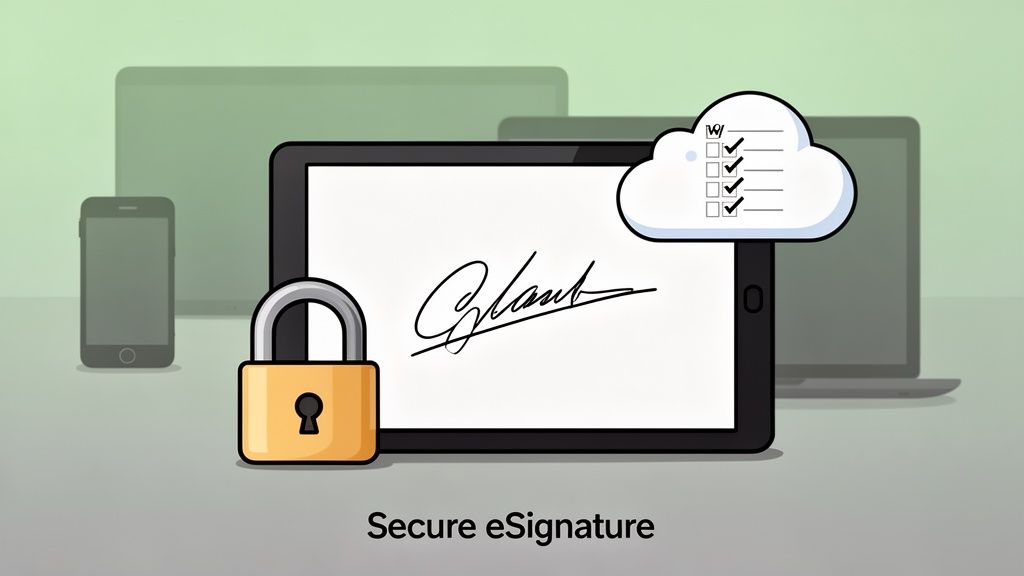
With a platform like BoloSign, you can send that finalized PDF for an eSignature in seconds. Your recipients get a secure link and can sign from any device, whether they're at their desk or on their phone. There’s no printing, scanning, or overnight shipping involved, collapsing the execution timeline from days or weeks into just a few minutes.
This kind of speed is a game-changer for fast-paced industries:
- Staffing Agencies: Onboard new hires remotely by sending employment contracts and getting them signed and returned the same day. Roles get filled faster, and you beat the competition.
- Education Institutions: Securely process student enrollment forms and faculty agreements from anywhere in the world, completely streamlining the admissions cycle.
- Healthcare Providers: Obtain patient consent forms and business associate agreements with full HIPAA compliance, ensuring data privacy is locked down while accelerating patient care.
Security and Compliance at the Core
In the rush to get contracts signed, security can't be an afterthought. The electronic signature market is booming, but so are cyber threats. For B2B sectors like real estate and professional services, where 80% of organizations now use e-signatures regularly, a secure platform is non-negotiable.
BoloSign ensures every signed document is tamper-proof by creating a comprehensive, court-admissible audit trail. This log captures every single action—who opened the document, when they viewed it, and the precise moment they signed. Want a deeper dive? Check out our guide on the best practices for signing a contract securely.
By 2025, the e-signature market is expected to surpass $15 billion, yet global cybercrime costs are projected to hit a staggering $10.5 trillion annually. This highlights the critical need for secure, compliant platforms that adhere to regulations like GDPR and the ESIGN Act. For industries managing sensitive data, this isn't a feature—it's a lifeline. Discover more insights about these global e-signature market trends.
Ultimately, using a secure eSignature tool like BoloSign gives you peace of mind. You know your agreements are not only signed quickly but are also legally binding, fully compliant, and protected against any unauthorized changes. It’s the final step in solidifying the trust you've worked so hard to build.
Managing Contracts After the Signature
A signed contract isn’t the finish line. In reality, it’s the starting whistle for an ongoing business relationship that needs careful management. The real value of an agreement is realized over its entire lifecycle, and failing to manage it proactively is a common—and costly—mistake.
Too many organizations let signed contracts disappear into scattered folders, spreadsheets, or forgotten email chains. It's like letting a valuable asset gather dust in a locked room.
This lack of organization creates huge risks. I’ve seen a real estate agency miss a critical lease renewal date, locking them into unfavorable terms for another year. Another time, a logistics company was caught completely off guard by an expiring carrier agreement, throwing their entire supply chain into chaos. These aren't just administrative errors; they are direct hits to the bottom line.
From Static Documents to Dynamic Assets
The modern approach is to treat your contracts not as static PDFs but as living, dynamic business assets. This starts with moving them into a centralized, secure, and searchable repository. Instead of digging through folders, you should be able to instantly pull up any agreement, review its terms, and understand your obligations.
This is where platforms like BoloSign completely change the game. By centralizing your entire contract portfolio, you gain complete visibility. The system automatically tracks key dates and sends you proactive alerts for renewals, expirations, or other important milestones. No more surprise auto-renewals or frantic searches for a document you signed six months ago.
Unlocking Insights with Contract Intelligence
Effective post-signature management goes way beyond just storage and reminders. It’s about extracting actionable intelligence from your agreements. AI-powered contract automation tools can analyze your entire portfolio to give you a high-level view of your business relationships.
For example, BoloSign’s AI can:
- Identify potential risks by flagging non-standard clauses across hundreds of vendor contracts.
- Uncover cost-saving opportunities by highlighting agreements with overlapping services or unfavorable payment terms.
- Ensure ongoing compliance by monitoring obligations and making sure you meet standards like GDPR or HIPAA.
This proactive approach gives you total control. It transforms your contracts from a source of potential liability into a tool for strategic advantage.
Key Insight: The work doesn't end when the ink is dry. Proactive contract management turns your agreements into a powerful source of business intelligence, helping you mitigate risk, control costs, and strengthen commercial relationships long after the initial deal is done.
Effective contract management extends beyond just signing, too. Powerful CRM integration can vastly improve how you manage contracts and customer relationships post-signature. By connecting these systems, you create a unified view of every customer interaction, from the initial proposal to post-sale obligations. This ensures your sales and legal teams are always aligned, providing a seamless experience for your clients.
Putting It All Together With BoloSign
Now that we’ve walked through the entire blueprint for making a contract, let’s talk about the final, crucial part: bringing it all to life. The old way of contracting—drafting in one tool, redlining in another, and signing in a third—is a recipe for slowdowns and mistakes. That disjointed workflow is where version control goes wrong and deals get stuck.
Modern platforms like BoloSign pull the entire lifecycle into one clean, unified space. It starts with AI-assisted drafting and goes all the way through to a secure eSignature. This means your team can create, send, and sign PDFs online without juggling different apps or worrying if they’re working on the right version.
Forget about paying per document. With BoloSign, you get unlimited documents, templates, and team members for one fixed price. It’s a simple, transparent model that makes it up to 90% more affordable than alternatives like DocuSign or PandaDoc.
Imagine a professional services firm onboarding a new client, or a logistics team finalizing a dozen vendor agreements in an afternoon. They can do it all without hitting a usage limit or getting hit with surprise overage fees. That’s contract automation built for how businesses actually grow.
By unifying your workflow and ensuring everything is compliant with standards like ESIGN and HIPAA, you can finally stop chasing paperwork and get back to focusing on your business.
Ready to see how simple your contract process can be? Start your 7-day free trial today.
Common Questions About Making Contracts
Even with a clear roadmap, a few questions always come up when you’re putting a contract together. Let's tackle the most common ones to give you the confidence to finalize your agreements.
What Actually Makes a Contract Legally Binding?
At its heart, a contract is just a promise the law will enforce. For that to happen, a few key ingredients must be present.
- Offer and Acceptance: One side makes a clear offer, and the other agrees to it without changing the terms.
- Consideration: This is the "what's in it for me?" part. Something of value has to be exchanged—money, services, or even a promise to do (or not do) something.
- Mutual Intent: Everyone involved has to be on the same page, understanding they're entering a formal, legally enforceable agreement.
- Capacity: The people signing must be legally able to do so (for example, of sound mind and legal age).
- Legality of Purpose: You can't have an enforceable contract to do something illegal. The contract's entire point has to be lawful.
When all these pieces are in place, you’ve got an agreement that will generally hold up in court.
Are Electronic Signatures as Good as Pen and Ink?
Yes, absolutely. In major economies like the United States, Canada, Australia, and the UAE, electronic signatures carry the same legal weight as a traditional "wet ink" signature. Laws like the ESIGN Act in the US and eIDAS in Europe provide a rock-solid legal foundation for their use.
The real key is using a secure, compliant platform. A digital signing solution like BoloSign doesn't just capture a signature; it creates a detailed audit trail of the entire signing process. This gives you a non-repudiable record proving who signed, when they signed, and where, which locks in the integrity of your executed agreement.
How Can AI Help Me Draft a Better Contract?
Artificial intelligence is a powerful co-pilot for contract creation. Modern AI contract review tools go way beyond simple grammar checks—they analyze your draft for hidden risks and potential weaknesses.
An AI assistant can:
- Spot ambiguous language that could lead to a dispute down the road.
- Flag missing clauses that are standard for your industry or agreement type.
- Suggest clearer, more precise wording to make your terms bulletproof.
This kind of tech helps you build more professional, robust agreements in a fraction of the time. It also cuts down your reliance on expensive legal reviews for more routine contracts. Tools like BoloSign's AI are designed to give you exactly this kind of intelligent support during the drafting process.
The shift to digital agreements has been explosive. In the early 2010s, there were about 198 million e-signature transactions globally each year. By 2025, that number is expected to hit 4,754 million—a staggering 24-fold increase. This trend is fueled by the rise of remote work, with 55% of companies now using e-signatures for everything from HR onboarding to major real estate deals. You can read more about these e-signature statistics here.
The rapid adoption of tools like eSignature and contract automation isn't just a fad; it's a fundamental shift toward more intelligent, secure, and efficient ways of doing business.
Ready to modernize how you create, send, and manage your agreements? With BoloSign, you get an all-in-one platform for unlimited documents, templates, and team members at a single fixed price. Experience the power of AI-powered automation and secure eSignatures for yourself.
Start your 7-day free trial of BoloSign today!

Paresh Deshmukh
Co-Founder, BoloForms
10 Feb, 2026
Take a Look at Our Featured Articles
These articles will guide you on how to simplify office work, boost your efficiency, and concentrate on expanding your business.