

A Practical Guide to the Core Elements of a Contract
Discover the essential elements of a contract that make it legally binding. Our guide breaks down offer, acceptance, and consideration for modern businesses.


Tired of nonsense pricing of DocuSign?
Start taking digital signatures with BoloSign and save money.
For any business, a contract is what turns a handshake deal into a real, enforceable promise. The elements of a contract are simply the essential ingredients that give it legal muscle. Think of them as the core pillars holding up the agreement: offer, acceptance, consideration, and a mutual understanding that you're both making a binding deal. Without these, your agreement is about as sturdy as a house of cards.
Why Contract Fundamentals Matter
Picture a contract as the blueprint for a business relationship. It doesn’t matter if you’re a Toronto-based staffing agency sending over a new statement of work or a healthcare provider in Dubai onboarding a new patient—getting that agreement legally sound is non-negotiable. This isn't just something for the lawyers to worry about; it's a vital skill for any business owner.
Nailing these fundamentals isn't just about dodging legal bullets. It's about building strong, clear, and trustworthy business relationships from the get-go. A solid contract cuts through the noise, clarifies what everyone expects, and gives you a clear roadmap if things don't go as planned.
The Building Blocks of an Agreement
Every single enforceable contract is built on a handful of key ingredients. We'll dive deeper into each one later, but here’s a quick snapshot of what a court would look for to see if your agreement holds water:
- Offer: One person puts a deal on the table with specific, clear terms.
- Acceptance: The other person agrees to that deal, exactly as it was offered.
- Consideration: This is the "what's in it for me?" part. Each side has to give and get something of value, like money in exchange for services.
- Mutual Intent: Both parties have to genuinely intend to create a legally binding agreement.
- Legal Capacity: Everyone involved must be legally able to enter a contract (for instance, they can't be a minor).
If you gloss over these elements, you’re inviting trouble. The data below really drives home how fuzzy contract terms lead directly to disputes, constant amendments, and a desperate need for automation to keep things consistent.
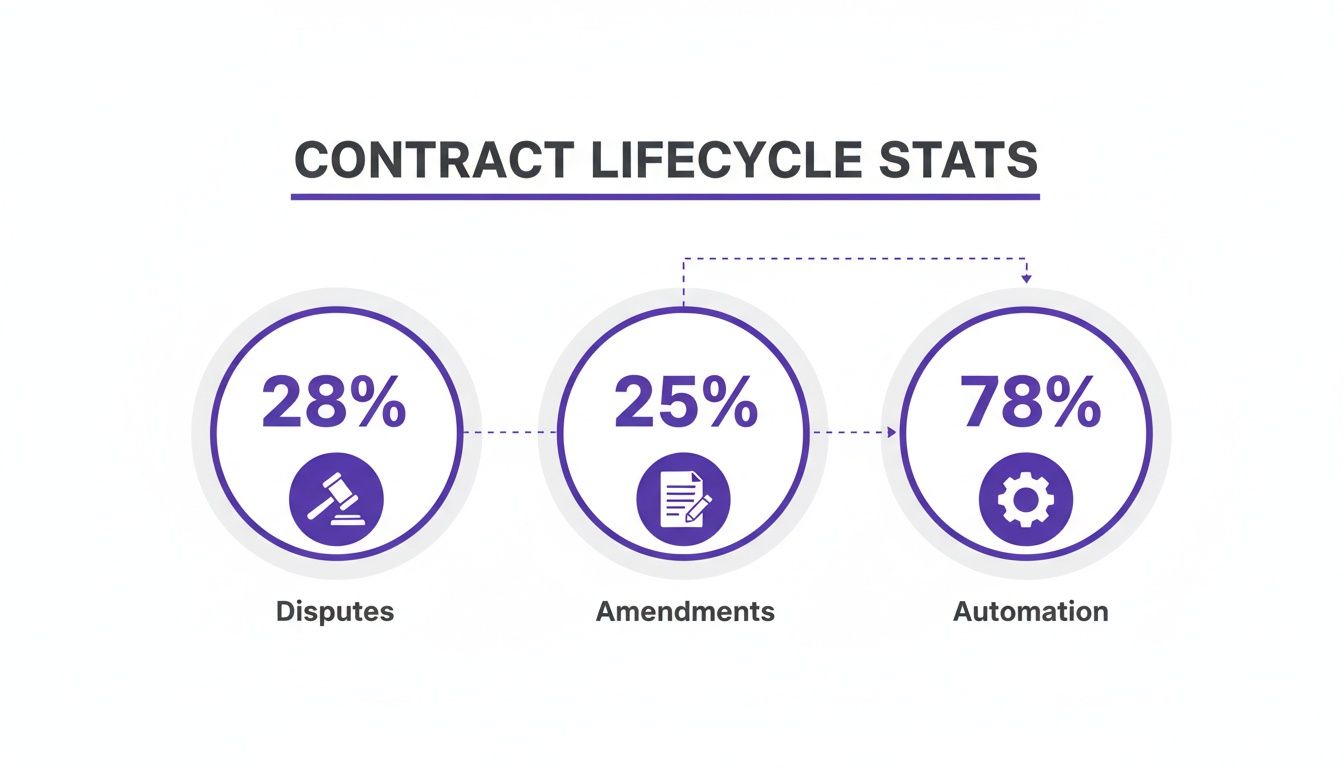
It's no surprise that 78% of organizations are now turning to automation to head off the disputes that come from poorly written contracts. When these core elements are left vague, the consequences are very real. Ambiguous terms in cross-border B2B deals are a factor in up to 28% of commercial disputes, and as many as 25% of contracts need to be amended within a year simply because the "consideration" terms weren't practical.
Getting these principles right directly cuts down on business risk and day-to-day friction. While knowing what makes a contract legally binding is the first step, it's just as important to understand what constitutes a breach of contract when someone doesn't hold up their end of the bargain. By focusing on a solid foundation from the start, you set your business up for smoother sailing and fewer headaches down the road.
What Really Makes a Contract Legally Binding?
Every solid agreement, whether it's a multi-million dollar deal or a simple service contract, stands on four core pillars. If even one of these is shaky, the whole structure can come crashing down, leaving your business in a tough spot. Let's ditch the dense legal jargon and walk through these essentials with a real-world scenario.
Imagine "FutureForce Staffing," a US-based agency, is about to place three senior software developers with a new Canadian tech client, "Innovate Solutions." The deal needs to be locked down quickly, but more importantly, it has to be legally sound across the border. This is where those four pillars become mission-critical.
Pillar 1: The Offer
The Offer is the handshake that starts it all. It’s a clear, direct promise from one party to another. Think of it as laying all your cards on the table. A vague statement like, "we'll provide some developers," just doesn't fly. The offer needs to be specific enough for the other side to know exactly what they're saying "yes" to.
In our scenario, FutureForce Staffing drafts a detailed Statement of Work (SOW) and sends it over to Innovate Solutions.
- What's in the Offer:
- The specifics: Three Senior Software Developer roles.
- The cost: The candidates' proposed hourly rates.
- The timeline: A clear start date and an initial six-month term.
- The payment details: Invoices due net 30 days.
This SOW is much more than a simple proposal; it's a formal offer. By spelling everything out, FutureForce creates a strong, defensible starting point for their agreement.
Pillar 2: The Acceptance
Once an offer is out there, the ball is in the other court. Acceptance is the clear, unqualified "yes" to the offer's terms. The key here is that the acceptance has to be a perfect mirror of the original offer. If Innovate Solutions comes back asking for a lower hourly rate, that’s not an acceptance—it's a counteroffer. A counteroffer kills the original offer and puts a new one on the table.
But let's say the hiring manager at Innovate Solutions likes what they see. They review the SOW and agree to every single term.
The moment they apply their electronic signature, that's it. The offer is formally accepted. This single action is what creates a "meeting of the minds" and turns a one-sided proposal into a mutual agreement.
This is where a simple, secure tool like BoloSign shines. When Innovate Solutions signs the SOW to sign PDFs online, the platform creates a bulletproof, timestamped audit trail. It captures the who, what, when, and where of the signature, making the acceptance crystal clear and legally enforceable under laws like the ESIGN Act in the U.S. and eIDAS in the EU.
Pillar 3: The Consideration
Consideration is the legal way of saying what each party is giving and getting. It's the value that's being exchanged, and it's the entire reason the contract exists in the first place. This value doesn't have to be cash; it can be a service, a product, or even a promise not to do something. The critical part is that both sides have to bring something of value to the table.
A promise that only goes one way is usually just a gift, not a legally binding contract.
- In our staffing deal, the consideration is clear:
- FutureForce Staffing gives: Their expertise in finding, vetting, and placing three highly skilled software developers.
- Innovate Solutions gives: Payment for those services at the agreed-upon rates.
This quid pro quo—services for money—is the consideration that breathes life into the contract. It’s the "skin in the game" for both companies.
Pillar 4: The Mutual Intent
The last pillar is Mutual Intent, or what lawyers sometimes call "mutuality of obligation." It boils down to this: both parties have to understand and agree that they're entering a serious, legally binding agreement. They know they have duties to fulfill and that there will be consequences if they don't hold up their end of the bargain.
This is what separates a formal business deal from a casual promise you might make to a friend. The context usually makes this pretty obvious. A professionally drafted document, formal emails, and the act of signing all point to a clear intent to be legally bound.
For FutureForce and Innovate Solutions, the intent is undeniable. They're using a formal business document (the SOW) to outline a commercial relationship. The language spelling out deliverables, timelines, and payment schedules makes it clear this isn't just a friendly chat.
When you manage multiple agreements, knowing the nuances of different types of business contracts and their specific use cases is key to ensuring every deal you sign is built on solid ground.
We’ve covered the big four: offer, acceptance, consideration, and the meeting of the minds. These are the core pillars of any contract. But a few other elements act as critical guardrails, ensuring the agreement isn’t just a document, but a legally sound commitment.
Think of them as the final quality checks before you push "go." Without them, even the most detailed contract can be rendered powerless right from the start.
Two of the most important are Legal Capacity and Legality of Purpose. They confirm that the people making the deal are legally allowed to, and that the deal itself is for something lawful. Overlooking these is a rookie mistake that can invalidate an agreement before the ink is even dry.

Verifying Legal Capacity
So, what is Legal Capacity? It’s simply a person's ability to actually understand the terms and consequences of a contract they’re about to sign. For a contract to be valid, everyone involved has to have the legal capacity to make that commitment.
If one party doesn’t have this capacity, the contract often becomes "voidable." This gives the person who lacked capacity the option to back out of the deal without any legal penalty. It’s a protection built into the law to shield vulnerable people from being locked into agreements they don't fully grasp.
Common scenarios where capacity gets tricky include agreements with:
- Minors: In most places like the US, Canada, and Australia, anyone under 18 isn't considered legally competent to enter a contract. If your firm signs a consulting deal with a 17-year-old tech prodigy, that contract might be unenforceable if the minor decides to walk away.
- Individuals with Mental Incapacity: This covers people who, due to a cognitive condition or impairment, just can't wrap their head around the agreement's nature. A real estate agent in New Zealand who gets a listing agreement from someone known to have severe dementia would likely find that contract invalidated by a court.
- Intoxicated Individuals: A person who is so impaired by drugs or alcohol that they can't understand what they're agreeing to may lack capacity. Proving this can be tough, though, unless it was obvious to the other party that the person was severely impaired.
Capacity is all about ensuring a fair playing field. It confirms that everyone at the table is of sound mind and legally recognized as able to make binding decisions for themselves or their business.
Ensuring Legality of Purpose
The second critical guardrail is Legality of Purpose. This one’s pretty straightforward but completely non-negotiable: a contract's objective must be legal for it to be enforceable. A court simply will not step in to help you enforce a deal that involves illegal activities or goes against public policy.
An agreement to do something illegal is "void" from the get-go—in the eyes of the law, it’s as if it never existed.
- Logistics Example: A logistics company in the UAE signs a contract to transport goods they know are counterfeit. If the client bails on the payment, the company can't sue. Why? Because the entire purpose of the agreement was illegal.
- Education Example: An online college in Canada can’t create an enforceable contract to grant a diploma to a student who hasn't completed the required coursework. That agreement would be void because it violates public policy and academic integrity standards.
Modern digital signing solutions can certainly help businesses stay compliant, but they don't replace the need for basic due diligence. Verifying the identity and authority of everyone signing is a huge step in confirming capacity. This is exactly where tools offering secure eSignature and detailed audit trails provide massive value, creating a clear, undeniable record of who signed what and when.
Ultimately, by confirming both legal capacity and legality of purpose, you're adding another layer of armor to your agreements. It's about making sure your contracts aren't just well-written, but fundamentally enforceable from the ground up.
Putting Contract Theory into Action
Knowing the textbook definitions of offer, acceptance, consideration, and the rest is one thing. Seeing how they play out in the real world is where it all clicks. These aren't just abstract legal ideas; they're the engine running under the hood of every deal you make.
Let's break down a few common business agreements and see where these core elements show up. This is also where having the right tools makes a huge difference. Starting with a solid, compliant template means you're not reinventing the wheel and accidentally leaving out a critical piece.
The Real Estate Lease Agreement
For anyone managing property in the US or Australia, the lease agreement is a daily workhorse. It’s a perfect, high-stakes example of every contract element firing on all cylinders.
- Offer: The landlord offers to rent a specific unit—say, "Apartment 4B at 123 Main Street"—for a clear term ("12 months") at a set price ("$2,000 per month"). This offer isn't just about the rent; it spells out everything from security deposits to maintenance duties and house rules.
- Acceptance: The tenant signs on the dotted line. That signature is their clear, unmistakable "yes" to every single term. A digital signature adds a timestamped, legally solid record of exactly when that acceptance happened.
- Consideration: This is the two-way street at the heart of the deal. The tenant provides monthly rent payments (their side of the bargain), and in exchange, the landlord provides a safe, habitable place to live (their side of the bargain).
- Capacity and Legality: The contract is only valid if both parties are legally able to enter it. This means the tenant is of legal age (usually over 18), and the property itself is legally zoned and fit for someone to live in.
The Healthcare Patient Intake Form
When a patient fills out intake paperwork, they're doing more than just providing their medical history. They're entering into a contract for services, and in healthcare, that comes with heavy-duty compliance rules like HIPAA in the US.
A patient intake form is more than just paperwork; it’s a contract where the provider offers medical services and the patient agrees to pay for them. Ensuring this process is secure and compliant is non-negotiable.
Here’s how a patient consent and financial responsibility form breaks down:
- Offer: The clinic offers its medical expertise, from evaluation to treatment.
- Acceptance: The patient gives their eSignature, which serves as their consent to be treated and their acknowledgment of the financial side of things.
- Consideration: The clinic delivers its professional medical services, and the patient agrees to cover the cost, whether out-of-pocket or through insurance.
- Legality: This agreement is wrapped in a thick layer of legal requirements, especially HIPAA, which dictates how patient data must be protected. Using a HIPAA-compliant platform like BoloSign helps clinics automatically tick these critical boxes.
The Logistics Master Service Agreement
In the world of shipping and logistics, a Master Service Agreement (MSA) is a common sight. It’s a foundational contract that sets the ground rules for an ongoing relationship between, for example, a manufacturer and a trucking company. Think of it as the master playbook for all future shipments.
- Offer: A logistics firm in the UAE offers to handle all freight for a manufacturer. The MSA lays out the big-picture terms: liability limits, payment schedules (like Net 45), and how fuel surcharges will be calculated.
- Acceptance: The manufacturer signs the MSA. This doesn’t order a truck for tomorrow, but it locks in the terms for every truck they will order.
- Consideration: The real exchange happens with each individual shipment, which is usually triggered by a separate work order. The carrier provides the transport, and the manufacturer pays the invoice. The MSA itself is held together by the mutual promise of future business.
Automating MSAs is a game-changer for logistics companies. With a tool like BoloSign, they can set up one master template and then spin up new work orders in minutes, automatically pulling in all the pre-agreed terms. No more re-reading the fine print every time.
The Professional Services Engagement Letter
For professional services firms in Australia or the UAE—like accountants, consultants, or lawyers—the engagement letter is the starting point. It clearly defines what the firm will provide and what the client commits to in return.
- Offer: The firm offers a specific service, like "Quarterly Financial Auditing," for a set fee. The offer details the scope of work, key deliverables, and the project timeline.
- Acceptance: The client signs the engagement letter, officially agreeing to the fees and the firm's terms of service.
- Consideration: The client pays the professional fees. In return, the firm delivers its expert services, advice, and reports.
Managing these different types of agreements in one place gives any business a huge advantage in control and visibility. Getting a firm grip on the key elements of contracts and how they are structured is the first step toward building a smarter, safer workflow.
How Modern Tools Strengthen Your Contracts
Knowing the essential elements of a contract is step one. But the real game-changer is using modern tools to make sure those elements are rock-solid in every agreement you create and sign. Digital signing solutions today do so much more than just replace a pen; they actively reinforce the legal integrity of your deals from the ground up.
Think of it this way: instead of just capturing a signature, platforms like BoloSign build a fortress of evidence around each agreement. They turn abstract legal ideas into concrete, provable actions, making your contracts not just signed, but truly defensible.
Locking Down Acceptance and Intent with Audit Trails
Two of the most critical contract elements—Acceptance and Mutual Intent—really come down to proof. How can you show, without a doubt, that a client agreed to your terms and knew they were entering a binding deal? This is where a secure audit trail becomes your most valuable player.
Every time you send a document for signature with BoloSign, the platform meticulously tracks every single interaction. This creates an undeniable digital paper trail that includes:
- Timestamps: Capturing the precise date and time the document was viewed, signed, and finalized.
- IP Addresses: Recording the signer's general location to help verify who they are.
- User Data: Documenting the signer's name and email address used in the transaction.
This detailed log gives you indisputable proof of acceptance. If a disagreement pops up later, you have a clear, chronological record demonstrating exactly when and how the agreement was made, cementing the element of mutual intent beyond any reasonable doubt.
Ensuring Clarity with Reusable Templates
Vagueness is the mortal enemy of a strong contract. The Offer and Consideration need to be defined with absolute clarity to prevent misunderstandings that can spiral into costly disputes. This is especially true for businesses that manage a high volume of similar agreements.
BoloSign lets you create and save unlimited reusable templates for your go-to documents, whether it’s client onboarding packets for a professional services firm or vendor agreements for a logistics company.
Using pre-approved templates isn't just a time-saver; it's a powerful risk management strategy. It ensures every contract you send contains the exact, legally-vetted language needed to define the offer and consideration perfectly, every single time.
For a busy staffing agency, this means every statement of work has consistent payment terms. For a real estate firm, it ensures every lease includes the same compliant clauses. This consistency slashes the risk of human error and strengthens the enforceability of your entire contract portfolio.
Automating Compliance and Enforceability
Finally, for any contract to hold up in court, it has to be legally valid. This is where compliance with regulations like the ESIGN Act in the U.S. and eIDAS in the EU becomes non-negotiable. Trying to keep up with these standards manually can be a massive headache for any business owner.
A modern digital signing solution like BoloSign builds compliance right into your workflow. The platform is designed from the ground up to meet strict international standards, including HIPAA and GDPR, ensuring your signing process is legally sound.
On top of that, AI-powered automation speeds up the entire contract lifecycle. You can create, send, and get legally binding signatures on your PDFs, templates, and forms in a matter of minutes, not days. It's this blend of speed and security that makes modern contract automation so effective. To really get a handle on all your agreements, looking into a contract management system can be a huge help.
The best part? This level of security and efficiency is no longer just for big corporations. BoloSign offers unlimited documents, templates, and team members for one fixed price, making it up to 90% more affordable than other tools. It’s about giving every business the technology needed to build stronger, more secure contracts.
Ready to see how a modern platform can reinforce every element of your contracts? Start your 7-day free trial of BoloSign today and experience a smarter way to manage your agreements.
Got Questions About Contract Elements?
Okay, so you've got the basics down—offer, acceptance, consideration, the whole nine yards. But in the real world, things get messy. Let's walk through some of the most common questions that pop up for business owners so you can keep your agreements on solid ground.

Is a Verbal Agreement Actually a Legally Binding Contract?
The short answer? Sometimes. But the long answer is far more important. While some handshake deals can technically hold up in court, proving the terms is a nightmare. It quickly becomes a "he said, she said" situation where you're trying to prove who offered what, who agreed to it, and what was promised in return.
For any business, a written agreement isn't just a good idea—it's essential protection. Using a platform like BoloSign removes all that guesswork. Its detailed audit trail creates a crystal-clear, documented history of every action, making sure everyone is on the same page from the get-go.
What Happens If a Contract Is Missing a Key Element?
If you leave out one of the essential ingredients, the contract is likely either void or voidable. A "void" contract was never legally valid to begin with (like a deal to do something illegal). A "voidable" contract, on the other hand, is valid, but one of the parties has the option to back out (like a contract signed by a minor).
This is exactly why having a set of go-to templates is a game-changer for any business.
Think of the templates inside BoloSign as your pre-flight checklist. They guide you through all the necessary elements so you don't accidentally create an unenforceable agreement that could put your business in a tight spot.
How Do Electronic Signatures Affect Contract Acceptance?
Electronic signatures are absolutely a valid form of acceptance. Major laws like the ESIGN Act in the U.S. and eIDAS in the EU give them the same legal weight as a wet-ink signature. In fact, a secure eSignature often provides stronger proof of acceptance than a pen-and-paper signature ever could.
Platforms like BoloSign don't just capture a signature; they create a comprehensive audit trail for every single document. This log meticulously records who signed, the exact time they signed, and their location, creating a robust, legally defensible record. This digital proof solidifies both the "acceptance" and "mutual intent" elements of your contract, making it far easier to enforce if you ever need to.
Strengthening your contracts doesn't have to be complicated or break the bank. With the right tools, you can ensure your agreements are clear, compliant, and legally sound, all while saving yourself a ton of time. BoloSign offers unlimited documents, team members, and templates for one fixed price, making top-tier contract management accessible to every business.
Ready to see how simple it can be? Start your 7-day free trial today.

Paresh Deshmukh
Co-Founder, BoloForms
26 Dec, 2025
Take a Look at Our Featured Articles
These articles will guide you on how to simplify office work, boost your efficiency, and concentrate on expanding your business.