

Understanding the Elements of a Contract: 6 Key Points You Should Know
Discover the element of a contract and the six essential parts that make an agreement legally binding. A clear, practical guide to protect your business.


Tired of nonsense pricing of DocuSign?
Start taking digital signatures with BoloSign and save money.
Every promise you make in your business is important, but not every promise will hold up in court. For a simple agreement to become a legally binding contract, it needs six essential ingredients: Offer, Acceptance, Consideration, Capacity, Legality, and Intent. If even one of these is missing, what you thought was a solid deal could turn out to be nothing more than an unenforceable handshake.
What Makes A Contract Legally Binding?
Think of a contract like a recipe for a cake. If you leave out a key ingredient—say, the flour—you won't end up with a cake. You’ll just have a mess. The same logic applies to your business agreements. Each element of a contract plays a crucial role in making sure the promises are clear, fair, and most importantly, recognized by the law.
This is especially true in high-stakes industries. For a real estate agency in the US or a professional services firm handling a UAE employment contract, a poorly built agreement can spiral into huge financial losses and nasty legal battles. Getting these fundamentals right is your best line of defense.
The Six Pillars Of An Enforceable Agreement
For a contract to be legally sound, it has to be built on these six pillars:
- Offer: A clear and specific proposal made by one party to another.
- Acceptance: The other party agrees to the offer's terms without changing them.
- Consideration: The value (like money, services, or goods) that each party agrees to exchange.
- Capacity: Everyone involved must be legally able to enter into a contract (e.g., of sound mind and legal age).
- Legality: The purpose of the contract must be lawful and not against public policy.
- Intent: Both parties must genuinely intend for the agreement to be legally binding.
This diagram breaks down how these core components come together to form a binding agreement.
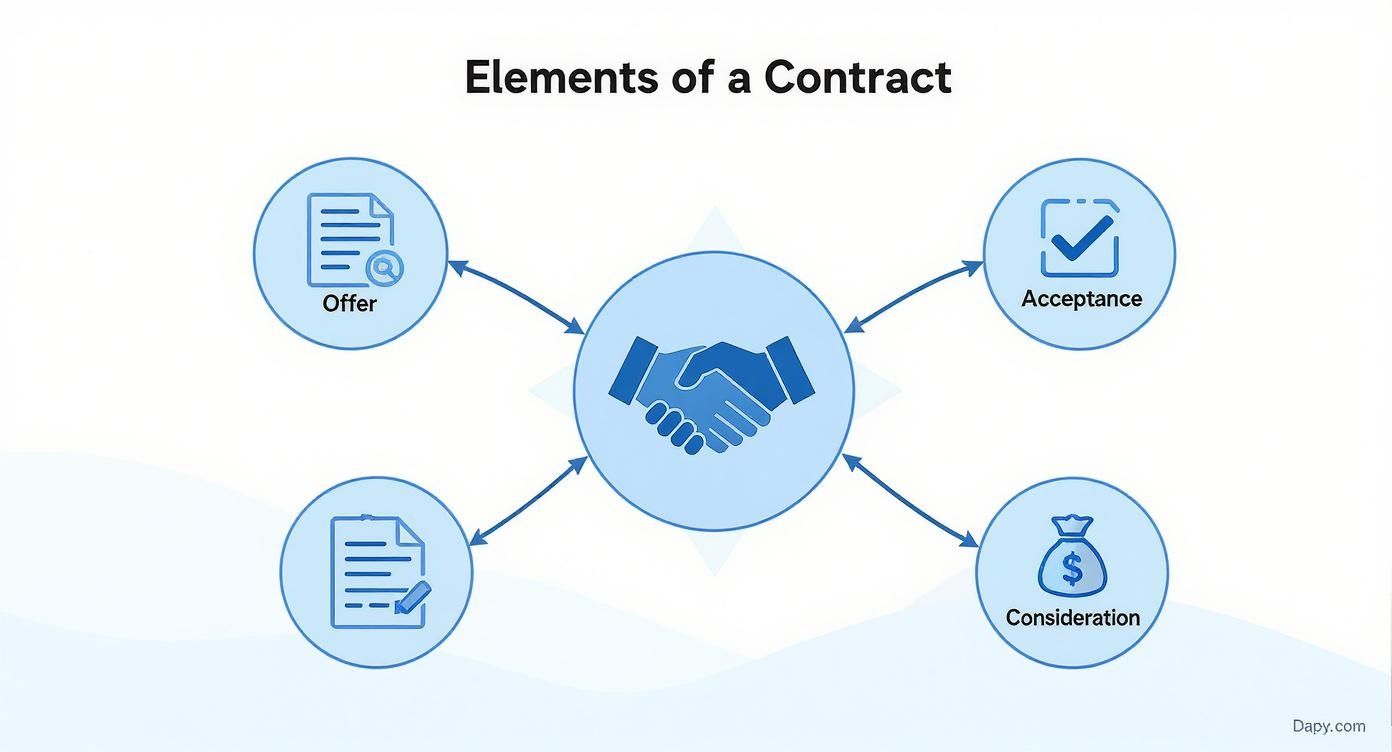
As the visual shows, Offer, Acceptance, and Consideration are the foundational actions that create the deal itself. These aren't just abstract legal ideas; they are practical principles that apply to contracts all over the world, from Canada to Australia.
A contract isn’t just a piece of paper; it’s a framework for trust and accountability. When every element is in place, it gives you a reliable roadmap for your business relationships, making sure everyone is protected and clear on what they need to do.
To help you keep these straight, here’s a quick reference table.
Quick Guide To The 6 Contract Elements
This table summarizes each element and shows what it looks like in a typical business scenario.
| Element | Simple Definition | Business Example |
|---|---|---|
| Offer | One party proposes a deal with clear terms. | A web developer sends a quote to a client to build a website for $5,000. |
| Acceptance | The other party agrees to all terms of the offer. | The client replies via email, "I accept your proposal to build the website for $5,000." |
| Consideration | Something of value is exchanged by both sides. | The client pays the $5,000, and the developer delivers the completed website. |
| Capacity | All parties are legally competent to make a deal. | Both the client and the developer are over 18 and mentally sound. |
| Legality | The contract's purpose is legal and ethical. | The website being built is for a legitimate e-commerce store, not an illegal enterprise. |
| Intent | Everyone involved intends to create a legal relationship. | The formal quote and written acceptance show a serious business arrangement, not a casual chat. |
Understanding this framework is the first step toward creating stronger, more reliable agreements. These rules aren't just legal formalities; they are practical safeguards. They ensure that everyone's rights and responsibilities are spelled out clearly from the start.
It's also important to remember that all interactions and agreements are governed by clear guidelines, just like those outlined in our own terms of service. This ensures transparency and a solid foundation for every partnership.
The Starting Point: Offer and Acceptance
Every solid contract, the kind you can actually rely on, kicks off with two core actions: a clear offer and an equally clear acceptance. Think of it as the foundational handshake for your entire agreement. An offer isn't just a casual suggestion; it’s a specific, detailed proposal from one party to another. Acceptance is the other side saying, "Yes, I agree to those exact terms."
This back-and-forth is often called a "meeting of the minds," or mutual consent, and it's the absolute cornerstone of any enforceable agreement. It's no surprise, then, that an estimated 60% to 80% of all business-to-business deals are governed by some form of contract, each one starting right here.
When this initial alignment is fuzzy, things get messy—and expensive. Poorly defined agreements contribute to the staggering $870 billion businesses spend globally each year to resolve disputes. You can learn more about these contract management statistics to see just how critical this first step is. This is why getting the details right from the very beginning matters so much.
What Makes a Strong Offer
A real, legally valid offer has to be more than just a vague idea tossed out in a conversation. It needs to be specific, unambiguous, and communicated directly to the person or company you want to do business with. There should be zero room for guessing games.
Here are a few real-world examples:
- Real Estate: An agent in Australia doesn't just talk about a price range. They present a formal purchase offer that spells out the exact price, the closing date, and any specific conditions. It’s a concrete proposal, ready for a simple "yes" or "no."
- Professional Services: A marketing agency in Canada sends a client a detailed Statement of Work (SOW). This document breaks down the project deliverables, timelines, and fees. The SOW is the offer.
- Logistics: A freight company provides a quote for shipping goods. It lists the precise route, the delivery schedule, and the total cost. That quote serves as their formal offer.
Without that level of detail, you don't really have an offer. What you have is an "invitation to treat," which is basically just opening the door for the other party to make you an offer.
The Power of Unconditional Acceptance
Once a solid offer is on the table, the acceptance needs to be its perfect mirror image. If the other party tries to tweak the terms—even slightly—it’s not an acceptance. It’s a counter-offer, and that move legally kills the original offer. A slow response can also sink the deal if the offer had an expiration date.
Acceptance must be unequivocal. It’s the moment a potential agreement solidifies into a mutual commitment. In a business context, this means a clear "yes" to the proposed terms, with no strings attached.
This is exactly where a reliable digital signing tool becomes so valuable. With a platform like BoloSign, you can send a contract for a secure eSignature, which creates an indisputable, timestamped record of the exact moment the offer was accepted. This digital audit trail is your proof of mutual consent, protecting you from future arguments over who agreed to what, and when.
For instance, a staffing agency can use BoloSign to create and send a work order to a new client. When the client uses the tool to sign the PDF online, the platform automatically captures the date, time, IP address, and other signer details. This creates an unchangeable record proving unconditional acceptance. It's the same simple process that streamlines patient intake in healthcare or student enrollment in education, delivering clarity and compliance right from the start.
By managing your offer and acceptance process digitally, you strip away the ambiguity and lay a rock-solid foundation for every business relationship. It’s the first, and most important, step in building a contract that holds up.
The Core of the Deal: Understanding Consideration
Once an offer gets a clear "yes," the next piece of the contract puzzle clicks into place: consideration.
Think of it as the classic "what's in it for me?" question. It’s the value—the goods, services, or money—that each person agrees to swap. Without this two-way street, you don’t have a contract; you have a gift or a one-sided promise, which usually won’t hold up in court.

This exchange of value is what powers the whole agreement. It’s the reason both sides are motivated to see it through. For large companies juggling tens of thousands of contracts, getting the consideration right is everything. When it’s vague, disputes are almost inevitable, contributing to the staggering $870 billion businesses spend each year just to resolve conflicts. You can discover more insights about contract management challenges to see just how big this problem is.
What Counts as Valid Consideration
Don’t get stuck thinking consideration is only about cash. It can be anything that the law recognizes as having value. The main idea is that each party has to either give something up or agree to do something they weren't already obligated to do.
Let's look at how this plays out in a few different fields:
- Logistics: A trucking company in the US promises to move 50 pallets from Los Angeles to Dallas. The client’s consideration is paying the invoice. The trucking company’s consideration is getting the goods there safely and on time.
- Healthcare: A patient in New Zealand needs a dental crown and agrees to pay for it. The dentist provides their professional skill and service (the consideration), and the patient provides the fee (their consideration).
- Education: A university offers a four-year degree program. The student pays tuition (their consideration), and the university provides the classes, professors, and campus resources to earn that degree (its consideration).
Even promising not to do something can be valid consideration. This is called forbearance. A common example is when an employee signs a non-compete, agreeing not to work for a direct competitor for a year after leaving in exchange for a nice severance package.
Common Pitfalls to Avoid
Just because it feels like an exchange doesn't mean it will stand up in court. One of the biggest mistakes businesses make is basing an agreement on past consideration. This is when you promise something in return for an action that has already happened.
For example, imagine a supplier delivers a huge shipment two weeks early, saving you from a major headache. Thrilled, you promise them a bonus. That promise is usually unenforceable because the early delivery is in the past. It wasn't part of the original bargain.
Consideration must be part of the present agreement, not a reward for a past action. It’s the agreed-upon exchange that induces each party to enter the contract in the first place.
This is exactly why documenting every single detail from the start is so critical. Every piece of the value exchange needs to be spelled out to prevent someone from saying, "That's not what I agreed to!" down the road.
This is a problem that modern contract automation was built to solve. With a platform like BoloSign, you can create, send, and sign PDFs, templates, and forms quickly. These templates come with required fields for things like the scope of work, deliverables, payment amounts, and due dates. By forcing you to fill out these crucial details before the document can even be sent for a signature, you create a rock-solid record of the consideration. It makes the core of the deal perfectly clear to everyone involved, right from the beginning.
The Pillars of Validity: Capacity, Legality, and Intent
Beyond the initial handshake of offer, acceptance, and consideration, a truly solid contract needs a deeper foundation. It rests on three final pillars: the capacity of everyone signing, the legality of what you're agreeing to, and the genuine intent to be bound by the agreement.
If any of these pillars are shaky, your contract could easily crumble under legal pressure. These elements are the gatekeepers of a valid agreement—they determine who is allowed to make a deal and what that deal can be about. When they're overlooked, disputes aren't far behind. In fact, challenges to contract enforceability are becoming more common. Case filings in administrative boards like the U.S. ASBCA and CBCA jumped by 34% and 22% respectively in a recent fiscal year, often because a party's capacity or the contract's legality was in question. Discover more insights about these contract appeal trends.
Legal Capacity: Who Has the Right to Sign?
Legal capacity is all about confirming that the people signing a contract are legally and mentally fit to do so. The law usually assumes adults have this capacity, but there are some critical exceptions to watch out for.
- Minors: People under 18 (or 21 in some places) generally can't be held to a contract they sign.
- Mental Incompetence: If someone can't grasp the terms and consequences of what they're signing, they lack the capacity to enter into the agreement.
- Intoxication: A person can lack capacity if they are so impaired by drugs or alcohol that they can't understand the deal they're making.
In a business context, this pillar is also about authority. You have to be sure the person signing for a company actually has the power to commit that company to the contract. This is also where legal tools like a Power of Attorney (POA) come into play, as it formally grants someone the authority to sign contracts on another person's behalf.
The Ground Rules: Legality of Purpose
The next pillar, legality, is simple on the surface: a contract's purpose can't break the law or go against public policy. It seems obvious, but this can get tricky in heavily regulated fields.
For example, a real estate agent in Australia must have a valid license to sign a listing agreement with a client. If that license is expired, any contract for their commission might be thrown out. Likewise, in healthcare, any agreement that violates HIPAA or other patient privacy laws is invalid from the moment it's created.
The Seriousness Factor: Intent to Be Bound
Finally, there's intent. This means everyone involved truly intends to create a legally binding relationship, not just a casual promise or a social agreement. Courts will look at the entire situation—the language used, the parties' actions, the formality of the document—to figure out if everyone was serious.
A contract is more than just words on a page; it's a mutual commitment to be legally accountable. The element of intent separates a serious business deal from a casual conversation, ensuring all parties understand the gravity of their promises.
This is where a solid digital signing solution becomes invaluable. A platform like BoloSign automatically creates a detailed audit trail, capturing every single step of the signing process. This secure log documents signer names, IP addresses, and exact timestamps, all of which serve as powerful proof of a clear intent to be legally bound.
For a professional services firm in Canada or the UAE sending out a client engagement letter, this digital record proves exactly who signed, when they signed, and that they fully intended to accept the terms. This doesn't just make your agreements valid; it makes them defensible.
A Practical Checklist for Stronger Contracts
Theory is one thing, but putting it into practice is what really counts. A solid contract isn’t built on hope; it’s the result of a deliberate, step-by-step process that confirms every critical piece is in place before anyone signs. This checklist is designed to help you turn legal concepts into a repeatable workflow, making sure your agreements are airtight from day one.
Rather than crossing your fingers and hoping for the best, this systematic approach acts as a safety net. Following these steps helps you create clear, fair, and legally sound deals that protect your business from confusion and expensive disputes down the road.
A Data Table on Contract Element Verification Checklist
Before diving into the specifics, here’s a quick-reference table. Think of it as your pre-flight checklist before launching any new agreement. It summarizes what to look for and how modern tools can make the process nearly foolproof.
| Checklist Item | What to Verify | How Digital Tools Help |
|---|---|---|
| Clear Offer | Is every term (price, scope, dates) specific and unambiguous? | Use templates with required fields to ensure no critical details are missed. |
| Explicit Acceptance | Is there a clear, recorded "yes" that mirrors the offer exactly? | eSignature platforms provide a time-stamped, unalterable audit trail of acceptance. |
| Defined Consideration | Is the value exchange (money, goods, services) quantified and detailed? | Document management systems store a clear record of the agreed-upon exchange. |
| Legal Capacity | Does the signer have the legal authority to bind themselves or their company? | Digital identity verification can help confirm the signer's credentials and authority. |
| Lawful Purpose | Does the agreement comply with all relevant laws and regulations (e.g., GDPR, HIPAA)? | Compliance features in contract software help flag regulatory requirements. |
This checklist isn't just about ticking boxes; it's about building a foundation of certainty for every business relationship you enter.
1. Define the Offer with Absolute Clarity
First things first: your proposal needs to be a firm offer, not just a vague "invitation to treat." A strong offer is so clear that it leaves zero room for misinterpretation.
- Specify All Terms: Get granular. State the exact goods or services, the precise price, delivery dates, and payment deadlines. Avoid fuzzy language like "a reasonable timeframe"—that’s just asking for trouble.
- Identify the Parties: Spell out the full legal names of every individual or business involved. No nicknames or abbreviations.
- Set an Expiration Date: Give your offer a deadline. This creates a healthy sense of urgency and prevents it from hanging out there in limbo forever.
This is where a tool like BoloSign really helps. By creating reusable templates for your proposals and agreements, you can set up required fields for all these critical details. That way, no one on your team can accidentally send out an incomplete offer. It builds consistency right into your process.
2. Ensure Acceptance is Explicit and Recorded
Acceptance has to be a direct, unequivocal "yes" to your offer—no ifs, ands, or buts. A verbal agreement is notoriously difficult to prove in court, which is why getting it in writing is non-negotiable.
- Require a Formal Response: Don't settle for a casual email or a quick phone call. Acceptance should be formalized with a signature.
- Mirror the Offer: The acceptance must be a perfect match to the offer. If the other party tries to change anything, that's not an acceptance; it's a counter-offer, and the clock resets.
- Document Everything: Here’s where digital solutions are a game-changer. An eSignature creates a permanent, timestamped record of exactly when and how the agreement was accepted.
Platforms with a detailed audit trail capture every single interaction, from the moment the document is opened to the final signature. This digital paper trail is your best evidence for proving mutual consent if a dispute ever pops up.
A contract is only as strong as its weakest element. A checklist forces you to slow down and verify each pillar—offer, acceptance, consideration, capacity, and legality—turning a potentially flawed agreement into an ironclad one.
3. Detail the Consideration Clearly
The "value exchange" needs to be spelled out with complete clarity to be enforceable. Both sides must know exactly what they're giving and what they're getting.
- Quantify the Exchange: Don't just say "payment for services." Get specific: "payment of $2,500 USD in exchange for the delivery of 10 graphic design concepts."
- Avoid Past Consideration: Make sure the exchange is for future actions. You can't create a contract to reward someone for something they've already done.
- Document Non-Monetary Value: If services or goods are part of the deal, describe them with the same level of detail you would a dollar amount.
4. Verify Legal Capacity and Authority
A contract signed by someone without the legal authority to enter into it isn't worth the paper it's printed on. This step is all about doing your homework.
- Confirm Age and Competence: You don't always need to check an ID, but be aware of any red flags that might suggest someone is a minor or lacks the mental capacity to understand the agreement.
- Check Business Authority: When you're dealing with a company, make sure the person signing is actually authorized to make decisions for that business. A quick check of their title or role can save you a massive headache.
- Ensure Legality of Purpose: Finally, do a quick sanity check to ensure the contract's purpose is legal and complies with any industry-specific rules, whether that's HIPAA in healthcare or GDPR for handling data.
Bringing contract automation into your workflow is the smartest way to manage these details without fail. For a closer look at how this works, check out our guide on how to streamline your contract management process.
By making this checklist a core part of your operations, you shift from hoping your contracts are solid to knowing they are. This proactive stance not only strengthens your business relationships but also gives you the legal certainty you need to grow with confidence.
Modernize Your Contract Workflow
Trying to juggle every single element of a contract by hand isn't just slow—it's a massive business risk. One forgotten detail or a simple human error can unravel an entire agreement, leaving your business wide open to costly disputes. This is exactly where bringing your process into the 21st century pays off big time.
A solid digital signing solution transforms contract management from a headache-inducing administrative task into a smooth, secure, and incredibly efficient workflow. By using smart, AI-powered tools, you can automate how you build, send, and track agreements, which slashes the kind of manual mistakes that can torpedo a contract's validity.
Shift from Manual to Automated
Picture a logistics company in Australia that needs to push out dozens of new carrier agreements every single day. Tracking each one manually is a recipe for chaos. With an automated system, they can simply use a pre-approved template, fire it off for an eSignature, and get real-time pings as each contract moves through the signing pipeline.
This switch does more than just claw back hours in your day; it makes your agreements stronger. The key benefits of automation are impossible to ignore:
- Fewer Errors: Smart systems can pre-populate data and double-check that every mandatory field is filled out before a signature is even applied, safeguarding every element of the contract.
- Tighter Security: Secure document trails with detailed audit logs provide ironclad proof of who signed what, when, and where.
- Compliance Baked In: Platforms that are already aligned with ESIGN, eIDAS, HIPAA, and GDPR let you operate with confidence in heavily regulated industries like healthcare or across international borders. You can see these principles in action when you automate company approval workflows.
Modernizing your workflow isn't just about moving faster. It's about building more resilient, defensible contracts from the very beginning. It ensures every agreement you sign is built on a rock-solid foundation of clarity, security, and compliance.
An Affordable Solution for Growing Businesses
Let's be honest: many businesses get spooked by the unpredictable costs of new technology. A lot of the traditional tools out there charge per user or even per document, making it a nightmare to budget for as you grow.
BoloSign flips that script completely. We offer a single, fixed price for unlimited documents, team members, and templates. This straightforward, transparent model finally makes advanced contract automation accessible for everyone and is often 90% more affordable than other platforms. For a professional services startup or a growing educational institution, this means you can get your operations in order without stressing about surprise bills.
By embracing a modern approach, you’re not just getting documents signed faster—you’re building a more resilient, efficient, and profitable business.
Ready to see how simple and affordable your contract workflow can be? Start your 7-day free trial of BoloSign today and experience the difference firsthand.
Frequently Asked Questions
Putting contract theory into practice can bring up some real-world questions. Here, we'll tackle a few common queries, connecting the essential contract elements to the daily realities of running a business.
Can An Email Exchange Form A Legally Binding Contract?
Absolutely. An email exchange can definitely become a legally binding contract, but only if all six essential elements are in place. If one person makes a clear offer, the other accepts it, and something of value (consideration) is exchanged, you’re well on your way to an agreement.
The real sticking point is intent. Both people must have genuinely intended to create a legal relationship, and the emails need to reflect that. The big risk? Trying to prove these elements from a jumbled email thread can be a legal headache, which is why formalizing agreements with a secure digital signing solution is always the smarter move.
What Happens If A Key Element Of A Contract Is Missing?
If a critical element of a contract is left out, the agreement is generally considered void or unenforceable. In simple terms, a court won't step in to make either party follow through on their promises. For example, a deal without consideration isn't a contract—it's just a promise someone isn't legally required to keep.
This is a huge risk for any business. It could lead to unpaid invoices, services that are never delivered, and no legal way to make things right. Using a platform like BoloSign to create, send, and sign your forms and templates ensures no crucial element ever gets missed, protecting your business.
How Do eSignatures Prove Acceptance And Intent?
An eSignature is much more than just a digital version of your name; it's a powerful tool that creates a court-admissible record of the agreement. When you use a secure digital signing solution, it automatically generates a detailed audit trail for every document.
This digital paper trail locks in the critical data points that prove both acceptance and intent, including:
- The signer's name and email address.
- The exact date and time the document was viewed and signed.
- The IP address used when the signature was applied.
This digital evidence makes it incredibly tough for someone to later claim they didn't agree to the terms, giving you solid legal protection. It transforms a simple click into undeniable proof that every element of a contract was understood and accepted.
Ready to modernize your contract workflow and ensure every agreement is airtight? With BoloSign, you get unlimited documents, team members, and templates at one fixed price, making it 90% more affordable than traditional tools. Experience the power of AI-powered automation and secure, compliant workflows. Start your 7-day free trial today!

Paresh Deshmukh
Co-Founder, BoloForms
9 Dec, 2025
Take a Look at Our Featured Articles
These articles will guide you on how to simplify office work, boost your efficiency, and concentrate on expanding your business.