

A Practical Guide to Click Wrap Agreements
Discover what makes a click wrap agreement legally binding. Learn best practices for creating enforceable online contracts that protect your business.

Tired of nonsense pricing of DocuSign?
Start taking digital signatures with BoloSign and save money.
Think about the last time you installed a piece of software, signed up for a streaming service, or bought something online. You almost certainly had to check a box or click a button that said, “I Agree.”
That simple action is what we call a click wrap agreement. It’s the modern-day equivalent of a signed contract, and it’s a legally powerful way to form agreements in the digital world. By requiring a user to take an explicit step, it becomes far more robust than the old-school “browsewrap” notices that just assumed your consent.
Understanding the Modern Clickwrap Agreement
Click wrap agreements are the gatekeepers of digital commerce. They ensure everyone is on the same page about the rules of engagement before any transaction or service begins. That single click serves as a clear, definitive signal that a user was presented with your terms and willingly accepted them. This is worlds away from its unreliable cousin, the "browsewrap" agreement, which tries to claim consent just because someone kept using a website.
A clickwrap creates a clean, documented record of acceptance. Courts across the US, Canada, Australia, and the EU consistently favor this explicit action because it leaves no room for doubt.
Clickwrap vs Other Online Agreements at a Glance
To truly grasp why clickwrap has become the standard, it helps to see how it stacks up against other common methods. This quick table breaks down the key differences.
| Agreement Type | User Action Required | Legal Enforceability | Best For |
|---|---|---|---|
| Clickwrap | Explicitly clicks "I Agree" or checks a box. | High - Widely upheld in courts. | Software installs, account sign-ups, online purchases, and most terms of service. |
| Browsewrap | None. Consent is implied by using the site. | Low - Often unenforceable. | Low-risk informational websites where binding terms are not critical. |
| Sign-In Wrap | Clicks a "Sign In" or "Register" button next to a notice. | Moderate - Depends on how clear the notice is. | User account creation and login flows. |
As you can see, when you need an agreement to hold up under scrutiny, nothing beats the clarity of a clickwrap.
Why Active Consent is the Gold Standard
The legal muscle behind a click wrap agreement comes down to one core concept: affirmative assent. The user has to do something—a deliberate click—to signal they're on board. This active step is what turns a casual website visit into an enforceable contract.
For any business, but especially those in regulated fields, this isn't just a "nice-to-have." It's an essential risk management tool. Think about these everyday situations where a click wrap agreement is non-negotiable:
- Healthcare Providers: Getting a patient’s consent for telehealth services or acknowledging HIPAA notices before an appointment.
- Professional Services: Onboarding a new client by having them accept your engagement terms before any work kicks off.
- Real Estate Agencies: Making sure potential buyers agree to disclosure terms before they view sensitive property details.
- Logistics Companies: Securing a carrier's agreement to shipping terms and conditions before they can pick up a load.
In all these cases, a passive notice buried in a footer just won’t cut it. You need undeniable proof that the other party saw, understood, and accepted the terms. This is particularly true for critical digital contracts like website Terms of Service.
The Problem with Outdated Agreement Methods
Relying on implied consent or a poorly designed agreement process opens your business up to huge legal and financial risks. If a dispute ever lands in court, proving that a user actually agreed to your terms becomes a messy, expensive fight you're likely to lose.
This is where a modern digital signing solution becomes so critical. BoloSign makes it simple to create and deploy legally sound click wrap agreements. Our platform lets you instantly create, send, and sign PDFs online, along with templates and forms that demand explicit user consent. With AI-driven contract intelligence and automation, you can be confident your agreements meet standards like ESIGN, eIDAS, and HIPAA.
Best of all, BoloSign offers unlimited documents, templates, and team members at one fixed price, making our solution up to 90% more affordable than alternatives like DocuSign or PandaDoc.
The Legal Foundation of Clickwrap Agreements
What gives a simple click its legal weight? The entire strength of a click wrap agreement comes down to one simple but powerful concept: affirmative assent.
This just means the user has to perform a clear, deliberate action—like checking a box or clicking an "I Agree" button—to show they consent. It’s this positive step that turns a bunch of terms on a screen into a contract that can actually hold up in court.
Unlike passive "browsewrap" methods where consent is vaguely implied by someone just using a site, affirmative assent provides solid proof. It shows the user was presented with the terms and willingly accepted them. This is exactly why courts in major markets like the US, Canada, and Australia overwhelmingly prefer this approach. There’s no guesswork; the user’s intent is clear and documented.
The Global Standard for Online Consent
The preference for clickwrap isn't just a passing trend; it's a legal standard backed by decades of court rulings. Click-to-accept agreements took over as the main form of online consent back in the 2000s and are now the primary way platforms create contracts for digital services.
Both U.S. and EU courts look far more favorably on clickwrap than passive browsewrap because it demands a clear action from the user. For instance, courts in California and Massachusetts have consistently upheld clickwrap agreements when the terms were clearly presented and the user took that affirmative step. English courts apply similar logic, making clickwrap the de facto global standard. To see how different jurisdictions handle this, you can explore insights on global contract standards.
This global consensus is baked into major electronic signature laws:
- The ESIGN Act (U.S.): This federal law gives electronic signatures the same legal status as pen-and-ink signatures, as long as there is clear intent to sign. A clickwrap agreement perfectly captures that intent.
- eIDAS Regulation (EU): Governing electronic ID and trust services across the European Union, eIDAS makes it clear that an electronic signature can't be denied legal effect just because it's digital.
- UETA (U.S. States): Adopted by nearly every state, the Uniform Electronic Transactions Act provides a legal foundation for using electronic records and signatures, reinforcing the validity of clickwrap.
These laws don’t just validate eSignatures; they set the expectation for how consent must be gathered. The common thread is the need for a clear manifestation of assent—which is exactly what a well-designed clickwrap delivers.
Why Conspicuous Presentation Matters
But an "I Agree" button alone isn't a magic bullet. The second pillar of enforceability is conspicuous presentation. The terms must be easy to find, read, and understand. Courts have thrown out agreements where the terms were buried in a hard-to-find link, displayed in a tiny, unreadable font, or hidden by a confusing design.
The core legal test is whether a "reasonably prudent" user would have known they were agreeing to a contract. This is where a robust digital signing solution becomes critical for ensuring compliance. BoloSign’s platform is built with these legal principles at its core. Our AI-powered contract intelligence helps you design clear, accessible agreement flows that meet these tough requirements.
For businesses in regulated industries like healthcare or real estate, this isn't just about best practices—it’s about survival. BoloSign is designed to support standards like HIPAA and GDPR by making sure consent is captured transparently and can be verified later. By automating the process, you can create, send, and have PDFs and forms signed instantly, all while building a secure, unchangeable audit trail. This is a foundational element of modern contract law, and you can dive deeper by reading our comprehensive guide on contract law fundamentals.
Best Practices for Ironclad Clickwrap Implementation
Knowing the theory behind a click wrap agreement is one thing. Building one that actually holds up in court is something else entirely. A solid implementation all comes down to creating a user experience that’s transparent, crystal clear, and perfectly documented.
Get this right, and you’ll sidestep future disputes and ensure your agreements are enforceable when it counts. The guiding principle is simple: a user should never be surprised to learn they’ve entered into a contract. Every choice—from the layout of a sign-up form to the text on a button—has to make the act of agreeing a conscious, deliberate one.
Design for Undeniable Consent
Your user interface (UI) and user experience (UX) are your first line of legal defense. If there’s a dispute, a court will look at whether a “reasonably prudent” user would have known what they were agreeing to. Ambiguity is your worst enemy.
To make sure your design leaves no room for doubt, stick to these guidelines:
- Prominent Display: Don’t hide your terms in the footer. Place the link right next to the acceptance button or checkbox where no one can miss it.
- Easy Accessibility: The full text of your agreement should pop up with a single click, ideally in a scrollable box right on the page. Don’t make people go on a scavenger hunt.
- Clear, Action-Oriented Language: Use straightforward words. Instead of a vague "Continue," go with something explicit like "I Agree to the Terms of Service" or "Create Account & Accept Terms."
This diagram breaks down the fundamental flow for creating a clickwrap that sticks.
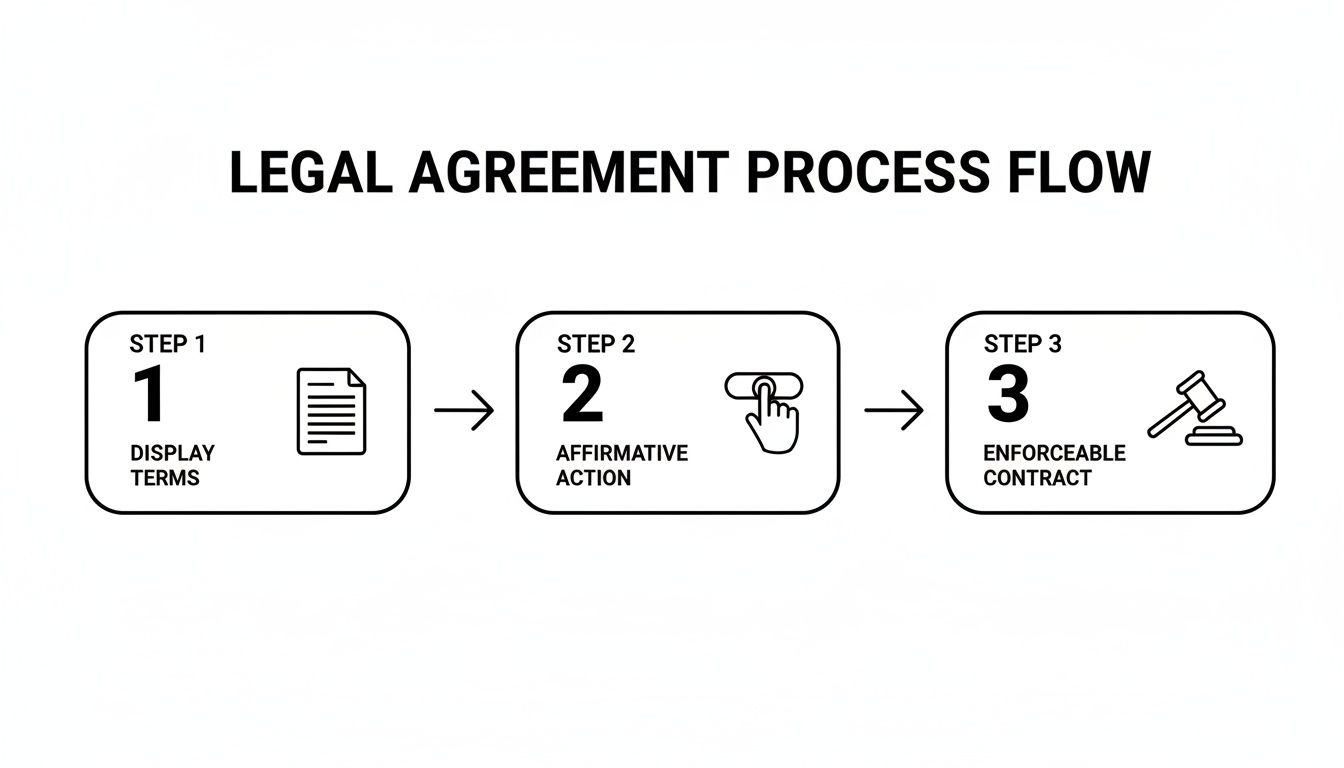
It’s a simple but powerful sequence: show the terms clearly, require a distinct action to agree, and only then is an enforceable contract actually formed.
Require an Unticked Checkbox
This one is non-negotiable. Always require an affirmative, unticked checkbox. Pre-ticked boxes assume consent instead of actively getting it, and they’ve been widely shot down by courts and regulators, especially under GDPR in the EU. By forcing the user to physically click the box, you create a clear record of their intent to be bound by the terms. This small action carries significant legal weight, transforming passive browsing into active agreement.
Many of the best practices for clickwrap agreements overlap with drafting general terms of service, a process where tools like AI for Terms of Service agreements are becoming incredibly helpful.
Maintain an Unalterable Audit Trail
Your final, and maybe most important, job is to keep a perfect record of every single agreement. If a user challenges their consent years down the road, you need undeniable proof that they agreed. A simple "yes" flag in your database just won't cut it.
A rock-solid audit trail has to capture:
- The specific version of the agreement the user accepted.
- A precise timestamp of the moment acceptance occurred.
- The user's IP address and other device information.
- A screen capture or record of the exact interface the user saw.
This is where manual tracking falls apart and a dedicated digital signing solution becomes essential. BoloSign automates this entire evidence-gathering process for you. When a user completes a clickwrap on our platform, we automatically generate a secure, unalterable audit trail that captures all this crucial data. For high-volume industries like logistics or education, BoloSign’s platform lets you create, send, and manage unlimited clickwrap agreements, knowing every acceptance is backed by a robust, court-admissible record. These principles are part of a larger strategy you can explore in our guide to contract management best practices.
How Global Courts Interpret Clickwrap Agreements
It’s one thing to understand the theory behind a click wrap agreement, but what really counts is how judges handle these disputes in the real world. Courts across the globe have spent years drawing the line between a digital contract that holds up and one that falls apart. Looking at these landmark decisions gives you a clear roadmap for building agreements that can withstand legal challenges.
The consensus from the bench is pretty clear: courts strongly favor agreements where the user had a genuine opportunity to review the terms and then took a deliberate, unambiguous action to accept them. This is the exact reason clickwrap is so consistently upheld, while its passive cousin, browsewrap, so often fails in court.
Key Rulings that Shape Today's Standards
A handful of critical court cases have become the foundation for how we design click wrap agreements today. These decisions offer a practical playbook on what to do—and, more importantly, what to avoid.
One of the most foundational cases is Feldman v. Google. The court sided with Google, upholding its clickwrap agreement because the user had to perform an unmistakable action—clicking "Yes, I agree"—before moving forward. The judge pointed out that the terms were clearly presented, and the user's click was a direct signal of acceptance. This case helped cement the idea that an affirmative click is powerful proof of consent.
On the flip side, Specht v. Netscape is a classic example of what not to do. In that case, the court ruled in favor of the users because the link to the terms was hidden "below the fold" on the webpage, nowhere near the download button. The lesson here is massive: presentation is everything. If a user isn't given reasonable notice, their click is legally meaningless.
The Global Shift Towards Explicit Consent
This focus on clear, explicit consent isn't just a U.S. phenomenon. Courts and regulators in the UAE, Australia, and across Europe have all landed on similar standards, creating a global expectation for transparency.
Take the European Union's landmark Planet49 ruling. The European Court of Justice was crystal clear: pre-ticked checkboxes do not count as valid consent under GDPR. That single decision sent shockwaves through the industry, forcing businesses all over the EU to redesign their consent flows to demand active, opt-in actions instead of assuming agreement. You can dive deeper into how courts distinguish between agreement types.
Aligning with Evolving Legal Precedents
These court cases aren't just interesting legal history; they're direct instructions for your business. Falling behind these evolving standards can lead to your contracts being invalidated, not to mention steep compliance penalties under regulations like GDPR or HIPAA.
This is where BoloSign’s compliance-first approach becomes a real business advantage. Our entire platform is engineered to align with these strict legal precedents. The AI contract review and automation tools ensure your clickwrap flows are built for enforceability right from the start. We help you create, send, and get PDFs, templates, and forms signed instantly with a process designed to stand up to judicial scrutiny.
BoloSign’s system automatically captures a tamper-proof audit trail for every single agreement, giving you the verifiable evidence of consent that courts demand. This lets you operate with confidence in major markets like the US, Canada, and Australia, knowing your agreements are built on a foundation of proven legal principles. With unlimited documents and users at one fixed price, BoloSign makes enterprise-grade compliance and security up to 90% more affordable than alternatives like DocuSign.
Streamlining Clickwrap Workflows with BoloSign
Knowing the legal theory behind a click wrap agreement is one thing. Putting it into practice efficiently is what separates the businesses that scale from those that get bogged down in manual work.
Trying to create, deploy, and track these agreements by hand is slow, full of potential errors, and simply won't keep up as you grow. This is where a dedicated platform stops being a nice-to-have and becomes absolutely critical.
BoloSign is built to turn this entire process from a legal headache into a simple, automated workflow. Forget about version control, audit trails, and clunky user interfaces. You can build and roll out legally sound click wrap agreements in minutes, letting you focus on your business while we handle the compliance.
Our platform gives you the tools to embed compliant agreement flows right into your website, app, or customer portal. This creates a frictionless experience for your users while making sure every single "I agree" is captured with the detail needed to hold up in court.
Creating and Embedding Agreements Effortlessly
With BoloSign, you can set up templates for your most-used agreements—think terms of service, privacy policies, or client intake forms. Our straightforward editor lets you design a clear, user-friendly interface that meets the legal standard for being easy to see and understand.
Once your template is good to go, deploying it is dead simple. BoloSign lets you:
- Sign PDFs Online: Upload an existing PDF of your terms and instantly convert it into an interactive clickwrap.
- Use Reusable Templates: Build templates from scratch to keep your branding and legal language consistent across the board.
- Embed Anywhere: Grab a simple snippet of code and drop your agreement right into your website, onboarding flow, or even add a signature to a Google Form.
This kind of flexibility is a game-changer for businesses that deal with a high volume of agreements. A staffing agency, for instance, can embed a work agreement directly into its online application. A real estate firm can require an NDA acceptance before a user can even view confidential property details.
Automating the Entire Agreement Lifecycle
A click wrap agreement isn't something you can just set and forget. Your terms and policies will eventually change, and when they do, you need to get consent again from your entire user base. Doing this manually is a logistical nightmare and a massive compliance risk.
BoloSign’s contract automation features solve this problem entirely. Our system handles the whole lifecycle for you. BoloSign's platform automates version control, keeps a record of which user agreed to which version of your terms, and can automatically send out re-consent requests whenever you publish an update. This keeps your legal agreements current and enforceable without you having to lift a finger.
This level of automation makes a huge difference. For a healthcare provider updating their HIPAA policy, BoloSign can automatically prompt every patient to accept the new terms the next time they log in. For a logistics company changing its carrier terms, the platform ensures every driver agrees before they can accept a new shipment. This is exactly what good contract management software is supposed to do.
And the best part? This powerful automation and compliance framework is incredibly affordable. BoloSign gives you unlimited documents, templates, and team members for one fixed price, making our solution up to 90% more affordable than platforms like DocuSign or PandaDoc.
The Business Case for Modernizing Your Agreements
Treating your click wrap agreements as just another legal checkbox is a massive mistake. In reality, it’s a strategic business decision with a real, measurable return on investment. Sticking with outdated methods like browsewrap or sloppy consent flows isn't just inefficient—it’s a direct hit to your bottom line.
Think about the hidden costs. You're looking at everything from drawn-out litigation over disputed terms to eye-watering regulatory fines under laws like GDPR or CCPA. Relying on implied consent is a huge gamble. When a customer dispute lands on your desk, the burden of proof is on you to show they knowingly agreed to your terms. Without a rock-solid audit trail, that's an uphill battle that will bleed resources and tarnish your reputation.
Modernizing your approach flips the script. You move from a defensive, reactive posture to a proactive, protected one.
Calculating the ROI of a Modern Solution
This is where the value of a platform like BoloSign becomes crystal clear. It’s not just about what you gain; it’s about the risks you eliminate and the efficiencies you unlock. By implementing a proper digital signing solution, you directly slash your legal exposure while speeding up critical business processes.
When companies switch from passive consent to an active clickwrap with detailed audit logs, the change is immediate. Learn more about how robust clickwrap reduces disputes. BoloSign is an investment in both protection and performance.
- Reduced Legal Risk: Our AI-powered contract intelligence and automated audit trails generate the verifiable proof you need to defend your agreements. This is a game-changer for staffing agencies onboarding contractors or healthcare providers managing patient consent forms.
- Accelerated Onboarding: When you embed agreements right into your sign-up or checkout flow, you create a frictionless user experience. For professional services, that means faster client intake. For sales teams, it means shorter deal cycles.
- Strengthened Compliance: BoloSign helps you meet global standards like ESIGN, eIDAS, and HIPAA with confidence. Our system guarantees every agreement is captured securely, with a clear record of who agreed, to what, and when.
An Investment in Your Future Growth
At the end of the day, modernizing your agreements is about building a scalable and resilient business. BoloSign gives you the tools to do just that. We offer unlimited documents, templates, and team members at a single fixed price—making our platform up to 90% more affordable than alternatives like DocuSign or PandaDoc.
Ready to see the difference for yourself? Start your 7-day free trial and see just how simple and secure your agreements can be.
Got Questions About Clickwrap? We've Got Answers.
Here are a few quick, straightforward answers to the most common questions we hear about using and enforcing a click wrap agreement.
Are Clickwrap Agreements Legally Binding?
Yes, absolutely. When they’re set up correctly, clickwrap agreements are legally binding in most major jurisdictions around the globe, including the US, Canada, the EU, and Australia. The secret sauce is making sure the user has clear notice of the terms and then performs an explicit action—like clicking that "I Agree" button—to signal their consent. BoloSign is designed to help you meet these global standards, keeping you aligned with laws like the ESIGN Act and eIDAS.
What's the Difference Between Clickwrap and Browsewrap?
It all comes down to active consent. A click wrap agreement requires a user to physically click a button or check a box to show they agree. A browsewrap agreement, on the other hand, just assumes consent is given because someone is using the website. Courts overwhelmingly prefer clickwrap because the user's intention is crystal clear, making it a far more reliable and enforceable digital signing solution.
How Can I Actually Prove a User Agreed to My Terms?
Proof is all about having a rock-solid, secure audit trail. A platform like BoloSign automatically captures a detailed record for every single agreement, which is a key part of our AI-powered automation. This digital receipt includes everything you need: an exact copy of the terms the user was shown, the user's identification information, and a precise timestamp with the IP address it came from. This kind of digital evidence is your best friend if a dispute ever arises, giving businesses in critical sectors like healthcare or real estate true peace of mind.
Modernizing your agreements isn’t just a tech upgrade; it’s a strategic move to protect your business and clear the runway for growth. BoloSign makes it simple with unlimited documents, users, and templates at one fixed price, making it up to 90% more affordable than other platforms.
Ready to see how it works? Start your 7-day free trial and discover how easy it is to create, send, and manage compliant clickwrap agreements.

Paresh Deshmukh
Co-Founder, BoloForms
12 Dec, 2025
Take a Look at Our Featured Articles
These articles will guide you on how to simplify office work, boost your efficiency, and concentrate on expanding your business.