

How to Cancel a Contract The Right Way
Learn how to cancel a contract legally and minimize risk. Our guide covers valid reasons, notice requirements, and ways to avoid costly penalties.

Tired of nonsense pricing of DocuSign?
Start taking digital signatures with BoloSign and save money.
Before you try to get out of a contract, you need to be sure you have a solid legal reason. A contract is a legally binding promise, and just having a change of heart rarely holds up. Your ability to walk away cleanly hinges on the specific terms you agreed to and the laws that apply.
Knowing When You Can Legally Cancel a Contract

Trying to end an agreement without proper justification can land you in hot water, leading to financial penalties or a drawn-out legal battle. The good news is that there are several well-established grounds for termination that can protect you when a business relationship just isn't working anymore.
Getting familiar with these reasons gives you the confidence to act decisively. Most valid grounds fall into a few key categories, and each one comes with its own playbook.
To give you a quick overview, here are the most common reasons you might be able to end an agreement.
Common Reasons for Contract Cancellation
| Reason for Cancellation | What It Means | Real-World Example |
|---|---|---|
| Material Breach | One party fails to deliver a core promise, defeating the contract's purpose. | A software developer fails to deliver the promised functional app, only providing a buggy, unusable version. |
| Termination Clause | The contract itself contains specific rules for ending the agreement early. | A logistics contract includes a "termination for convenience" clause allowing either party to exit with 30 days' notice. |
| Mutual Agreement | Both parties agree to dissolve the contract and release each other from their duties. | A healthcare clinic and a service provider both agree to part ways on an equipment lease that no longer meets the clinic’s needs. |
| Statutory Rights | A specific law (like a "cooling-off" rule) gives you the right to cancel within a set time. | A consumer cancels a newly signed gym membership within the 3-day period legally allowed in their state or country. |
Understanding these grounds is your first step. Now, let's dig into what each of these looks like in practice.
Finding a Material Breach of Contract
One of the clearest paths to cancellation is a material breach. This isn't about a minor slip-up or a slight delay. A material breach is a failure so significant that it strikes at the very heart of the agreement, effectively ruining the deal for the other party.
Imagine a professional services firm hires a marketing agency that guarantees 50 qualified leads per month. If the agency consistently delivers only a handful, that failure to perform on a core promise is a classic material breach. It gives the company solid grounds to terminate the contract.
Acting on a Termination Clause
Many well-written contracts have built-in escape hatches—clauses that spell out exactly how and when either party can end the agreement. These are your best friend when you need a clean exit.
You'll typically see two kinds:
- Termination for Cause: This is for when the other party messes up, similar to a material breach.
- Termination for Convenience: This lets one or both parties end the contract without a specific reason, though it usually requires a notice period (30-90 days is common) and sometimes a termination fee.
For example, a logistics company might use a "termination for convenience" clause to switch shipping partners with 60 days' notice if a better deal comes along. These clauses create a predictable, orderly way out. You can learn more about managing these documents in our guide on eSignature contract automation.
A contract's termination clause is your roadmap for ending the agreement. Ignoring its instructions—like notice periods or required delivery methods—can put you in breach, even if your reason for leaving is valid.
Reaching a Mutual Agreement
Sometimes, a contract just isn't working out, and everyone knows it. In these situations, the cleanest break is a mutual rescission or termination agreement. This is essentially a new contract signed by both parties that officially dissolves the old one, releasing everyone from their obligations.
This happens all the time in real estate. A homeowner and a contractor might agree to part ways during a renovation that's gone off the rails with budgets and timelines. By signing a mutual termination, they can settle up on work completed and move on without a fight. Using a secure digital signing solution to document this is crucial to avoid "he said, she said" arguments later.
Exercising Statutory Rights
Finally, consumer protection laws often provide a "cooling-off" period. This gives you the right to cancel certain types of contracts within a few days, no questions asked. These laws are designed to protect people from high-pressure sales for things like timeshare deals, gym memberships, or door-to-door sales.
The window to act is usually very short—often just a few days. These rights can vary widely depending on where you are, so always check your local laws, whether you're in the US, Canada, Australia, New Zealand, or the UAE.
Where to Find the Cancellation Clause in Your Agreement
Your signed contract is the official rulebook for your business relationship, and it’s the very first place you need to look when you’re thinking about ending it. Buried in all that legal language are the exact instructions for parting ways correctly. If you try to cancel without following these rules, you could accidentally put yourself in breach of contract.
The section you're hunting for is usually called "Termination" or "Term and Termination." This clause is your built-in exit strategy, spelling out the agreed-upon conditions for ending the deal before its natural expiration. Think of it as a pre-negotiated roadmap for a clean break.
Clauses That Define Your Exit Strategy
Once you find the termination section, you'll likely see a couple of key phrases that give you the right to cancel.
- Termination for Cause: This is your out if the other party drops the ball on their obligations—what we earlier called a material breach. For a professional services firm, this might get triggered if a client is constantly late on payments, which violates a core part of the agreement.
- Termination for Convenience: This one is powerful but often misunderstood. It gives one or both parties the ability to end the agreement without having to prove fault or provide a specific reason. For example, a fast-growing staffing agency might want a "termination for convenience" clause in their client contracts. This gives them the flexibility to end a partnership with 30 days' notice if their business strategy changes.
Knowing the difference here is everything. "For cause" means you have to prove the other party messed up. "For convenience" is a no-fault exit, but it almost always comes with specific hoops you have to jump through.
Don't Skip the Fine Print: Notice Periods and Delivery Methods
Finding the right clause is only half the battle. The contract will also tell you exactly how to deliver the bad news. People often gloss over these procedural details, and it's a costly mistake.
Notice Period: This is the amount of advance warning you have to give before the termination officially kicks in. I’ve seen it be anything from a few days to several months. A complex logistics contract, for instance, might demand a 90-day written notice to give everyone enough time to unwind operations without causing a massive disruption. If you don't give the full notice, you could be on the hook for financial penalties.
Method of Delivery: The contract often gets very specific about how the notice has to be sent to be legally valid. Some older agreements might still insist on certified mail to create a paper trail. Thankfully, most modern contracts now allow for electronic notice via email, especially when it's backed by a secure eSignature platform that can confirm it was received.
This is where a tool like a digital signing solution really becomes a lifesaver. When you send a termination notice through a platform like BoloSign, you get a legally binding, time-stamped audit trail. You’ll know the exact moment the notice was sent, delivered, and even opened, which removes any doubt that you followed the contract's rules to the letter. It’s far more reliable than a standard email that can get “lost in the spam folder.”
Your Pre-Cancellation Checklist
Before you do anything, go through your agreement with a fine-tooth comb and get clear answers to these questions. Writing this down will make sure your cancellation is compliant from the get-go.
- Is there a termination clause? Find the specific section and paragraph numbers.
- What are the grounds? Can you terminate "for cause," "for convenience," or both?
- What’s the notice period? Write down the exact number of days, weeks, or months.
- How must the notice be delivered? Does it have to be formal mail, or is email okay? It can be insightful to read your provider's own legal documents, like BoloSign's Terms of Service, to see how modern tech companies handle these notifications.
- Are there any penalties? Look for any fees or costs tied to an early exit.
Once you have these details nailed down, you can move forward with confidence, knowing you're playing by the rules you both agreed to from the start.
How to Write and Send a Formal Cancellation Notice
Alright, you’ve done your homework, confirmed you have the legal grounds to cancel, and you know what the contract requires. Now comes the critical part: actually telling the other party.
Drafting and sending a formal cancellation notice isn't just a formality—it’s a crucial step that protects your business and makes the termination legally stick. A vague or poorly worded notice can cause confusion, invite disputes, or worse, get your entire cancellation attempt thrown out.
Your communication needs to be direct, professional, and leave absolutely no room for misinterpretation. This document is your official record. It establishes a clear timeline and spells out exactly why you’re ending the relationship.
Key Elements of a Strong Cancellation Notice
Think of your termination letter or email as a checklist. Every notice needs to have a few essential parts to be legally sound. If you miss one, it could weaken your position down the road if things get messy.
Make sure your notice includes:
- A Crystal-Clear Statement of Intent: Don't beat around the bush. Start with a direct statement that you are terminating the agreement. Phrases like "we're thinking about ending our partnership" are too weak. Be firm.
- Specific Contract Details: Always reference the contract by its official name, the date it was signed, and any project or account numbers. This ensures everyone is on the same page about which agreement is being cancelled.
- The Legal "Why": Cite the exact clause in the contract that gives you the right to terminate. For instance, "as per Section 7.2, Termination for Convenience," or "in accordance with Section 8.1 for material breach."
- The Effective Date: State the exact date the termination takes effect. Double-check your contract for any required notice periods (e.g., 30 or 60 days) and make sure your effective date respects that timeline.
- The Reason (If Required): If you're terminating "for cause" (like a breach of contract), briefly and professionally state the reason. Reference the specific breaches without getting emotional.
- Next Steps and Final Obligations: Briefly outline what needs to happen next. This could be about returning company property, settling the final invoice, or procedures for data hand-offs.
This process chart shows the basic workflow: you find the relevant clause, check the notice requirements, and then deliver your formal notice.
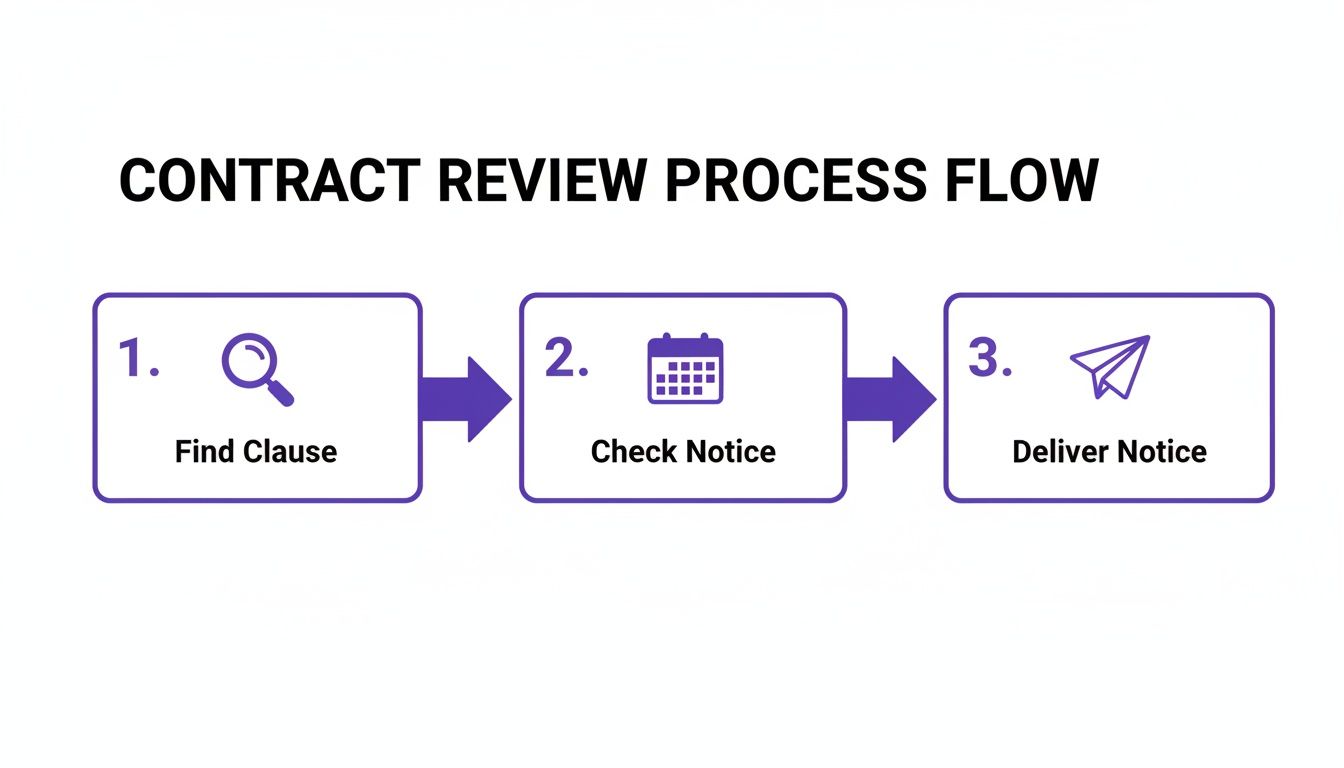
This simple, three-step approach keeps you aligned with the contract's rules, minimizing the risk of a simple procedural mistake derailing your cancellation.
Example in Action: A Staffing Agency Scenario
Let's put this into a real-world context. Imagine a staffing agency in the UAE needs to cut ties with a client who has been consistently late on payments—a clear material breach of their agreement.
Their notice might read something like this:
"This letter serves as formal notice of termination of the Master Service Agreement dated January 15, 2024, between Innovate Staffing and Global Tech Solutions. In accordance with Section 8.1(a) (Termination for Cause), we are terminating this agreement due to repeated late payments, constituting a material breach of your obligations under Section 4.3 (Payment Terms). The termination will be effective in 30 days, on December 1, 2024. Please arrange for the final payment of all outstanding invoices by this date."
This works because it's specific, professional, and points directly to the contractual obligations that were broken. There's no ambiguity.
Modernizing Notice Delivery with eSignatures
The old days of sending a letter by certified mail and hoping for the best are long gone. Today's businesses need speed, certainty, and a bulletproof audit trail. This is where a digital signing solution completely changes how you send a formal notice to cancel a contract.
Sending a termination notice is a high-stakes communication. You need undeniable proof of when it was sent, delivered, and opened. A standard email simply doesn't provide this level of legal certainty.
Instead of the tedious print-sign-scan-email routine, a tool like BoloSign creates a clean, secure workflow. You can pull up a pre-approved cancellation template, fill in the details, and send it for a secure eSignature. This isn't just about making things easier; it's about smart risk management.
BoloSign’s AI-powered automation gives you a complete, time-stamped audit trail that is legally binding under frameworks like ESIGN and eIDAS. You'll get real-time notifications when the recipient opens and signs the notice, which shuts down any "I never got it" claims before they can even start. This is especially vital for businesses in regulated fields like healthcare and professional services, where documentation is king and compliance with HIPAA and GDPR is non-negotiable. Check out our guide on eSignature contract automation to learn more about how these tools work.
For a single fixed price, BoloSign gives you unlimited documents, templates, and team members, making it 90% more affordable than traditional tools that charge per envelope. That means you can handle every document workflow—from new hire onboarding to contract termination—without watching costs spiral.
Ready to see how simple and secure managing critical notices can be? Start a 7-day free trial and experience BoloSign's compliant and automated document workflows firsthand.
What Cancelling a Contract Will Cost You
Ending a contract early isn’t just about sending a notice. Let’s be real—it almost always has a price tag attached. Before you pull the trigger, you need a crystal-clear picture of the financial fallout. Skipping this step can quickly turn what seems like a smart business move into a costly mistake.
The most common financial hurdle you'll face is the early termination fee. Think of this as a pre-agreed penalty meant to cover the other party’s lost income and the headache of replacing your business. It's usually a flat fee or a percentage of what's left on the contract.
Common Penalties to Look For
When you dig into your agreement, zero in on the clauses spelling out the financial consequences. These are the terms that will hit your bank account if you decide to walk away.
Here are the usual suspects:
- Early Termination Fees (ETFs): This is a straightforward penalty for bailing before the contract is up. For instance, a marketing agency might charge a fee equal to two months of service to cover their overhead while they find a new client.
- Liquidated Damages: This is a specific dollar amount both parties agree to upfront, representing a fair estimate of damages if someone breaches the contract. You see this a lot in construction or real estate, where calculating the actual damage from a delay or cancellation is a nightmare.
- Forfeiture of Deposit: In many deals, you put down a deposit or earnest money to show you're serious. If you cancel without a valid reason, you can kiss that money goodbye.
A Perfect Example: Real Estate
The high-stakes world of real estate shows exactly how these penalties work. When a buyer makes an offer on a house, they put down an earnest money deposit. This cash sits in an escrow account and is completely at risk if the buyer gets cold feet for a reason not covered by a contingency (like a bad inspection report).
If a buyer in the US or Canada backs out just because they found a better deal down the street, they'll almost certainly forfeit their entire deposit—and we’re talking thousands of dollars. This isn't just a hypothetical; it happens all the time, especially when the market gets shaky.
In fact, one recent housing boom saw over 53,000 home-purchase agreements get cancelled in a single month. That's a staggering 15% of all homes that were under contract at the time. This spike was driven by rising interest rates and economic uncertainty, proving how quickly financial pressures can lead to contract terminations.
How to Negotiate Penalties and Limit Your Exposure
Just because a penalty is written into the contract doesn’t mean it’s non-negotiable. You might have some wiggle room, especially if you have a good relationship with the other party or if they also see a mutual benefit in going your separate ways.
Your best negotiating tool is a clear understanding of your contract and a professional, solution-oriented approach. Frame the cancellation as a mutual decision to move forward, not a hostile breakup.
Start with an honest conversation. Explain why you need to terminate and see if you can land on a reduced fee or a more manageable payment plan. Whatever you agree to, make sure it’s documented in a final settlement agreement. Using a secure digital signing solution to finalize everything gives both sides a legally-binding record, which is crucial for compliance and avoiding headaches down the road.
As you navigate the financial side of things, it's also smart to look into the specific tax implications of termination payments, since these can vary based on your location and the contract details. And always make sure you understand your rights regarding payments and charges by reviewing all related documents, like a company's refund policy. For example, BoloSign’s own approach to financial matters is laid out in our transparent refund policy.
Managing Final Steps and Avoiding Disputes

Successfully sending that notice to cancel a contract might feel like you've crossed the finish line, but the race isn’t quite over. The period right after termination is critical for tying up loose ends and making sure minor disagreements don’t escalate into major, costly disputes.
Just because the main work has stopped doesn't mean every obligation has vanished. Your original agreement likely has clauses that survive the termination, and handling these final steps with care is the key to a truly clean break.
Fulfilling Post-Termination Obligations
Once the termination is effective, both you and the other party probably have a final to-do list. Ignoring these tasks can lead to messy legal problems and can seriously damage your professional reputation. Think of it as a formal offboarding for a business relationship.
Here are some common duties you'll need to handle:
- Final Payments: Getting all invoices paid for work completed and accepted right up to the termination date.
- Return of Property: Giving back any equipment, documents, keys, or proprietary materials that belong to the other party.
- Data Destruction/Transfer: Securely deleting or returning any sensitive data as spelled out in the contract.
- Respecting Surviving Clauses: Sticking to any confidentiality agreements (NDAs) or non-compete clauses that explicitly continue after the main contract ends.
Imagine a healthcare clinic ending its contract with a medical billing provider. The clinic must ensure all patient data is securely transferred or destroyed according to HIPAA regulations, and the provider must return all access credentials to the clinic's systems. Failure on either side is a significant compliance breach.
The Power of Secure Record Keeping
Throughout this entire wind-down phase, meticulous documentation is your best friend and strongest defense. Keeping a clear, accessible record of everything you do—from the final payment confirmation to an email acknowledging returned property—creates an undeniable history of your compliance. When you carefully follow the cancellation procedures, you can often head off the risk of common contract disputes before they even start.
This is where a dedicated platform for contract automation and management really proves its worth. Trying to piece together a story from scattered email chains and files saved on different computers is a recipe for disaster, especially if you need to prove you did your part months or years later.
A clean, unchangeable audit trail is the strongest evidence you can have. It transforms a potential "he said, she said" argument into a straightforward matter of fact, backed by time-stamped, legally binding records.
Using a platform like BoloSign centralizes this whole process. When you send and sign a final settlement or termination acknowledgment, BoloSign automatically creates a comprehensive audit trail. This secure, compliant workflow is essential for businesses in regulated sectors like healthcare and education, where rules like HIPAA demand strict, verifiable documentation.
Strategies for Resolving Disagreements
Even with the best intentions, friction can still happen. Maybe the other party contests the final invoice amount, or they claim you didn't meet one of the post-termination requirements. The goal is to tackle these issues constructively before they spiral out of control.
Mediation is often a smart first move. It brings in a neutral third party to help both sides find some common ground, and it's almost always faster and cheaper than going to court. In fact, many modern contracts require mediation as the first step before anyone can file a lawsuit.
For instance, a marketing agency and its client might disagree on the final bill for a partially completed campaign. Instead of jumping into a legal battle, they can hire a mediator to help them agree on a fair payment for the work that was delivered. This approach can preserve the professional relationship and saves everyone time and money.
To make any resolution official, you can quickly draft a settlement agreement and use BoloSign to manage the digital signing solution. This makes sure the final terms are locked into a legally binding document that complies with ESIGN and eIDAS standards, giving everyone closure. At BoloSign, we believe in straightforward value—we offer unlimited documents, templates, and team members for a single fixed price, making our platform 90% more affordable than many traditional tools.
This approach doesn't just solve the immediate problem; it strengthens your entire process for the future. By using secure, automated workflows to manage every step of the contract lifecycle—from creation to termination—you build a resilient system that protects your business.
Ready to see how an organized, secure platform can help you manage agreements and part ways smoothly? Start your 7-day free trial of BoloSign and experience firsthand how simple and secure document workflows can be.
Got Questions About Cancelling a Contract? We’ve Got Answers.
Ending a business relationship can feel like walking through a minefield. To help you step confidently, here are some straight answers to the questions we hear most often about cancelling contracts.
What if My Contract Doesn't Have a Termination Clause?
It’s a common misconception that no termination clause means you’re locked in for life. That's rarely the case. Your strongest option is often to terminate for a "material breach," which is just a legal way of saying the other party failed to deliver on a core part of the deal so badly that it defeats the whole purpose of the contract.
Another path is simply to ask for a mutual termination. This involves both of you signing a separate, new agreement to officially dissolve the original contract. It's a clean break. While it gets more complicated, courts might also permit termination if unforeseen events make it genuinely impossible to proceed. In any of these scenarios, it’s smart to get a bit of legal advice to understand your best move.
Can I Cancel a Verbal Agreement?
Yes, you can cancel a verbal agreement, but your biggest hurdle will be proving its terms. First, you have to be sure the agreement is legally enforceable in your area; some contracts, like those for real estate, absolutely must be in writing.
Assuming it's a valid verbal contract, you can end it for the same reasons you'd end a written one—a major breach by the other party or a mutual decision to part ways. The trick is to create a paper trail now. Document every conversation and follow up with a formal, written cancellation notice. Using a tool to capture an eSignature on a cancellation document is a great way to formalize everything and stop future arguments over who said what.
Void vs. Terminated Contracts: What's the Difference?
A void contract is treated like it never legally existed, usually because of an issue like illegality or one person not having the capacity to agree. Terminating a contract, however, accepts that it was valid but formally brings it to an end.
How Much Notice Do I Need to Give?
Check the termination clause first—the answer is almost always spelled out right there. Notice periods can be anything from a few days to 90 days or more, depending on the industry. A logistics partner, for instance, might require a long heads-up to unwind their operations smoothly without causing chaos for your business.
If the contract is silent on this, the standard is to provide "reasonable notice." What’s considered reasonable can be debated, but 30 days is a widely accepted and safe benchmark. No matter what, always send your notice in writing. This creates a clear, undeniable record of exactly when the clock started ticking.
Does a Cancellation Notice Really Need to Be Signed?
Absolutely, yes. A signature transforms your notice from a simple message into a legally authoritative document. Without it, the other party could easily argue they never acknowledged it, leaving you in a messy situation. Sending the notice through a platform that provides a secure digital signing solution is the modern standard for a reason.
This approach gives you a legally binding record that is compliant with laws like ESIGN and eIDAS. More importantly, it generates an audit trail that proves exactly when the notice was sent, delivered, opened, and signed. It removes all doubt and is a crucial step in protecting your business and ensuring a clean break.
Managing contract terminations doesn't have to be a headache. With the right approach, you can make sure every step is clear, compliant, and secure. BoloSign is built to handle exactly this, giving you AI-powered automation, secure eSignatures, and a full audit trail for every document. For one fixed price, you get unlimited documents, team members, and templates—making it 90% more affordable than the usual suspects.
Ready to see how simple secure document workflows can be? Start your 7-day free trial today.

Paresh Deshmukh
Co-Founder, BoloForms
19 Dec, 2025
Take a Look at Our Featured Articles
These articles will guide you on how to simplify office work, boost your efficiency, and concentrate on expanding your business.