

Elements of a Valid Contract: A Quick Guide to Enforceable Agreements
Master the elements of a valid contract with clear explanations of offer, acceptance, consideration, and practical examples.

Tired of nonsense pricing of DocuSign?
Start taking digital signatures with BoloSign and save money.
Ever wonder what makes a business deal actually stick? Before you sign on the dotted line, there's a critical question to answer: Is this agreement legally real? For a contract to be valid and hold up in court, it needs to be built on five core pillars: offer, acceptance, consideration, capacity, and legality. If even one of these is shaky, the whole agreement could come crashing down.
The Pillars of an Enforceable Agreement
Think of building a solid business relationship like constructing a bridge. Each of the elements of a valid contract is a critical support beam. Miss one, and the entire structure is at risk. Getting these pillars right is the first step to creating agreements that protect your interests and prevent costly headaches later on.
It’s a common mistake to use "agreement" and "contract" as if they’re the same thing, but they're not. A contract carries a specific legal weight that a simple agreement just doesn't have.
Building a Foundation for Trust
Every single business—from a healthcare clinic ordering supplies to a real estate agency closing a sale—runs on enforceable contracts. These documents are way more than just paperwork; they're the bedrock of trust and accountability in any professional relationship. They make sure everyone is on the same page about their rights and responsibilities.
A solid contract clearly defines:
- The Promise: What each party is committing to do.
- The Price: What's being exchanged, whether it's money, goods, or services.
- The Plan: The timeline and conditions for getting it all done.
This chart breaks down the core components that turn a simple promise into a legally binding contract.
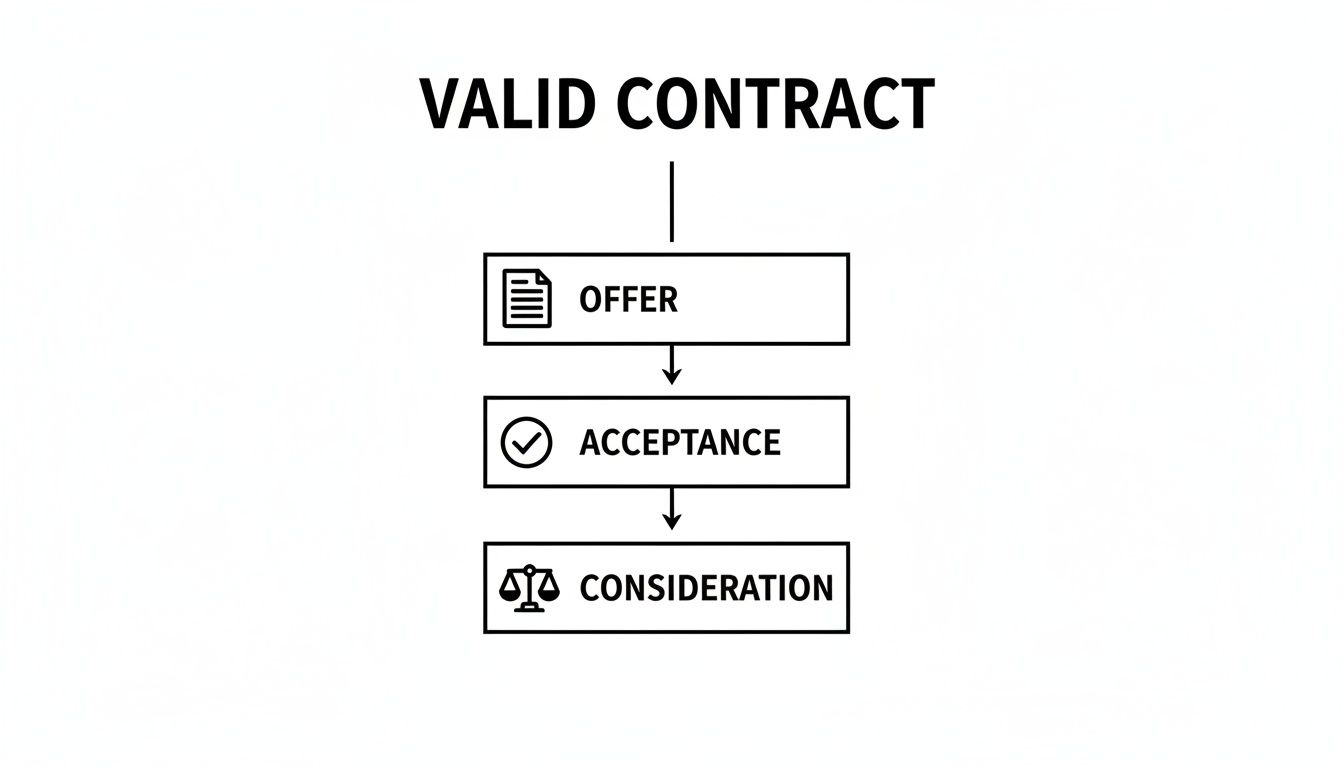
As you can see, the offer, acceptance, and consideration are the absolute fundamentals. Without those three locked in, the other elements can’t save the contract.
Quick Overview of Contract Essentials
To give you a quick reference, here’s a breakdown of the five core components every legally sound contract needs. Getting these right is non-negotiable for protecting your business.
| Contract Element | What It Means | Why It Matters for Your Business |
|---|---|---|
| Offer | A clear proposal from one party to another, outlining the terms of the deal. | It sets the stage for the entire agreement. If the offer is vague, the contract is built on a weak foundation. |
| Acceptance | The other party agrees to the offer's terms without any changes. | This is the "handshake" moment that confirms mutual agreement and creates a binding commitment. |
| Consideration | Something of value (money, goods, a service) is exchanged between the parties. | It proves the deal isn't just an empty promise. Both sides have to give and get something. |
| Capacity | All parties must be legally competent (of sound mind, legal age) to enter a contract. | This prevents agreements from being voided because someone wasn't legally able to make a commitment. |
| Legality | The contract's purpose must be legal and not against public policy. | You can't enforce a contract for an illegal activity. This ensures your agreements are legitimate and supported by the law. |
Understanding this table is the first step toward drafting and reviewing contracts with confidence, ensuring every deal you make is built to last.
Why Every Element Matters
Getting a handle on these components isn't just for drafting new agreements; it’s also crucial for knowing when an existing one has been broken. When a contract is breached, your ability to get a remedy often comes down to proving that a valid contract existed in the first place. Knowing these elements helps you understand when you might need to explore options like how to sue for breach of contract.
In today’s fast-paced business environment, manually checking every document for these elements is inefficient and risky. This is where a modern platform like BoloSign makes a huge difference. You can create, send, and sign PDFs and templates instantly, with AI-powered features that help ensure every pillar is firmly in place. Our AI contract review can flag ambiguities, while secure eSignature workflows provide undeniable proof of acceptance, giving you complete confidence in every agreement you sign online.
The Critical Handshake of Offer and Acceptance
At the very core of every contract is a "meeting of the minds"—that precise moment when two parties lock into an agreement on the exact same terms. This isn't just a casual conversation; it's a formal dance between two key elements: offer and acceptance. Think of it as the clear, legally significant handshake that kicks off the entire relationship.
An offer is far more than just a suggestion. It’s a specific, concrete promise one party makes to another. For an offer to be legitimate, it must be clear, definite, and properly communicated. It basically sets the stage, laying out exactly what’s on the table.
On the flip side, acceptance is the clean, unqualified "yes" to those terms. It has to be a mirror image of the offer. Any tweak, no matter how small, turns it into a counter-offer, which kills the original proposal and sends everyone back to the drawing board.
What Makes an Offer Legitimate?
Not every discussion about a potential deal counts as a legal offer. A product advertisement, for instance, is typically considered an "invitation to treat." It's inviting you to make an offer, which the seller can then accept or reject.
A real offer has to be detailed enough for the other party to know exactly what they’re agreeing to. Here’s how this plays out in the real world:
- Real Estate: A real estate agent in Australia presents a formal purchase offer spelling out the price, settlement date, and specific conditions. That’s a clear, actionable offer.
- Staffing: A professional services firm in the UAE extends a formal employment contract detailing the salary, start date, and job responsibilities. It’s a concrete proposal.
- Logistics: A shipping company in Canada provides a formal quote that specifies the cost, delivery timeline, and scope of services for a shipment.
In each scenario, the offer is specific enough to be accepted, forming one of the essential pillars of a valid contract. Vague proposals just create ambiguity and are a common reason agreements fall apart before they even begin.
The Power of Unconditional Acceptance
Acceptance must be absolute, clear, and communicated directly to the person who made the offer. As a general rule, silence or inaction doesn't count. Both sides need to take an explicit step to create a legally enforceable agreement.
This is where modern digital tools have become indispensable. While a quick "I agree" in an email might work in some cases, it lacks the security and clear audit trail of a dedicated digital signing solution. Modern platforms provide undeniable proof of acceptance, capturing the exact moment a party agrees to the terms with a legally binding eSignature.
For fast-moving online businesses, this is especially true for things like terms of service, where acceptance happens with a single click. You can learn more about how these work in our guide on click-wrap agreements.
An offer is like proposing a dance with specific steps. Acceptance is agreeing to dance to that exact music, following those exact steps. A counter-offer is like saying, "I'll dance, but only if we change the song to a waltz." The original dance is now off the table.
Misaligned offers and acceptances are a huge source of friction. In the fast-growing Contract Lifecycle Management (CLM) market, businesses are automating to prevent these costly mistakes. Research shows contract data is often fragmented across 24 different systems, which can lead to mismatches that erode deal value by 8.6% annually. For sectors like professional services, AI-powered drafting with instant eSignature tracking ensures offers are clear and acceptance is confirmed, adhering to standards like the ESIGN Act and GDPR.
This is exactly why centralizing your contracting process is so critical. When you create, send, and sign PDFs using a platform like BoloSign, you eliminate the risk of miscommunication. Our contract automation creates a single source of truth, where the offer sent is the exact document that gets signed. There’s no room for "he said, she said" disputes. BoloSign provides a complete, time-stamped audit trail that shows precisely when the offer was viewed and when it was accepted, creating an ironclad record that accelerates deal cycles and protects your business.
Understanding Consideration: The Exchange of Value
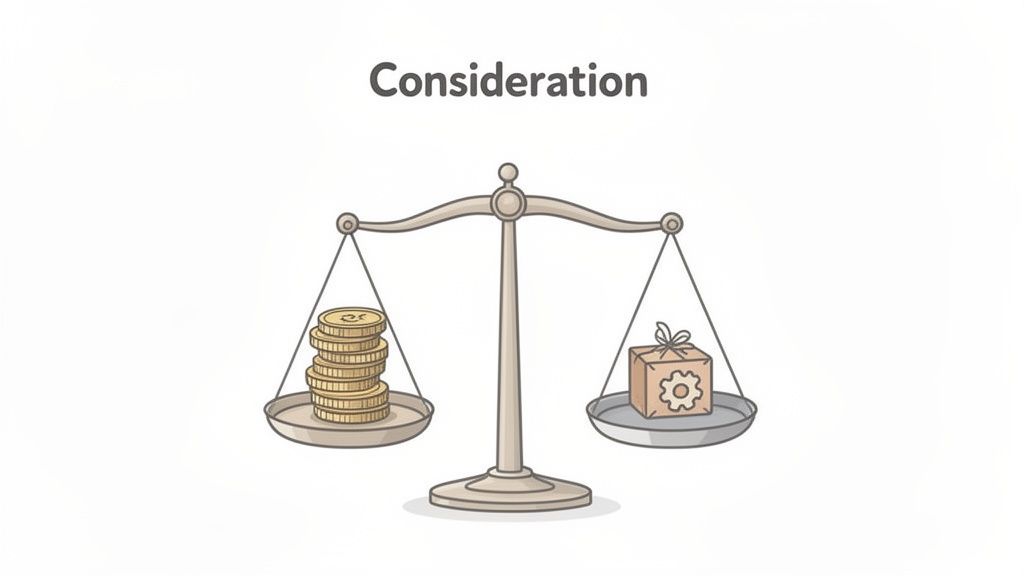
A contract isn't just a promise; it's a two-way street. For any agreement to be legally sound, both sides have to give and get something of value. This mutual exchange is called consideration, and it's what separates a binding contract from a simple, unenforceable gift.
Think of consideration as the "what's in it for me?" part of the deal for everyone involved. Each party must provide something valuable—and receive something valuable in return. This doesn't always mean money. It can be goods, a service, or even a promise not to do something.
This concept of reciprocity is the engine that makes a contract run. It ensures the agreement is a genuine bargain, not just a one-sided obligation.
What Counts as Valid Consideration?
People often mistake consideration for just the price tag on a deal, but it's much broader than that. The key is that the value exchanged must be "legally sufficient," meaning it has some recognizable worth in the eyes of the law.
Here are a few industry-specific examples of what this looks like in the real world:
- Healthcare: A hospital in the US pays a vendor for a shipment of MRI machine parts. The hospital’s consideration is the payment; the vendor’s is the delivery of the specialized parts, all while maintaining HIPAA compliance.
- Education: A university in New Zealand provides a series of advanced coding bootcamps in exchange for tuition. The school’s consideration is the expert instruction, while the student’s is the fee.
- Logistics: A freight company agrees to transport temperature-sensitive goods for a pharmaceutical firm. The manufacturer's consideration is the payment for specialized shipping, and the logistics company's is the safe, timely transport.
In each scenario, there’s a clear and direct exchange. This give-and-get is what makes the agreement enforceable.
Debunking Common Myths About Consideration
One of the most persistent myths is that a contract for a tiny amount, like $1, is always legally airtight. While it can sometimes be sufficient, courts might scrutinize these deals to make sure they aren't just a disguised gift or a way to mask a fundamentally unfair agreement. The exchange has to be a genuine bargain.
Consideration is less about the amount of value and more about the presence of a bargained-for exchange. The law generally doesn't second-guess what people decide is a fair price, but it demands that a real bargain exists.
Another common misconception is that a past favor can serve as consideration for a new promise. This is known as "past consideration" and is almost never valid. For instance, if a supplier gave your company incredible service last quarter, promising to pay them a bonus for it now doesn't create a binding contract, because the service was already completed.
When consideration is poorly defined or tracked, it creates major business friction. The Contract Lifecycle Management (CLM) software market is projected to grow significantly, partly because poor tracking contributes to an estimated 8.6% erosion of contract value. You can find out more about how the market is evolving in this detailed report on contract management software.
This is where technology offers a massive advantage. When you use BoloSign, our platform provides a clear, unchangeable record of the agreed-upon terms. Even better, BoloSign's AI contract review capabilities are invaluable for spotting potential issues before they become problems. Our AI assistant can automatically flag imbalanced or ambiguous consideration clauses, helping your legal and procurement teams ensure every agreement is fair, reciprocal, and legally sound before it ever goes out for signature. It’s a proactive approach that minimizes risk and builds stronger business relationships from day one.
Getting the Ground Rules Right
Beyond the initial dance of offer and acceptance, a contract’s real power comes from a few foundational ground rules. These elements decide if an agreement can even exist in the eyes of the law. Think of them as the operating system for your contract—without them, even the most perfectly written terms simply won't run.
These ground rules are intention, capacity, and legality. They make sure the agreement is a serious commitment, made by people who are able to make it, for a purpose that’s above board. Getting these right isn’t just a good idea; it’s non-negotiable for any contract you want to stand up to scrutiny.
The Intention to Create a Legal Relationship
For a contract to be valid, both sides must genuinely intend for their promises to have legal teeth. This is what separates a binding business deal from a casual promise you might make to a friend over coffee. The law looks at the whole picture to figure out if you were just talking or actually making a serious, legally-backed commitment.
For instance, a consulting firm sending a formal proposal to a potential client clearly shows this intent. On the other hand, a quick verbal promise to help a colleague with a project probably doesn't. This distinction is everything, as it determines the exact moment an agreement becomes enforceable.
An enforceable contract is a deliberate act. It requires a clear, mutual understanding that the promises made are not just words, but commitments backed by the force of law. Lacking this intent, an agreement is just an empty gesture.
This is where a professional platform makes all the difference. When you use BoloSign to build and send an agreement for an eSignature, the act itself creates a clear record of your intent. The formal workflow and the audit trail it generates provide solid proof that everyone involved understood they were making a serious commitment.
Verifying Legal Capacity to Sign
Capacity is just a legal term for a person's ability to enter into a contract. This means the signers must be of legal age, mentally sound, and not under the influence or forced into it. This also applies to businesses—the person signing on behalf of a company must actually have the authority to do so.
This is a surprisingly common tripwire. Imagine a junior staffer at a healthcare clinic signing a multi-year equipment lease they weren't authorized to approve. That contract could easily be voided, throwing operations and finances into chaos.
BoloSign helps you sidestep this mess by creating structured approval workflows. You can set it up so that high-value contracts are automatically routed to the right people—like a department head or the CFO—for their signature. This workflow creates an internal record confirming that the person with the proper authority signed the document, reinforcing the contract's validity from the start.
Ensuring the Contract Is for a Legal Purpose
Finally, the whole point of the contract must be legal. This element, legality, is as straightforward as it gets, but it's an absolute deal-breaker. A contract to do something illegal is void from the moment it’s created. No court will ever enforce an agreement that breaks the law or goes against public policy.
For example, a logistics contract to knowingly ship illegal goods is completely unenforceable. The same goes for an employment agreement for a job that requires a professional license if the person being hired doesn't have one.
While BoloSign can't give you legal advice, its entire structure is built to encourage good governance and compliance. By managing your agreements through our platform, you’re already operating within a framework built on top-tier security and legal standards. Our built-in compliance with ESIGN, eIDAS, HIPAA, and GDPR provides a secure environment for creating legitimate agreements. The detailed audit trail for every document helps prove that the entire process was transparent and professional, reinforcing that all parties intended to enter a lawful, enforceable contract.
Your Practical Checklist For Creating Valid Contracts
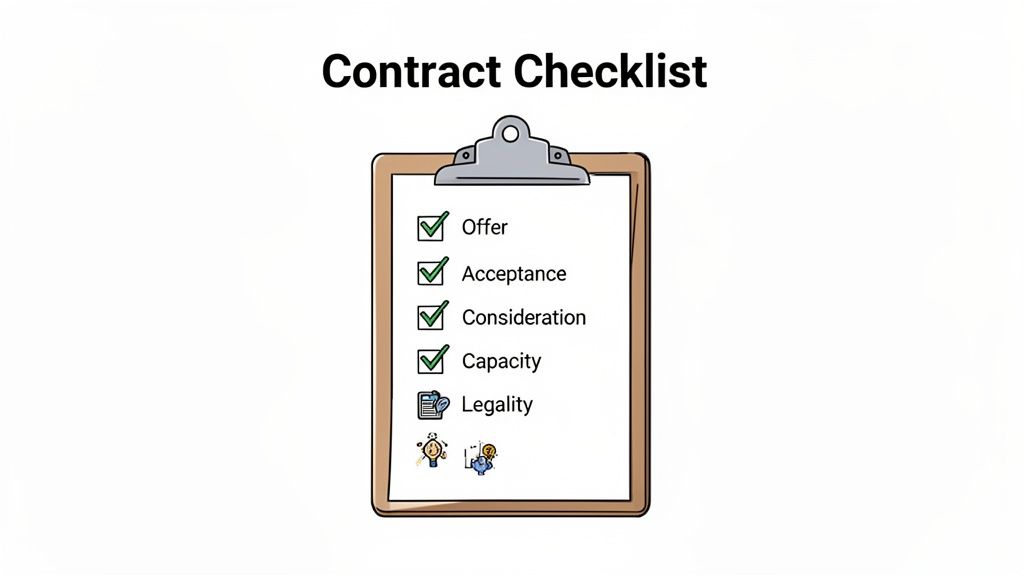
Knowing the theory behind a valid contract is one thing, but putting it into practice when you're staring at a 20-page document is another challenge entirely. To help you bridge that gap, we’ve put together a simple but powerful checklist.
Think of it as a quick pre-flight check before your contract takes off. Running through these points can help you spot potential issues early, saving you from major turbulence and costly disputes down the road. It boils all the essential elements of a valid contract into a practical tool you can use every day.
Contract Validity Checklist
Use this step-by-step checklist to ensure your agreement includes all the necessary elements of a valid contract before sending it for signature.
| Checklist Item | Verification Status | How BoloSign Helps |
|---|---|---|
| Is the offer clear, specific, and detailed? | ☐ Complete | Use pre-built templates to standardize offers, ensuring key terms like price and scope are always included. |
| Is the acceptance unconditional and a mirror image of the offer? | ☐ Complete | The secure audit trail provides time-stamped, undeniable proof of unconditional acceptance from all parties. |
| Is the exchange of value (consideration) clearly defined for all parties? | ☐ Complete | AI Assistant scans documents to flag ambiguous or one-sided consideration clauses that introduce risk. |
| Does the signer have the legal authority (capacity) to bind their organization? | ☐ Complete | Build custom approval workflows to ensure only authorized individuals can review and sign high-value agreements. |
| Is the contract's purpose legal and compliant with all relevant laws? | ☐ Complete | Maintain a central repository of compliant, pre-approved templates for different jurisdictions and use cases. |
| Have all parties mutually consented to the terms without coercion or misunderstanding? | ☐ Complete | A transparent, tracked signing process ensures all parties have a clear opportunity to review and consent. |
This checklist is more than just a box-ticking exercise; it’s a fundamental risk management tool. By systematically confirming each element, you shift your contracting process from a reactive chore to a proactive business advantage.
Breaking Down the Checklist
Let’s look a little closer at what these checks mean in practice.
Core Offer and Acceptance
First, you need to confirm that the handshake—the fundamental agreement—is clear and undisputed. Ambiguity here is a huge red flag.
- Is the offer specific and detailed? Your contract needs to spell out the essentials—price, quantity, services, deadlines—so there’s no room for someone to say, "That's not what I thought we agreed to."
- Is the acceptance unconditional? The signature or formal agreement must mirror the offer exactly. If the other party signs but changes a key term, that’s not an acceptance; it’s a counter-offer, and it voids the original deal.
With BoloSign, you can create, send, and sign PDFs using templates that keep your offers consistent and clear from the start. The platform's secure audit trail then captures the unconditional acceptance with a timestamp, giving you concrete proof.
Value, Authority, and Legality
Next, you have to verify the pillars that give the contract its legal weight. These elements confirm the deal is fair, authorized, and compliant with the law.
- Is the exchange of value (consideration) clearly defined? The contract must state what each party is giving and getting. This two-way street is what makes a contract a contract, not a gift.
- Have you verified the signer’s authority (capacity)? Make sure the person signing on behalf of a company actually has the power to do so. An agreement signed by an unauthorized employee isn't worth the paper it's printed on.
- Does the contract’s purpose comply with all relevant laws (legality)? This one’s straightforward: the agreement can’t require anyone to break the law.
BoloSign’s contract automation helps enforce these rules. You can set up approval workflows so only designated leaders can sign off on high-value agreements. Our AI assistant can also scan documents for risky clauses related to consideration, turning a tedious manual review into a fast, secure check. For more general guidance on this front, you can explore resources on how to prepare legal documents to strengthen your internal processes.
Ultimately, this checklist helps you build sound agreements from the ground up. For a deeper dive into the drafting process itself, check out our guide on how to write a contract. By combining solid practices with smart tools, you can ensure every contract you manage is built to last.
How BoloSign Ensures Every Contract You Sign Is Valid
Understanding what makes a contract legally sound is one thing. Manually checking every single document to make sure it hits the mark? That’s a recipe for human error and a huge drain on time.
This is where a smart, centralized platform like BoloSign does more than just help—it transforms your entire contracting process from a source of risk into a real strategic advantage. We built BoloSign to systematically reinforce every element of a valid contract, making compliance and security feel effortless. It’s a unified platform where you can create, send, and sign PDFs, templates, and forms instantly, all while knowing the legal pillars of your agreements are solid.
A Strategic Partner for Secure Contracting
At its core, BoloSign delivers undeniable proof of intent, offer, and acceptance. When you send a document for an eSignature, our system generates a comprehensive audit trail. This secure, court-admissible record captures every single action—from the moment the document is opened to the final signature—complete with IP addresses and timestamps. It's concrete evidence of mutual consent.
But we go far beyond just signatures. Our platform is designed for the real-world workflows of modern businesses:
- For Staffing Agencies: Send employment offers and client agreements from pre-approved templates and use automated approval workflows to ensure signing authority before the final signature request ever goes out.
- For Healthcare Providers: Maintain HIPAA compliance with secure digital signing for patient intake forms and vendor contracts, ensuring all parties have the legal capacity to sign.
- For Real Estate Professionals: Close deals faster. Send purchase offers and lease agreements that are clear, standardized, and ready for a legally binding eSignature in minutes, not days.
This level of control ensures your agreements aren't just signed, but are legally sound from the ground up.
Unlocking Efficiency with AI and Smarter Pricing
BoloSign is more than a signing tool; it’s an intelligent contract partner. Our AI contract review assistant automatically scans documents for missing clauses or vague terms related to consideration, ensuring every deal is built on a fair and clear exchange of value. This proactive risk check saves legal and procurement teams countless hours of tedious manual review.
We believe this kind of power should be accessible. That’s why BoloSign offers unlimited documents, templates, and team members at one fixed price. This simple, transparent model makes us up to 90% more affordable than alternatives like DocuSign or PandaDoc. No more unpredictable costs, just the freedom to scale without limits.
BoloSign isn't just about getting a signature faster. It's about building a smarter, safer, and more cost-effective contracting foundation that supports every element of a valid contract, every single time.
By combining practical contract automation with robust compliance features that adhere to ESIGN, eIDAS, and GDPR, we give you peace of mind. You can focus on growing your business, confident that your agreements are secure, compliant, and enforceable.
Experience the confidence that comes with automated, compliant contracting. Start your 7-day free trial today and see firsthand how BoloSign can protect and accelerate your business.
Frequently Asked Questions
Got questions about what makes a contract stick or how digital agreements work? Here are some quick, straightforward answers to the most common queries we hear.
Are Electronically Signed Contracts Legally Valid?
Yes, absolutely. In most developed economies, including the United States (ESIGN Act), the EU (eIDAS), Canada, and Australia, electronic signatures have the same legal standing as a wet ink signature.
The key is enforceability. To hold up in court, the eSignature needs to be captured through a compliant platform like BoloSign. These systems provide essential security, confirm the signer's identity, and generate a complete audit trail that proves the signature's integrity and the signer’s intent.
What Happens If a Contract Is Missing One Element?
Think of a valid contract like a stool with several legs—if one is missing, the whole thing collapses. If a contract lacks an essential element, like clear consideration or an unconditional acceptance, a court can declare it "void" or "unenforceable."
This means the agreement has no legal power, and neither party can be forced to follow through on their promises. It's a huge risk, which is exactly why using tools with AI contract review is so valuable for spotting those critical gaps before they become expensive problems.
How Can I Prove Who Signed a Digital Document?
This is where a reputable digital signing solution really shines. For every document, these platforms create a comprehensive, tamper-proof audit trail, often called a Certificate of Completion. This digital receipt meticulously logs every single action taken during the signing process.
This record typically includes:
- When the document was created and sent out.
- The exact time it was viewed and by whom.
- The IP address and unique device identifiers of the signer.
- A secure timestamp marking the precise moment the signature was applied.
This creates a powerful, court-admissible file that proves the who, what, and when of the entire signing event, leaving no room for doubt.
Can An Email Exchange Form a Valid Contract?
It’s possible, but it’s messy and risky. If an email chain clearly contains all the core elements—a specific offer, a direct acceptance, and a defined exchange of value (consideration)—it can technically form a binding contract.
The problem? These "accidental contracts" are often ambiguous, lack crucial details, and leave you with a fragmented paper trail that’s a nightmare to prove in a dispute.
Using a dedicated contract automation platform like BoloSign avoids all that chaos. It centralizes every part of the agreement into a single, authoritative document, giving you a clear, secure, and legally sound contract every single time.
Ready to create, send, and sign contracts with confidence? BoloSign offers a single, intuitive platform to manage your agreements with AI-powered intelligence and enterprise-grade security.
Start your 7-day free trial to experience how simple and affordable compliant contracting can be.

Paresh Deshmukh
Co-Founder, BoloForms
26 Dec, 2025
Take a Look at Our Featured Articles
These articles will guide you on how to simplify office work, boost your efficiency, and concentrate on expanding your business.