
Electronic signature legal requirements: Quick Compliance Guide
Learn electronic signature legal requirements in simple terms, plus what you need to stay compliant and avoid penalties.


Tired of nonsense pricing of DocuSign?
Start taking digital signatures with BoloSign and save money.
Let's get right to it: Yes, electronic signatures are legally binding. But—and this is a big but—they have to meet specific legal standards to hold up.
This isn't some legal gray area. We're talking about a globally regulated practice. Think of it as a digital handshake, but one that’s backed by powerful laws giving it the same exact weight as an old-school, ink-on-paper signature.
Why Your Business Can Trust Electronic Signatures
The idea that a simple click can carry the same legal force as a pen might seem a little strange at first, but it’s all built on a rock-solid legal foundation. For decades, governments in the US, Canada, Australia, and beyond have been hammering out clear rules for digital transactions, all to make sure businesses like yours can operate with total confidence.
Because of this, digital signing isn't a niche workaround anymore; it's a standard, secure, and fully enforceable part of modern business.
The Legal Pillars Holding Up E-Signatures
At the heart of electronic signature legal requirements are a few landmark laws designed to put digital and paper records on equal footing. These laws don’t get bogged down in specific technologies. Instead, they focus on one thing: the integrity of the signing process itself.
To give you a quick overview, here’s a look at the major legal frameworks you'll come across.
Key E-Signature Laws at a Glance
| Legislation | Jurisdiction | Core Principle |
|---|---|---|
| ESIGN Act | United States (Federal) | Grants e-signatures the same legal status as handwritten ones for interstate and foreign commerce. |
| UETA | United States (State Level) | Harmonizes state laws with ESIGN, ensuring consistent e-signature validity across 49 states. |
| eIDAS | European Union | Provides a standardized legal framework for electronic identification and trust services across the EU. |
These frameworks are the reason you can trust that a signature collected online is legitimate and enforceable.
Platforms like BoloSign are built from the ground up to comply with these critical legal pillars. Every document you send—whether it’s a detailed service agreement for a professional services firm in the UAE or a simple consent form for a healthcare clinic in New Zealand—is handled within a secure document workflow that automatically satisfies these global standards.
If you want to dig deeper into how this applies to specific agreements, you can explore our guide to managing and signing contracts online.
This built-in compliance means every signature is not just simple and fast, but legally sound from the moment it’s captured. It's all about giving you—and your clients—total peace of mind.
The Four Pillars of a Valid E-Signature
So, what exactly turns a simple click into a legally binding agreement? It’s not some kind of digital magic. Instead, it’s a clear set of electronic signature legal requirements built on four essential pillars.
Think of these pillars like the legs on a table—if even one is missing, the whole agreement gets wobbly and could easily collapse under legal scrutiny.
Getting a handle on these four pillars makes it crystal clear why a professional e-signature platform isn't just a "nice-to-have" but a must-have for making sure every document you send is actually enforceable. Let's break each one down.
Pillar 1: Intent to Sign
First things first: the person signing has to mean to sign. This is the digital version of someone deliberately picking up a pen and putting it to paper. It can't be an accident, and it can't be forced.
In the real world, this is usually captured with a clear, direct action. For example, when a new hire at a staffing agency in Australia clicks a button that says "I Agree" or "Sign Here" on their employment contract, their intent is undeniable. The action is purposeful and the meaning is clear.
Pillar 2: Consent to Do Business Electronically
This one is pretty straightforward. Everyone involved has to agree to handle the transaction using electronic records and signatures. You can't just surprise someone with a digital document when they were expecting to sign a physical copy. They have to give you the green light to go digital.
This is usually taken care of right at the start of the signing process.
For a real estate agent in Canada: This could be as simple as a checkbox a client ticks before they even see the digital purchase agreement, confirming they're okay with signing electronically.
For a healthcare provider in the US: A patient might agree to a consent clause on an online intake form before they start filling in their medical history, ensuring HIPAA compliance.
This step is critical, and it’s something we build directly into our AI-powered workflows at BoloSign to automatically create a compliant record showing everyone was on board with using e-signatures.
A valid electronic signature is so much more than a name typed on a screen. It’s a recorded process that proves clear intent, consent, and integrity. That process is what gives it legal muscle.
Pillar 3: Clear Attribution and Authentication
The signature has to be uniquely tied to the person who signed. In other words, you need solid proof of who actually signed the document. This is where authentication comes in.
Imagine a logistics company sending a delivery confirmation. How do they prove the right person signed for that high-value shipment? A secure digital signing solution provides that proof through different methods:
Requiring the signer to log into a password-protected portal.
Sending a unique, one-time link to a verified email address.
Using multi-factor authentication (MFA) for really important documents.
These methods forge a strong link between the signature and the signer, making it incredibly difficult for someone to claim, "That wasn't me."
Pillar 4: Record Integrity and Retention
Finally, the signed document has to be locked down and tamper-proof. You must be able to prove that nothing—not a single word or comma—has been changed since the moment it was signed. On top of that, the record has to be saved and remain accessible to everyone involved.
This is where a detailed audit trail becomes your best friend. For every document sent through BoloSign, we generate an unchangeable log that captures every single interaction: who opened it, their IP address, when they viewed it, and the precise timestamp of their signature.
This secure record guarantees the integrity of every agreement, whether it’s a client contract for a professional services firm or a student enrollment form for an education provider.
These four pillars work in concert to meet major compliance standards like ESIGN and eIDAS. A powerful eSignature platform automates these requirements, giving you peace of mind that every document is secure and legally sound. Explore how BoloSign provides a simple, affordable, and compliant eSignature solution for businesses of all sizes.
Navigating Global E-Signature Laws
When your business crosses borders, your documents do too. Signing a contract with a partner in another country means you need to understand the local rules of the road. Thankfully, the core principles behind electronic signature legal requirements are remarkably similar worldwide, all centered on building trust and making sure agreements stick.
For businesses operating in the United States, a pair of key laws work in tandem to create a reliable legal standard. The federal ESIGN Act and the state-level Uniform Electronic Transactions Act (UETA) together establish that electronic signatures carry the same legal weight as their ink-and-paper counterparts. This dual framework provides a consistent, predictable environment for digital business across the country.
The US Framework: ESIGN and UETA
Think of the ESIGN Act as the national baseline. It’s the federal law that makes e-signatures legally valid for interstate and foreign commerce, ensuring a contract signed electronically between a company in California and another in New York is enforceable.
The Uniform Electronic Transactions Act (UETA) then complements this by harmonizing laws at the state level. Adopted by 49 states, UETA ensures that local business deals also benefit from the same legal recognition. Together, they form a powerful one-two punch for domestic business.
The European Standard: eIDAS
If you work with partners in the European Union, you'll need to know about the eIDAS Regulation (Electronic Identification, Authentication and Trust Services). This regulation creates a single, standardized legal framework for e-signatures across all EU member states, which massively simplifies cross-border business.
What makes eIDAS unique is its three-tiered system for electronic signatures, each with a different level of security and legal muscle. Knowing which one to use is key.
Simple Electronic Signature (SES): This is the most common type you'll encounter. Think of actions like clicking an "I agree" button or typing your name into a form. It's perfect for low-risk agreements like service terms or basic consent forms.
Advanced Electronic Signature (AES): This tier steps up the security. An AES must be uniquely linked to the signer, capable of identifying them, and created using data that only the signer can control. It also locks the document down so it can't be altered after signing.
Qualified Electronic Signature (QES): This is the gold standard, offering the highest level of security. A QES is an advanced signature created with a specific secure device and backed by a qualified certificate from a government-approved trust provider. In the EU, a QES has the exact same legal value as a handwritten signature, no questions asked.
So, a design firm in Canada might use a simple SES for a basic non-disclosure agreement with a client in France. But for a high-value, multi-year contract, they would be wise to opt for an AES or QES to ensure maximum legal protection.
This flowchart breaks down the four core requirements that underpin all these global laws, ensuring every signature is valid.
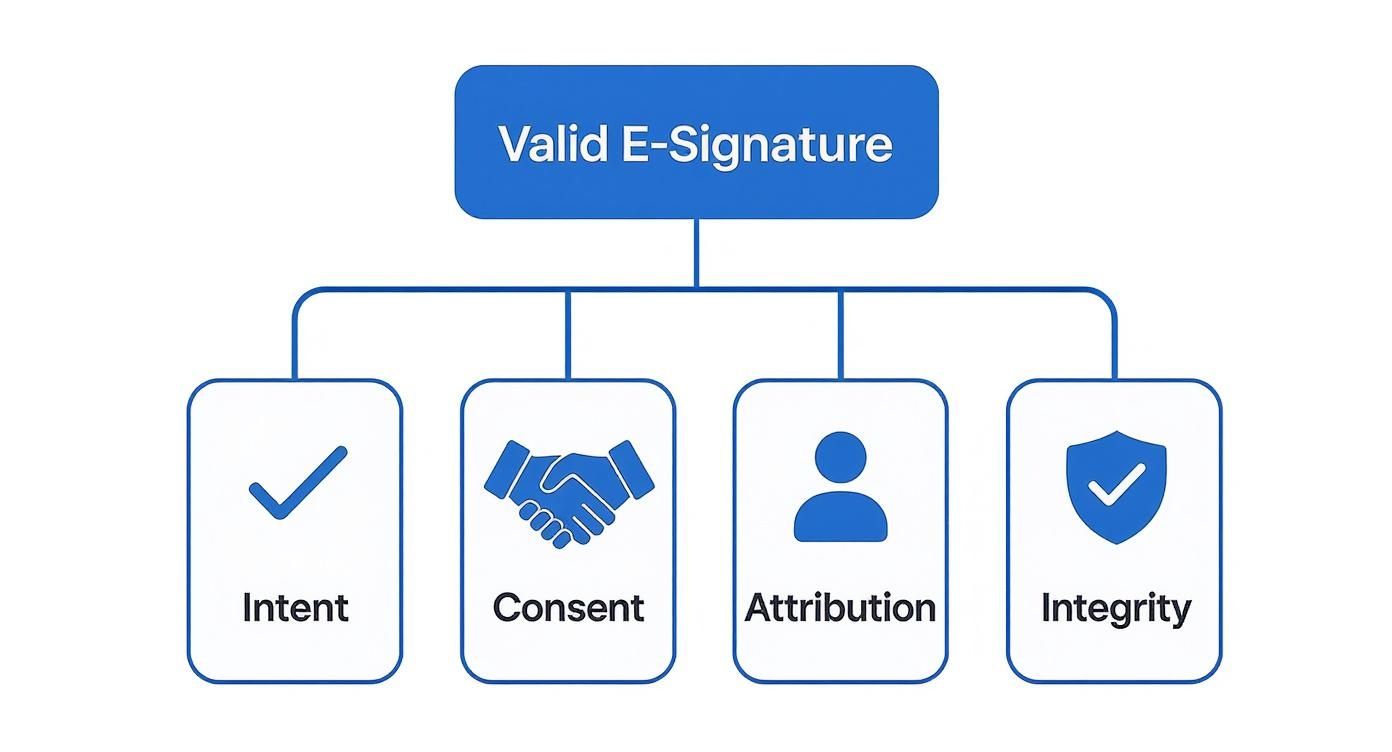
This visual shows how Intent, Consent, Attribution, and Integrity are the building blocks of a legally solid e-signature, no matter which specific law you're dealing with.
Juggling these different legal frameworks might seem daunting, but a compliant platform like BoloSign acts as a universal passport for your documents. It handles the heavy lifting for you. For instance, a logistics company in the UAE can securely sign agreements with a supplier in Australia, confident that the process meets international standards.
Security and compliance are what give electronic signatures their legal teeth. A recent survey shows just how much this matters: in 2025, 83% of current electronic signature users point to security as its most important benefit. This reflects a growing understanding of the risks that come with old-school paper processes.
Just as e-signatures demand strict legal adherence, so do other digital processes. For example, understanding the nuances of HIPAA requirements for IT equipment disposal is non-negotiable for healthcare organizations trying to protect sensitive patient data.
Common E-Signature Pitfalls and How to Avoid Them
Navigating the world of electronic signatures is mostly straightforward, but a few common potholes can trip up even the most careful businesses. While most agreements are perfect for a digital workflow, knowing the key exceptions and procedural missteps is crucial for keeping everything legally sound. Think of this as your roadmap for steering clear of legal challenges.
These pitfalls aren't just about obscure legal technicalities. They often boil down to simple oversights in your process that can have surprisingly big consequences. From failing to get clear consent to using a system with a weak audit trail, these mistakes can unravel an otherwise solid agreement.
The good news? They're all easily avoidable with the right approach and a solid platform.

Pitfall 1: Ignoring Document Exclusions
The first major stumble is assuming every single document can be signed electronically. While laws like ESIGN and UETA give the green light to the vast majority of business transactions, they specifically fence off certain documents that carry immense personal and legal weight.
These documents are the heavy hitters, often requiring a traditional wet-ink signature because of their gravity and the need for absolute certainty—sometimes with a notary or witnesses present.
Commonly Excluded Documents:
Wills and Testamentary Trusts: Anything dictating the distribution of assets after death almost always needs a physical signature.
Family Law Documents: Think divorce decrees, adoption papers, and other sensitive materials handled directly through the court system.
Court Orders and Official Notices: Formal legal notices, like eviction warnings or foreclosure proceedings, typically fall into this category.
Certain Real Estate Transactions: While many real estate forms are fine to sign digitally, some jurisdictions still require a wet signature for deeds and mortgages.
How to Avoid It: Always double-check local and national rules for these kinds of high-stakes documents. For everything else, a compliant digital signing solution like BoloSign is the perfect fit. An education provider, for example, can process thousands of student enrollment forms electronically, but they should absolutely verify the requirements for any legally sensitive disciplinary actions.
Pitfall 2: Having a Weak or Inaccessible Audit Trail
One of the biggest mistakes a business can make is using an e-signature process that doesn’t generate a rock-solid, unchangeable audit trail. If a signature’s validity is ever questioned in court, this trail is your star witness. Without it, proving who signed, when they signed, and that the document is pristine becomes a nearly impossible task.
An electronic signature is only as strong as the evidence backing it up. The audit trail is the digital equivalent of having a notary public witness and record every single step of the signing ceremony.
BoloSign automatically creates a comprehensive, tamper-evident certificate for every completed document. This log captures every critical detail—IP addresses, device information, and precise timestamps for every action from viewing to signing. It’s an ironclad record that meets all electronic signature legal requirements.
Pitfall 3: Failing to Obtain Clear Consent
You can't just fire off a digital document and assume the recipient is on board with signing it electronically. All major e-signature laws are crystal clear on this: signers must give their explicit consent to do business using electronic records. Skipping this step can invalidate the entire agreement.
How to Avoid It: Your signing workflow must include a clear, affirmative consent clause before the user even sees the signature field. BoloSign builds this right into the process, asking signers to agree to use electronic records with a simple checkbox. This creates an undeniable record of consent, ensuring every professional services contract or healthcare intake form starts on solid legal ground.
This principle of clear user action is fundamental, whether you need to sign PDFs online or gather permissions in other ways. For instance, many of our users want to know how to add a digital signature to Google Forms, a process that also hinges on obvious user intent. By using a secure and compliant platform, you guarantee every signature is built on a foundation of proven consent and integrity.
Your Practical Checklist for E-Signature Compliance
All the legal theory behind electronic signatures is great, but putting it into practice with confidence is what really matters. Let's turn that knowledge into action. This straightforward checklist will help you verify that your e-signature process is ironclad and fully compliant with key electronic signature legal requirements.
Think of this as your pre-flight check before sending out any important document. Each point is a critical checkpoint to ensure your agreements are secure, enforceable, and built on a solid legal foundation.

Here’s a practical rundown of what you need to confirm to keep your e-signature process legally sound and defensible. We've organized this into a table you can easily reference.
E-Signature Compliance Checklist for Your Business
This checklist breaks down the essential compliance checks, explains why each one is crucial for legal validity, and shows you how a platform like BoloSign handles it for you.
| Compliance Check | Why It Matters | How BoloSign Delivers |
|---|---|---|
| Provider's Legal Adherence | Your platform must be built on a compliant framework. Non-adherence to laws like ESIGN, UETA, or eIDAS means signatures collected might not be legally binding. | BoloSign is designed from the ground up to comply with major international standards, including ESIGN, UETA, eIDAS, HIPAA, and GDPR, giving you a secure foundation. |
| Strong Identity Authentication | You have to prove the person signing is who they claim to be. Weak authentication is a massive legal vulnerability and makes it easy to challenge a signature's validity. | Every signature request is sent via a secure, unique link to a verified email address, creating a clear, defensible link between the signature and the signer. |
| Explicit Consent to Sign | Legally, you can't just assume someone agrees to sign electronically. Laws like the ESIGN Act require clear, affirmative consent to conduct business digitally. | Our workflow automatically includes a consent clause. Signers must agree to use electronic records before they can even view the document, ensuring compliance every time. |
| Detailed & Secure Audit Trail | If an agreement is ever challenged in court, the audit trail is your most critical piece of evidence. It's the digital story of the entire signing event. | We automatically generate a comprehensive, tamper-evident audit certificate for every document, capturing every action from viewing to signing, including timestamps and IP addresses. |
| Document Integrity | The final, signed document must be protected from any changes or tampering. Any alteration after signing can invalidate the entire agreement. | Signed documents are sealed and protected, ensuring their integrity. Any attempt to modify the document after the final signature is immediately detectable. |
By running through this checklist for every agreement, you can confidently manage your digital documents. The right platform automates these critical tasks, taking the burden of compliance off your shoulders.
A Deeper Look at the Core Checks
Let's unpack a few of these points a bit more.
Confirm Your Provider’s Legal Compliance
The first and most important step is choosing a platform built on a compliant framework. Your digital signing solution isn't just a tool; it's your partner in maintaining legal integrity. You need to ensure it meets the major global and industry-specific standards.
Key Legal Frameworks: Does the provider adhere to ESIGN, UETA, and eIDAS? These are the non-negotiable standards for general legal acceptance in the US and EU.
Industry-Specific Needs: If you're in a regulated sector, does it meet standards like HIPAA for healthcare or GDPR for data privacy? This is crucial for handling sensitive information securely.
BoloSign is designed for compliance from the ground up, adhering to ESIGN, eIDAS, HIPAA, and GDPR to ensure your documents meet the highest legal and security benchmarks, no matter your industry.
Ensure a Detailed and Secure Audit Trail
If an agreement is ever challenged, the audit trail is your most critical piece of evidence. It's the indisputable digital record of the entire signing event. A weak or incomplete trail leaves you exposed.
A great audit trail tells the complete story of a document. It should capture every touchpoint—who opened it, when they viewed it, their IP address, and the exact moment they signed—all in a way that is tamper-evident and secure.
BoloSign automatically generates a comprehensive audit certificate for every signed document. This detailed log provides a step-by-step account of the signing process, giving you an ironclad record to uphold the validity of every agreement.
Obtain Explicit Consent to Sign Electronically
You can’t assume someone is okay with signing documents digitally. Legal frameworks like the ESIGN Act require you to obtain the signer’s clear, affirmative consent to conduct business electronically.
This step should be an integrated part of your workflow. For example, a real estate firm sending a lease agreement should present a clear consent clause before the client can even access the document. Our platform's contract automation features can streamline this entire process for you.
By using this checklist, you can confidently sign PDFs online and manage your agreements without worry. BoloSign simplifies this by handling these critical compliance tasks automatically, all while being 90% more affordable than traditional tools.
Ready to see how simple compliance can be? Start your 7-day free trial today and experience a secure, affordable, and fully compliant e-signature workflow firsthand.
Put Your Compliance Knowledge into Practice with BoloSign
Knowing the legal landscape is one thing, but putting it into practice with confidence is what really counts. The good news? Rolling out a fully compliant workflow doesn't have to be a complex or costly headache. With BoloSign, you can bridge the gap between legal theory and a practical, secure solution designed for how you actually work.
Think about a real estate agent trying to close a deal in a hot market. They need a purchase agreement signed, and they need it now. Using BoloSign, they can pull up a template, send a secure link, and let the client sign PDFs online in just a few minutes. Every single action is logged in a comprehensive audit trail, ensuring the entire process is locked down and meets all electronic signature legal requirements.
From Document Creation to Full Compliance, Seamlessly
We built BoloSign to make compliance a natural, invisible part of your day-to-day. You can create, send, and sign PDFs, templates, and forms quickly, knowing the four pillars of a valid e-signature—intent, consent, attribution, and integrity—are baked right into the platform. You don't have to double-check if you're covered; it's just handled.
This kind of built-in assurance is a game-changer for industries where speed and accuracy are everything:
Healthcare: Process patient intake forms securely with workflows designed for HIPAA compliance.
Logistics: Get delivery confirmations and vendor contracts signed instantly, right on the spot.
Professional Services: Finalize client agreements with a clear, tamper-proof record of exactly who agreed to what, and when.
Our platform is packed with features to support these needs, like AI-powered contract automation and secure cloud storage, all wrapped in a simple, intuitive interface.
The Smartest, Most Affordable Path to Peace of Mind
Legal compliance shouldn't drain your budget. We believe every business, regardless of size, deserves access to enterprise-level security and the peace of mind that comes with it. That’s why we decided to do things differently.
We are up to 90% more affordable than other tools because we don't nickel-and-dime you. You get unlimited documents, unlimited team members, and unlimited templates—all for one simple, fixed price. No surprise per-envelope fees. No user limits. Just predictable, powerful performance.
This straightforward approach makes BoloSign one of the most intelligent and secure digital signing solutions you can find. You get full compliance with ESIGN, eIDAS, HIPAA, and GDPR without having to make tough budget choices. It's time to stop worrying about the legal fine print and get back to growing your business.
Discover how straightforward and cost-effective a fully compliant workflow can be. Begin your 7-day free trial today and see the BoloSign advantage firsthand.
Have Questions? We Have Answers
Navigating the world of electronic signature legal requirements can feel a bit tricky. Let's clear up some of the most common questions people have.
Are Electronic Signatures Really as Legal as Pen and Paper?
Yes, they absolutely are. Foundational laws like the ESIGN Act in the U.S. and the eIDAS regulation in the EU were specifically passed to give electronic signatures the exact same legal weight as their handwritten counterparts.
The key is that the signing process has to meet a few standards—things like proving the signer's intent, getting their consent to sign electronically, and ensuring the final document can't be tampered with. A good e-signature platform like BoloSign handles all this behind the scenes, so you don't even have to think about it.
Are There Any Documents I Can't Sign Electronically?
While you can sign the vast majority of business and personal documents online, there are a few exceptions. These are typically high-stakes documents that, by law, still require a physical "wet ink" signature. The specifics can change depending on where you are, but they usually include things like:
Wills, codicils, and certain trusts
Official court orders and legal notices
Family law documents, like adoption or divorce papers
Some real estate transfers, such as property deeds
Always double-check your local laws for these specific categories. But for everyday business—from sales contracts for professional services firms to new hire paperwork for staffing agencies—a secure digital signing solution is perfectly legal and binding.
How Would I Prove an E-Signature Is Valid in Court?
This is where the digital evidence comes in. If a signature is ever challenged, its validity boils down to one critical piece of evidence: the audit trail.
Think of the audit trail as a digital notary. It’s an unchangeable log that records every single action taken on a document, providing the concrete proof needed to show who signed, when they signed, and that the document is authentic.
Platforms like BoloSign automatically generate a detailed, tamper-proof audit trail for every single document. It meticulously captures every step of the journey—from the moment the email was opened, to the signer's IP address, and the precise timestamp of the signature. This comprehensive log is the court-admissible evidence that stands up to scrutiny.
Ready to put all this compliance knowledge into practice? BoloSign is built to make creating, sending, and managing legally binding documents simple. You get built-in compliance and AI-powered automation, plus unlimited documents, users, and templates at one fixed price—giving you enterprise-grade security that’s 90% more affordable than other tools.
Experience simple, secure, and affordable eSignatures by starting your 7-day free trial.

Paresh Deshmukh
Co-Founder, BoloForms
1 Dec, 2025
Take a Look at Our Featured Articles
These articles will guide you on how to simplify office work, boost your efficiency, and concentrate on expanding your business.